
Understanding the evolution and challenges of gravity theories, from Newton’s laws to Einstein’s relativity and beyond into modified gravity theories.
Introduction to Modified Gravity Theories
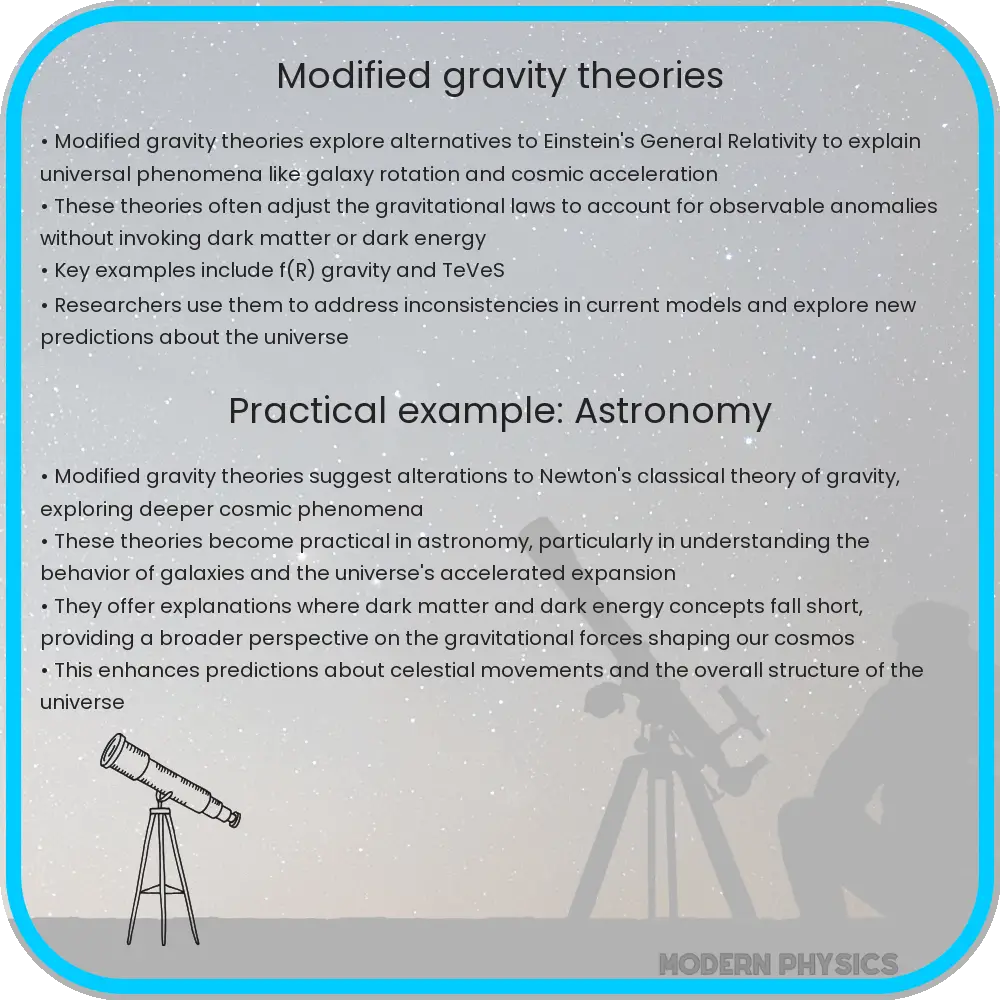
Gravity, as described by Isaac Newton and later refined by Albert Einstein’s General Theory of Relativity, is a fundamental force that explains the attraction between bodies due to their mass. However, as comprehensive as these theories are, there are astronomical phenomena that they cannot fully explain, such as the accelerated expansion of the universe and the rotation curves of galaxies. This has led scientists to explore modifications and extensions to the theory of gravity, known as modified gravity theories.
Evolution of Gravity Theories
The journey into understanding gravity began with Newton’s Law of Universal Gravitation, which provided a formula that could predict the forces of attraction between bodies:
\( F = G \frac{m_1 * m_2}{r^2} \)
where \( F \) is the gravitational force, \( G \) is the gravitational constant, \( m_1 \) and \( m_2 \) are the masses, and \( r \) is the distance between their centers. This law successfully explained many observations within our solar system.
However, the 20th century brought new challenges that Newton’s framework could not address. Einstein’s theory of General Relativity replaced the concept of gravitational force with the curvature of spacetime caused by mass and energy, encapsulated in the famous field equations:
\( G_{\mu\nu} + \Lambda g_{\mu\nu} = \frac{8 \pi G}{c^4} T_{\mu\nu} \)
Here, \( G_{\mu\nu} \) represents the curvature of spacetime, \( \Lambda \) is the cosmological constant, \( g_{\mu\nu} \) is the metric tensor, \( T_{\mu\nu} \) is the stress-energy tensor, \( G \) is the gravitational constant, and \( c \) is the speed of light. This new theory excellently described large-scale phenomena and added black holes and cosmological models to our understanding of the universe.
Challenges Leading to Modified Gravity Theories
Despite the successes of General Relativity, astronomers and physicists have identified several phenomena that challenge its predictions. These include the unexpected behavior of the outer regions of galaxies, the mass discrepancy in galaxy clusters, and the cosmic acceleration observed in distant supernovae. These observations suggest that either there is unseen ‘dark matter’ and ‘dark energy,’ or that a new theory of gravity is needed.
Modified gravity theories thus arise either by altering General Relativity’s geometric side (curvature) or its matter side (energy-momentum). Examples include \( f(R) \) theories, where modifications to the curvature part of Einstein’s equations are proposed, and theories like Scalar-Tensor-Vector Gravity (STVG), which introduce additional fields into the gravitational theory.
Testing Modified Gravity Theories
The path to universal acceptance of any new theory in physics involves rigorous testing and validation against observations. For modified gravity theories, this includes consistency with Solar System dynamics, which are well-explained by General Relativity, and providing compelling explanations for cosmic phenomena that remain unexplained.
One key area of testing is the detailed observation of galactic rotations and clustering of galaxies, where deviations from Newtonian dynamics are evident. Another area is the observation of gravitational lensing effects, where the bending of light by gravity can be more accurately measured with modern telescopes and observational techniques.
Further tests involve looking at the Cosmic Microwave Background radiation for imprints of gravitational phenomena in the early universe, as well as studying gravitational waves, which offer a new modality to probe the high-energy and large-scale structure of spacetime.
By comparing these observations with predictions made by modified gravity theories, scientists can determine the viability and accuracy of these new models. This iterative process involves refining existing theories and, potentially, formulating new ones to better match our observations of the universe.
Future Prospects in Modified Gravity Research
As research into modified gravity theories continues to develop, the future holds promising avenues that could significantly alter our understanding of the universe. One of the most exciting prospects is the potential unification of gravity with the other fundamental forces of nature, which has remained elusive in classical physics frameworks. Scientists are also exploring the implications of modified gravity in the context of the early universe, particularly during the inflationary period, which could provide insights into physics beyond the Standard Model.
Further advancements in technology, such as more sensitive detectors and faster computational tools, will enhance our ability to test these theories under extreme conditions. These developments may eventually lead to a standard model of cosmology that either incorporates elements of modified gravity or completely replaces the need for dark matter and dark energy hypotheses.
Impact on Astrophysics and Cosmology
The exploration of modified gravity not only deepens our theoretical knowledge but also has practical implications for astrophysics and cosmology. For instance, understanding gravity at a more fundamental level could improve our models of stellar and galactic behavior, leading to more accurate predictions about the lifecycle of stars and the dynamics of galactic structures. Moreover, it could alter our predictions about the ultimate fate of the universe, influencing theories about the Big Crunch, Big Freeze, or a Big Rip scenario.
It also stimulates interdisciplinary collaborations, bridging gaps between particle physics, astrophysics, and cosmology, creating a richer, more integrated view of how the universe operates at both the microscopic and macroscopic scales.
Conclusion
In conclusion, the pursuit of understanding gravity beyond Newton and Einstein’s descriptions illuminates the vibrant and evolving nature of scientific inquiry. Modified gravity theories are not merely academic exercises but are fundamental to addressing some of the most pressing mysteries in physics today. As we continue to observe the universe with increasingly sophisticated technologies, we may find that these theories not only deepen our understanding of the cosmos but also redefine it.
Whether modified gravity can fully explain the oddities of cosmic observations or if it will be a stepping stone to even deeper insights remains to be seen. What is clear, however, is that the journey through these theories is as important as the destination, driving technology forward, fostering global collaboration, and inspiring the next generation of scientists. Through persistent inquiry and rigorous testing, we are slowly unraveling the fabric of the universe—one gravitational puzzle at a time.