
Explore how Mie Resonance in nanostructures revolutionizes light manipulation, enhancing efficiency in solar cells, LEDs, and optical devices.
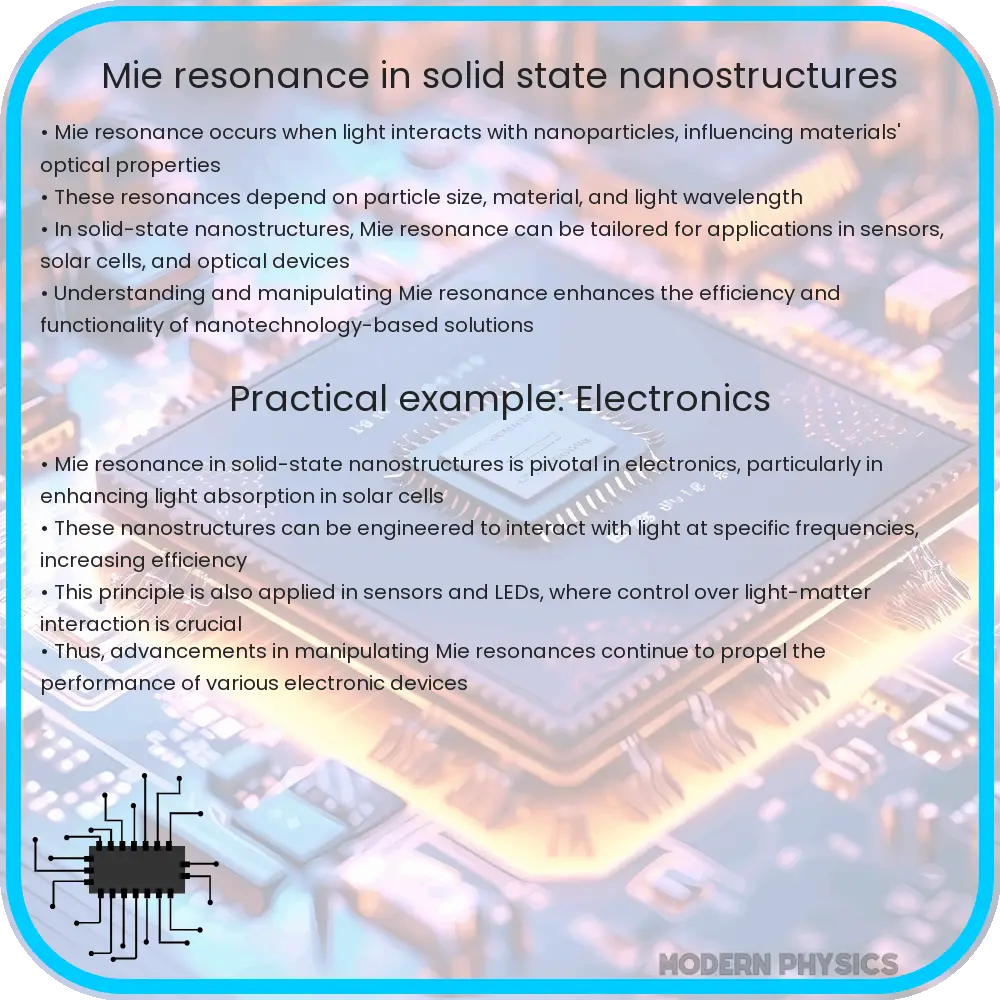
Mie Resonance in Nanostructures: A Path to Advanced Light Manipulation
The concept of Mie resonance in nanostructures has emerged as a revolutionary approach in the field of photonics, offering unparalleled control and manipulation of light at the nanoscale. This phenomenon, rooted in the Mie theory originally developed by Gustav Mie in 1908, explains the scattering of electromagnetic waves by spherical particles. Today, the applications of this theory extend far beyond its initial scope, enabling significant advancements in enhancing the efficiency and functionality of various optical devices.
Understanding Mie Resonance
Mie resonance occurs when the wavelength of light interacting with a particle is comparable to the particle’s size, leading to enhanced scattering and absorption properties. In nanostructures, these resonances can be finely tuned by adjusting the size, shape, and material composition of the nanoparticles, thus allowing for the manipulation of light in ways that were previously unattainable. The ability to control light at such a fine scale has opened up new avenues in sensor technology, solar energy harvesting, and even in medical diagnostics.
Applications in Enhancing Light Efficiency
One of the most promising applications of Mie resonance is in the field of solar energy. By incorporating nanostructured materials that exhibit Mie resonances into solar cells, it is possible to significantly increase their efficiency. These materials can trap light more effectively, reducing reflection and increasing the amount of light absorbed by the solar cell. Similarly, in LED technology, nanostructures designed to exploit Mie resonances can direct light more efficiently, enhancing the brightness and color purity of these devices.
Advancements in Light Manipulation
Beyond enhancing efficiency, Mie resonance in nanostructures enables precise control over the direction and properties of light. This capability is crucial in the development of optical circuits and on-chip photonic devices, where light is used to carry information. By manipulating light at the nanoscale, devices can be made smaller, faster, and more energy-efficient, heralding a new era in the miniaturization of optical components.
The implications of Mie resonance for future technologies are vast, with ongoing research focused on unlocking even more applications. From creating more sensitive biosensors to improving the performance of photonic devices, the potential of Mie resonance in nanostructures continues to captivate scientists and engineers alike.
Enhancing Sensing Capabilities Through Mie Resonance
The precise control over light offered by Mie resonance has significant implications for the field of optical sensing. Nanostructures designed to harness this phenomenon can detect minute changes in the environment, making them ideal for applications ranging from environmental monitoring to healthcare diagnostics. By tailoring the resonance characteristics of these nanostructures, sensors can be developed to have unparalleled sensitivity and specificity, capable of detecting low concentrations of biomolecules or pollutants.
Challenges and Future Directions
Despite the promising advancements brought about by Mie resonance in nanostructures, there remain challenges to be addressed. Fabricating nanostructures that meet specific resonance criteria requires sophisticated techniques and precise control over material properties. Additionally, integrating these nanostructures into functional devices at scale poses another set of challenges, including maintaining consistency and stability over time. However, the ongoing research and development in nanofabrication and material science are paving the way for overcoming these obstacles, promising a future where the full potential of Mie resonance can be realized.
Conclusion
The exploration of Mie resonance in nanostructures represents a fascinating frontier in the manipulation and control of light at the nanoscale. This phenomenon not only enhances the efficiency and performance of photonic devices but also opens up new possibilities in sensing and energy harvesting. The ability to tailor the interaction between light and matter at such a precise level could revolutionize a wide range of technologies, from solar cells and LEDs to optical sensors and beyond. As researchers continue to unravel the complexities of Mie resonance and develop new methods for exploiting its potential, we stand on the brink of a new era in photonic technology, marked by devices that are more efficient, compact, and capable of performing tasks that were once thought impossible. The journey into the realm of nano-optics, guided by the principles of Mie resonance, promises to reshape our technological landscape, illuminating the path towards a brighter, more efficient future.