
Explore the Microwave Photonics Processor: a breakthrough in speed, integration, and efficiency for telecommunications, defense, and medical imaging.
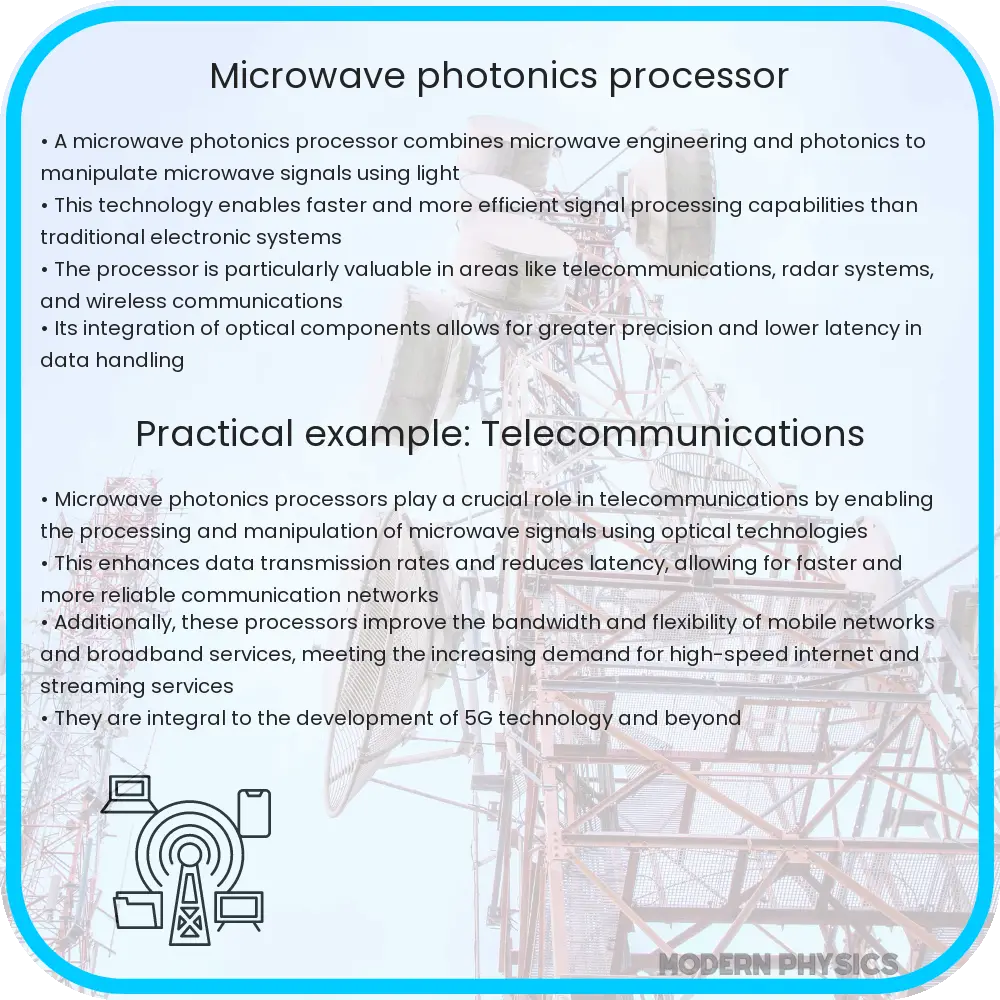
Understanding Microwave Photonics Processor: Revolutionizing Speed, Integration, and Efficiency
The realm of microwave photonics, a field that combines radio frequency engineering and photonics, has witnessed a groundbreaking advancement with the development of the Microwave Photonics Processor (MPP). This innovative technology heralds a new era in telecommunications and signal processing, leveraging the speed of light for faster, more efficient, and highly integrated processing systems.
Speed: Breaking the Barriers of Traditional Processing
At the core of MPP’s advancements is its unparalleled processing speed. Unlike conventional electronic processors that are limited by the electron mobility in materials, MPP operates using photons, which travel at the speed of light. This results in a significant leap in processing speeds, making it ideal for applications requiring real-time data processing, such as radar systems, wireless communications, and satellite operations.
Integration: A Compact and Versatile Solution
Another notable aspect of MPP is its high level of integration. By merging multiple functions into a single photonic chip, MPP reduces the size and complexity of traditional microwave systems. This integration not only minimizes space requirements but also enhances the reliability and performance of the system. The compactness of MPP makes it a perfect fit for space-constrained applications like airborne platforms and portable devices.
Efficiency: Optimizing Power and Performance
The efficiency of MPP is not just confined to its size and speed. It also exhibits exceptional energy efficiency. Photonic signals, unlike electronic signals, are less prone to resistive losses, which results in lower power consumption. This energy-efficient nature makes MPP a sustainable and cost-effective solution, particularly important in an era where energy conservation is paramount.
Additionally, MPP offers improved signal quality. Photonic systems are inherently immune to electromagnetic interference, a significant challenge in electronic systems. This immunity ensures a cleaner and more reliable signal, which is crucial in high-precision applications.
One of the key technologies enabling MPP is the integration of optical modulators, which convert electrical signals into optical signals. These modulators use materials like Lithium Niobate (LiNbO3) and Indium Phosphide (InP), known for their excellent electro-optic properties.
In conclusion, the Microwave Photonics Processor is a paradigm shift in the world of signal processing. Its exceptional speed, high level of integration, and energy efficiency make it a game-changer in various applications, promising a future where processing limitations are a thing of the past.
Expanding Horizons: Advanced Applications and Future Potential of Microwave Photonics Processor
The Microwave Photonics Processor (MPP) is not just a theoretical marvel; its practical applications are diverse and far-reaching. In sectors like defense, telecommunications, and medical imaging, MPP is set to redefine existing standards.
Revolutionizing Telecommunications
In telecommunications, MPP’s ability to process signals at the speed of light is a game-changer. It enables ultra-fast data transmission, a critical requirement for emerging technologies like 5G and beyond. MPP’s efficiency and speed facilitate higher bandwidths and faster data rates, ensuring seamless connectivity in an increasingly digital world.
Transforming Radar and Satellite Systems
The defense sector stands to benefit significantly from MPP’s speed and efficiency. Advanced radar systems, reliant on real-time signal processing, can leverage MPP for quicker and more accurate data analysis. Similarly, in satellite communications, MPP’s compactness and efficiency ensure better performance in the harsh and space-limited conditions of space.
Advancements in Medical Imaging
Medical imaging is another area where MPP’s precision and speed can be pivotal. High-resolution imaging systems, such as MRI and ultrasound, can utilize MPP for faster image processing, leading to quicker diagnoses and more effective treatments.
The Future: Pushing the Boundaries of Technology
Looking ahead, the potential of MPP in various fields is immense. Its application in quantum computing, for instance, could revolutionize data processing and encryption. Additionally, ongoing research in nanophotonics and material science promises even more compact and efficient MPPs, opening new avenues in wearable technology and IoT devices.
Conclusion: A New Era of Signal Processing
The Microwave Photonics Processor marks a significant leap in signal processing technology. Its unmatched speed, high integration, and energy efficiency address the growing demands of modern applications. From improving global communication networks to enhancing radar and imaging systems, MPP is set to transform a multitude of industries. As research and development continue, we can anticipate even more innovative applications, making MPP a cornerstone technology for the future. In an era where speed and efficiency are paramount, the Microwave Photonics Processor stands as a beacon of technological advancement, heralding new possibilities in the realm of signal processing and beyond.