
Explore the innovative world of microgels and responsive hydrogels: smart, biocompatible materials revolutionizing drug delivery and environmental science.
Introduction to Microgels and Responsive Hydrogels
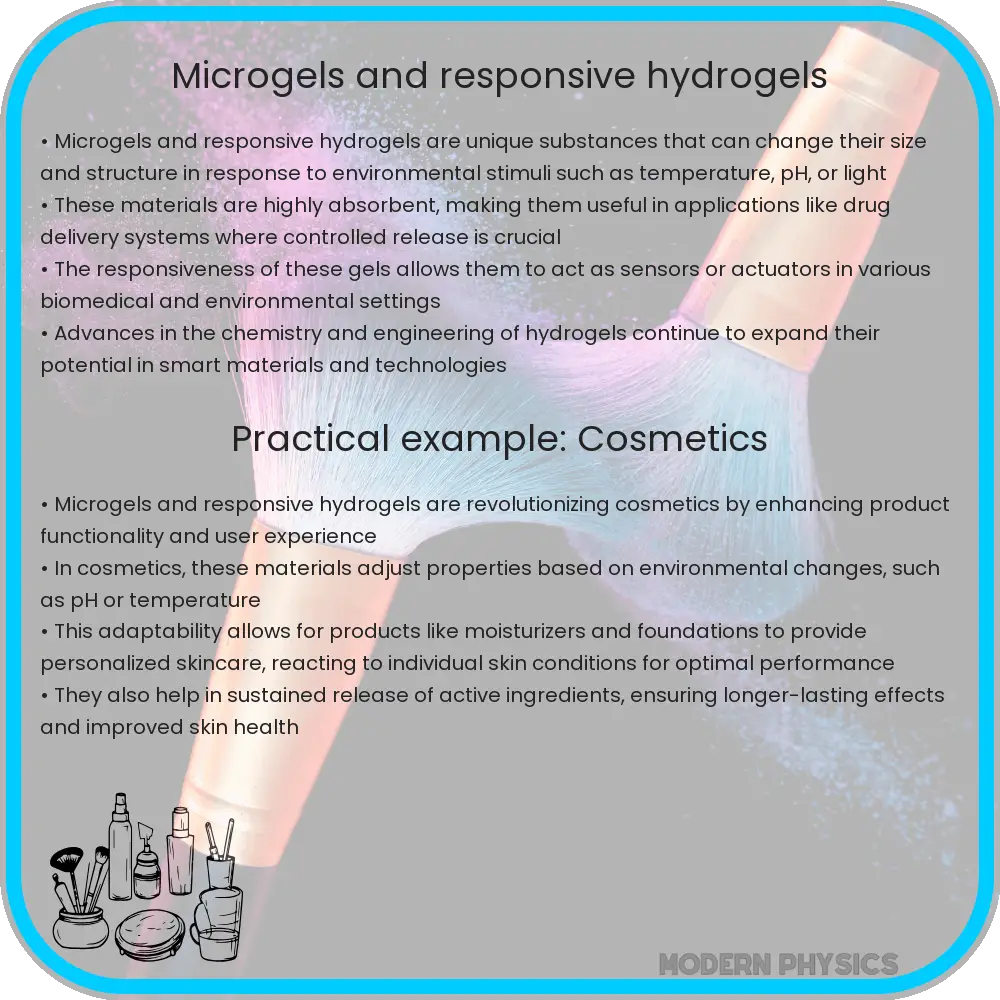
Microgels and responsive hydrogels represent a fascinating class of materials that hold significant promise in the fields of biomedicine, environmental science, and smart materials engineering. These soft, water-swollen networks, often biocompatible and highly tunable, are gaining attention for their unique ability to respond to environmental stimuli such as temperature, pH, or chemical factors. This responsiveness, combined with their inherent biocompatibility, makes them ideal candidates for a variety of applications ranging from drug delivery systems to water purification technologies.
Understanding Microgels
Microgels are tiny, crosslinked polymer networks that can absorb large amounts of water or biological fluids, swelling to many times their original size. Their structure and composition can be finely tuned to change their properties, such as porosity, mechanical strength, and responsiveness to external stimuli. This tunability allows for the design of microgels that can release therapeutic agents in response to specific physiological conditions, thereby enhancing the efficacy and safety of treatment protocols.
Responsive Hydrogels: Smart Materials for Advanced Applications
Responsive hydrogels, also known as “smart gels,” are hydrogel systems designed to undergo significant, reversible changes in their structure and properties in response to external stimuli. These stimuli-responsive materials can swell, shrink, dissolve, or change their mechanical strength, porosity, or conductivity in response to variations in environmental conditions such as temperature, pH levels, or the presence of specific ions or molecules. For example, a temperature-sensitive hydrogel may exhibit a dramatic volume change around human body temperature, making it particularly useful for biomedical applications like drug delivery or tissue engineering.
Biocompatibility and Tunability: Key Features for Medical Applications
The biocompatibility and tunability of microgels and responsive hydrogels make them especially appealing for medical and pharmaceutical applications. They can be designed to be non-toxic and compatible with body tissues, allowing them to be used for controlled drug release, wound healing dressings, and as scaffolds for tissue engineering. The ability to fine-tune the chemical and physical properties of these gels enables the creation of highly specialized materials tailored for specific therapeutic outcomes.
Applications in Drug Delivery and Tissue Engineering
One of the most promising applications of microgels and responsive hydrogels lies in the field of drug delivery. By encapsulating drugs within these materials, scientists can create systems that release therapeutic agents in a controlled manner, directly at the target site, and in response to specific biological signals. This approach minimizes side effects and improves the therapeutic efficiency of drugs, particularly in the treatment of chronic diseases such as cancer or diabetes. Furthermore, in tissue engineering, these materials provide a supportive scaffold that mimics the natural extracellular matrix, promoting cell attachment, proliferation, and differentiation, which are essential for tissue regeneration.
Environmental Applications: Purification and Sensing
Beyond biomedical uses, microgels and responsive hydrogels have significant applications in environmental protection and sustainability. They can be engineered to absorb pollutants, such as heavy metals or organic compounds, from water, acting as effective purification systems. Additionally, their sensitivity to environmental changes makes them excellent candidates for developing new sensors and indicators for environmental monitoring, offering a smart solution for the detection of contaminants and the preservation of natural resources.
Challenges and Future Directions
Despite their vast potential, the application of microgels and responsive hydrogels is not without challenges. Issues such as large-scale production, reproducibility, and long-term stability need to be addressed to fully realize their commercial potential. Moreover, further research is required to understand the long-term biocompatibility and degradation products of these materials, particularly for in-body applications. As the field advances, the development of more robust, efficient, and sustainable production methods will be crucial for the widespread adoption of these smart materials.
Conclusion
Microgels and responsive hydrogels are at the forefront of material science, offering innovative solutions across medicine, environmental science, and beyond. Their unique properties of biocompatibility, tunability, and responsiveness to environmental stimuli make them highly versatile and effective in various applications. While challenges remain in their development and implementation, ongoing research and technological advancements promise to overcome these hurdles, paving the way for broader application and significant impact on society. As we continue to explore and refine these materials, their full potential is only beginning to be realized, heralding a new era of smart, responsive materials that can adapt to meet the complex needs of the modern world.