
Explore the metal-insulator transition (MIT), a key phenomenon in solid-state physics where materials toggle between metallic and insulating states under varying conditions.
Understanding Metal-Insulator Transition
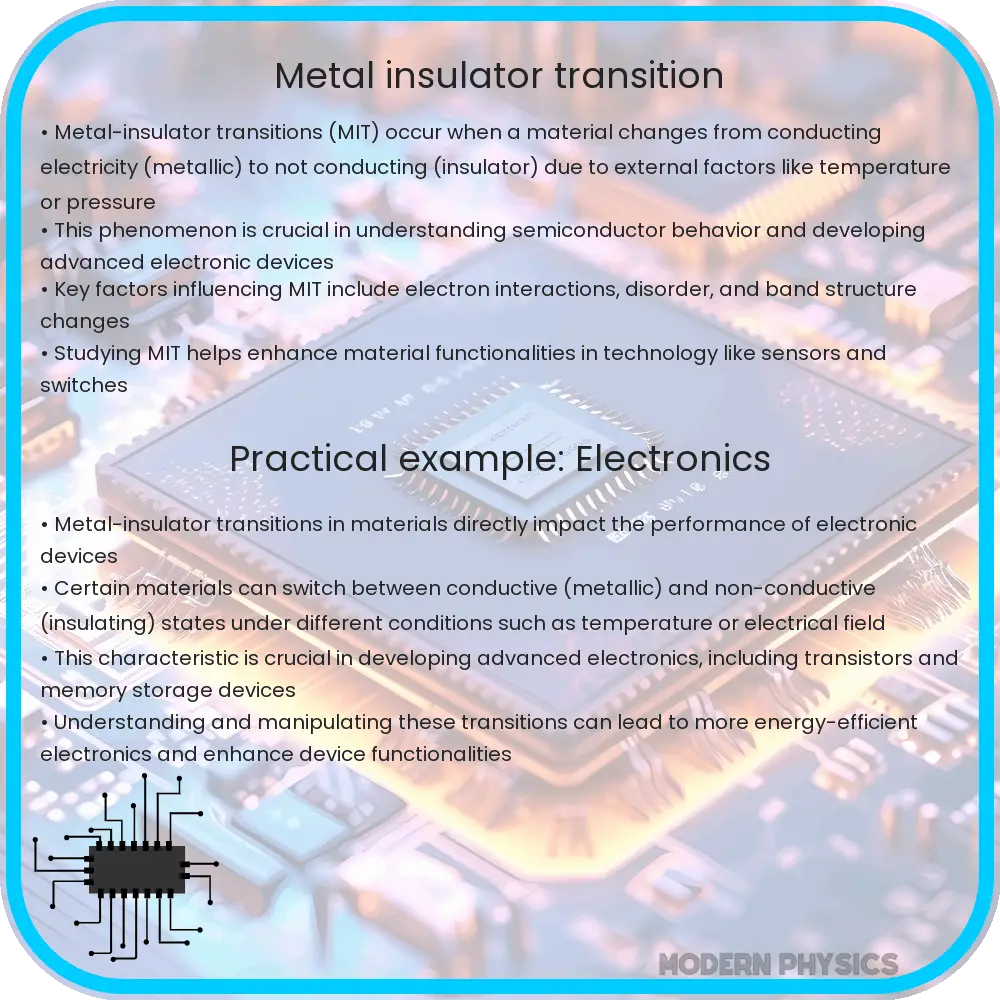
The metal-insulator transition (MIT) is a fascinating phenomenon in solid-state physics where a material changes from being metallic to an insulator (or vice versa) under varying conditions such as temperature, pressure, magnetic field, or electrical doping. This transition directly impacts the electronic properties of materials, making it a critical area of study for applications in electronics, energy storage, and quantum computing.
Mechanisms Behind Metal-Insulator Transitions
Several mechanisms can induce a metal-insulator transition, each linked to changes in the material’s electronic structure and interactions among its electrons. The most common mechanisms include:
- Mott Transition: Propounded by Neville Mott, this transition occurs due to strong electronic correlation effects. In a Mott transition, the repulsive interaction between electrons (Coulomb repulsion) is so strong that it prevents electrons from conducting, thus turning the metal into an insulator.
- Bandwidth-Controlled Transition: This involves changes in the bandwidth of the electrons. An increase in pressure, for instance, can decrease the interatomic distance in a material, thereby increasing the bandwidth. If the bandwidth becomes large compared to the electron-electron interaction energy, the material transitions from an insulator to a metal.
- Anderson Localization: Proposed by P.W. Anderson, this mechanism suggests that disorder in a material can localize the wave functions of electrons, restricting their mobility and leading to insulating behavior, even in a disordered metal.
- Peierls Transition: In a one-dimensional metallic system, a distortion of the lattice structure (Peierls distortion) can open a gap at the Fermi surface, leading to insulating behavior.
Theoretical Framework of Metal-Insulator Transitions
The theoretical analysis of MITs often involves complex calculations within the framework of quantum mechanics and solid-state physics. The Hubbard model is one of the primary models used to study Mott transitions. It describes electrons in a lattice considering both their kinetic energy and the interaction energy among them:
Hamiltonian (H) = -t ∑i,j (ci†cj + cj†ci) + U ∑i ni↑ni↓
Here, t represents the hopping term (kinetic energy) between sites, U is the on-site Coulomb repulsion, and ci† (ci) denotes the creation (annihilation) operator at site i, with niσ being the number density operator for electrons at site i with spin σ.
Additionally, the role of dimensionality and disorder in MITs is analyzed using various computational techniques, including the Density Functional Theory (DFT) and Monte Carlo simulations, to understand and predict material behavior under different conditions.
Applications of Metal-Insulator Transitions
The ability to control and utilize the metal-insulator transition opens up several technological applications:
- Smart Windows: Materials that can switch between reflective and transparent states based on external conditions (eg., temperature, light) are being explored for energy-efficient buildings.
- Memory and Switching Devices: MIT materials are ideal candidates for next-generation memory storage devices that require less energy and provide higher efficiency than traditional transistors.
- Sensors: MIT-based sensors that alter their electrical resistance with varying environmental conditions can be used for precise monitoring and control systems.
The exploration of metal-insulator transitions not only enriches our understanding of material science but also paves the way for innovations in various industrial applications. At the interface of experimental research and theoretical predictions, continuous advancements are being made, marking an exciting frontier in condensed matter physics and material engineering.
Experimental Approaches to Studying Metal-Insulator Transitions
To gain insight into the metal-insulator transitions, scientists employ various experimental techniques that allow them to observe changes in material structures and properties under different conditions. Among these methods are:
- X-ray Diffraction: This technique helps in determining changes in crystal structures which could lead to phase transitions.
- Electrical Resistivity Measurements: By measuring how the resistance of a material changes with temperature or pressure, scientists can identify at what point the MIT occurs.
- Optical Measurements: Using optical spectroscopy, researchers can explore the electronic structure and band gap variations as a function of external stimuli, providing clues about the transition mechanisms.
These experimental approaches are crucial in validating theories related to metal-insulator transitions and help in advancing the understanding of these complex phenomena.
Challenges and Future Directions
Despite significant progress, challenges remain in the comprehensive understanding and control of MITs. For instance, the precise control of conditions like doping at the nanoscale poses technical challenges. There is also a need to develop materials with reversible MIT properties under room temperature and ambient conditions for practical applications.
Future research will likely focus on discovering new materials and refining existing ones to enhance their performance in devices. Advances in nano-fabrication techniques and computational methods are expected to play key roles in these developments.
In conclusion, the study of metal-insulator transitions represents a vital field of research in condensed matter physics with extensive potential applications. From creating smart devices and energy-efficient systems to enhancing data storage technologies, the insights gained from understanding MITs can lead to significant technological innovations. The endless possibilities continue to drive interest and investment in this exciting area of study, promising new discoveries and improvements in material sciences and engineering.