
Explore the enigmatic world of mesonic atoms, their role in particle physics, connections to dark matter, and implications for understanding the cosmos.
Exploring Mesonic Atoms: Unveiling Particle Mysteries in the Cosmos
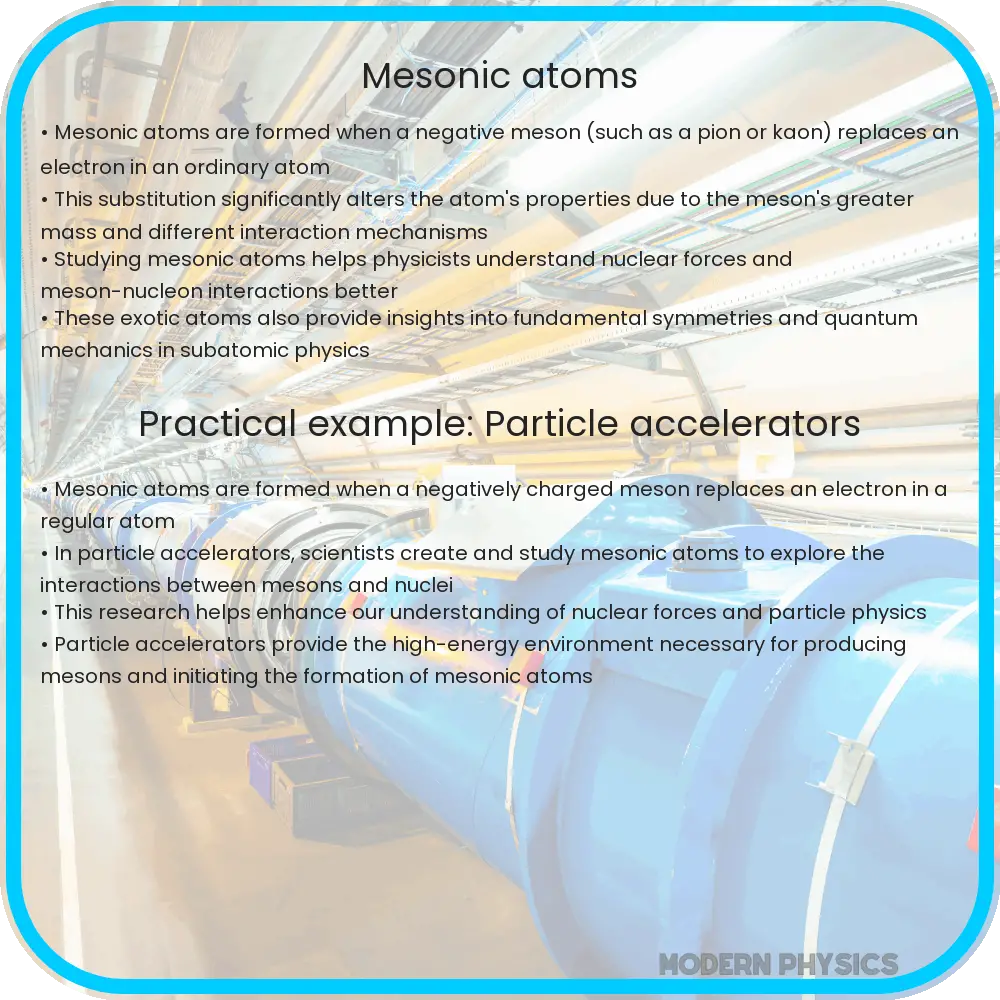
In the vast expanse of the cosmos, the study of mesonic atoms provides fascinating insights into the fundamental forces and particles that govern our universe. Mesonic atoms are exotic forms of matter where one electron is replaced by a meson, a type of subatomic particle that acts as a mediator between quarks, the building blocks of protons and neutrons.
Understanding Mesonic Atoms
Mesonic atoms are primarily formed by two types of mesons: pions (π) and kaons (K). These mesons bind with the nucleus of an atom in a similar way to electrons, but with a much greater mass. The interaction between mesons and the nucleus opens new avenues for studying the strong nuclear force, one of the four fundamental forces in physics, which holds the atomic nucleus together.
The Role of Mesonic Atoms in Particle Physics
The investigation of mesonic atoms aids scientists in understanding the behavior of hadronic matter under extreme conditions, akin to those existing in neutron stars and during the early stages of the universe. By examining the shifts in energy levels within mesonic atoms, researchers can infer properties about the nuclear force and the distribution of charge within the nucleus.
Connecting Mesonic Atoms with Dark Matter
One of the most intriguing aspects of mesonic atoms is their potential link to dark matter, a mysterious substance that constitutes about 27% of the universe. While dark matter does not interact with electromagnetic radiation, making it invisible to telescopes, its gravitational effects are evident. The study of mesonic atoms, particularly through their interaction with ordinary matter, could provide indirect evidence of dark matter particles and help unravel the mysteries surrounding their nature and properties.
Implications for the Cosmos
The research into mesonic atoms extends beyond particle physics, offering critical insights into astrophysical phenomena and the early universe’s conditions. By bridging the gap between quantum mechanics and cosmic scales, mesonic atoms contribute significantly to our understanding of the cosmos, challenging existing theories and prompting new questions about the fundamental structure of matter.
Advancements in Mesonic Atom Research
Recent advancements in particle accelerators and detection technologies have propelled the study of mesonic atoms forward. Modern experimental setups, such as the Large Hadron Collider (LHC) and other high-energy physics facilities, have enabled scientists to create and study mesonic atoms under controlled conditions, providing unprecedented insights into their properties and interactions. This research is critical for refining our understanding of the strong nuclear force and the internal dynamics of atomic nuclei.
Challenges and Future Directions
Despite significant progress, the study of mesonic atoms faces numerous challenges. The fleeting existence of these atoms, coupled with the complexities of measuring their properties, requires innovative approaches and technologies. Future research aims to address these challenges by developing more sensitive detectors and precise measurement techniques. Additionally, theoretical physicists continue to refine models of mesonic atoms, integrating quantum chromodynamics (QCD) and other theoretical frameworks to better predict their behavior.
Interdisciplinary Impact
The implications of mesonic atom research extend beyond particle physics, impacting fields such as cosmology, astrophysics, and even materials science. For example, understanding the interaction between mesons and nuclear matter contributes to our knowledge of the internal conditions of neutron stars. Moreover, the principles learned from mesonic atoms could influence the development of new materials with unique quantum properties.
Conclusion
Mesonic atoms represent a fascinating frontier in modern physics, offering a unique window into the interactions that govern the micro and macro cosmos. Their study not only enhances our understanding of fundamental forces and particles but also sheds light on the enigmatic nature of dark matter and the early universe. Despite the challenges involved, ongoing research and technological advancements promise to unravel more of the mysteries surrounding mesonic atoms. As we continue to explore these exotic particles, we move closer to answering some of the most profound questions about the nature of our universe and the fabric of reality itself.