
Explore the mysteries of meson mixing and CP violation in this insightful article, uncovering their role in understanding the universe’s fundamental forces.
Understanding Meson Mixing: A Gateway to Quantum Mysteries and the Universe
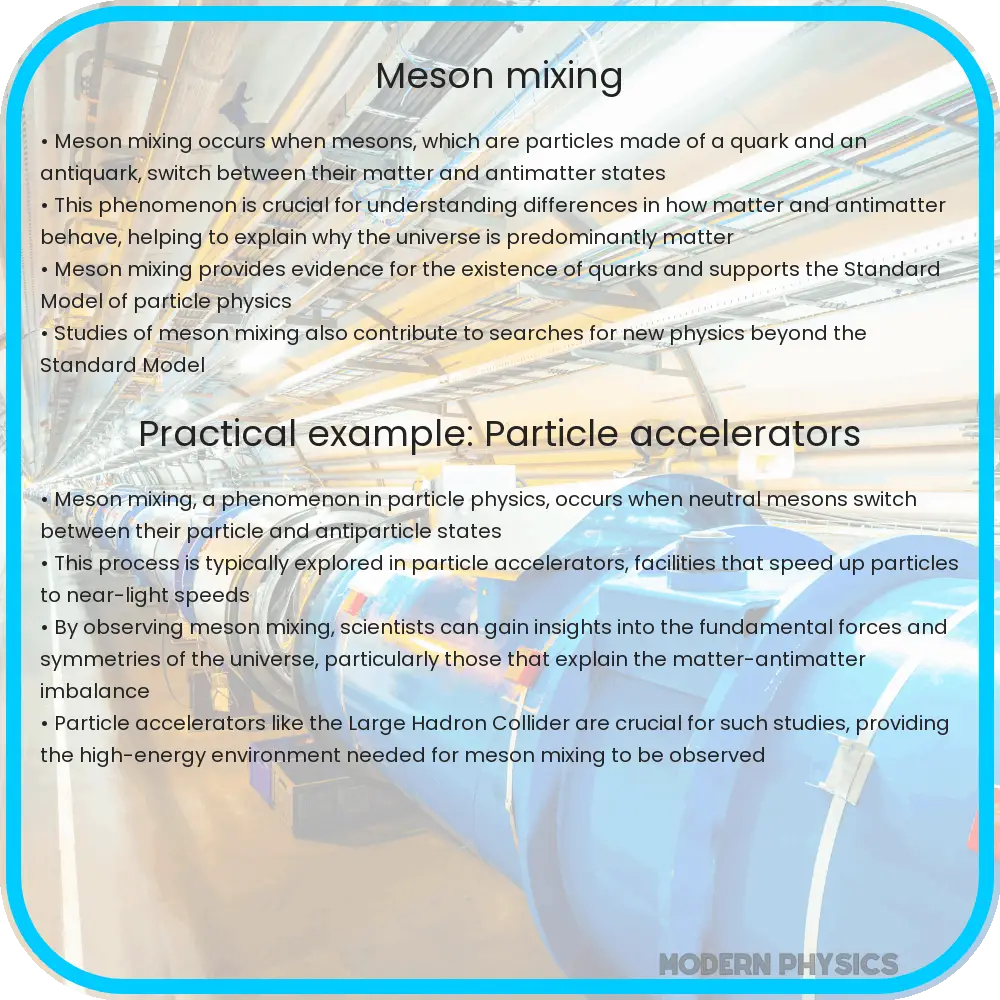
Meson mixing is a fascinating quantum phenomenon that serves as a window into the complex and intriguing world of particle physics. Mesons are subatomic particles made up of a quark and an antiquark, bound together by the strong force. Unlike more familiar particles like electrons and protons, mesons are inherently unstable and exist for only a brief moment before decaying. However, it’s during their fleeting existence that some mesons exhibit a peculiar behavior known as mixing, where they oscillate between different identity states.
This quantum oddity is not merely a theoretical curiosity; it plays a pivotal role in our understanding of fundamental forces and the symmetries of the universe. Particularly, meson mixing is closely associated with Charge-Parity (CP) violation, a phenomenon that could help explain the matter-antimatter asymmetry in the universe. According to the Big Bang theory, the universe should have begun with equal amounts of matter and antimatter. However, our observable universe is predominantly made of matter, a discrepancy that remains one of the greatest mysteries in physics.
CP violation refers to the slight difference in behavior between particles and their antiparticles, which could provide clues as to why the universe is matter-dominated. In meson mixing, CP violation is observed as a difference in the transformation rates between meson states and their antimatter counterparts. This discrepancy is tiny but significant, offering insights into the early universe’s conditions and the laws governing nature’s fundamental particles.
The study of meson mixing and CP violation requires intricate experiments performed in high-energy particle colliders, where physicists recreate the conditions similar to those just after the Big Bang. By observing how mesons switch between their different states, researchers can probe into the heart of quantum mechanics and the forces that shape our universe. These experiments are not just about understanding the subatomic world; they are a quest to unravel the origins of the cosmos itself.
Exploring the Implications of Meson Mixing and CP Violation
The exploration of meson mixing and CP violation extends beyond mere academic interest; it has profound implications for our understanding of the cosmos. By studying these phenomena, scientists are able to test the Standard Model of particle physics, the theoretical framework that describes the fundamental forces and particles in the universe. Despite its success, the Standard Model is not complete. It does not incorporate the force of gravity, nor does it explain dark matter and dark energy, mysterious components that make up a significant portion of the cosmos. Meson mixing and CP violation experiments can point to new physics beyond the Standard Model, guiding researchers in their quest for a more unified theory.
Furthermore, the study of meson mixing is instrumental in improving our understanding of the strong interaction, one of the four fundamental forces in nature. This force, also known as the strong nuclear force, is responsible for holding the nucleus of an atom together. By examining the behavior of mesons, physicists can gain deeper insights into the strong force’s properties and how it operates at the quantum level.
Technological advancements have also been spurred by the intricate requirements of meson mixing research. High-energy particle colliders, sophisticated detectors, and advanced computational tools have been developed to observe and analyze these fleeting quantum events. These technologies not only push the boundaries of particle physics but also find applications in medicine, computing, and materials science, demonstrating the broader impacts of fundamental research on society.
Conclusion
Meson mixing and CP violation are at the forefront of our quest to understand the fundamental principles of the universe. These phenomena challenge our current understanding and hint at the existence of new physics that could explain the universe’s deepest secrets, from its predominant matter composition to the forces that have shaped its evolution. As we continue to probe these quantum mysteries, we edge closer to unlocking the answers to some of the most profound questions in physics. The journey through the microscopic world of mesons reveals much more than the particles themselves; it illuminates the pathways through which the cosmos has evolved and continues to evolve. As such, the study of meson mixing and CP violation is not just a chapter in the story of particle physics but a bridge to a deeper understanding of the universe itself.