
Explore the science behind megaphones, focusing on their acoustic design and how they amplify sound for clearer and farther voice projection.
Understanding Megaphones: Clarity, Range & Acoustic Design
Megaphones, often recognized as simple yet powerful tools for amplifying voices, stand as a pinnacle of acoustic design. They elegantly demonstrate how principles of physics can be applied to enhance the range and clarity of sound. In this article, we’ll delve into how megaphones work, highlighting the importance of their design and the role of acoustics.
Physics of Sound Amplification
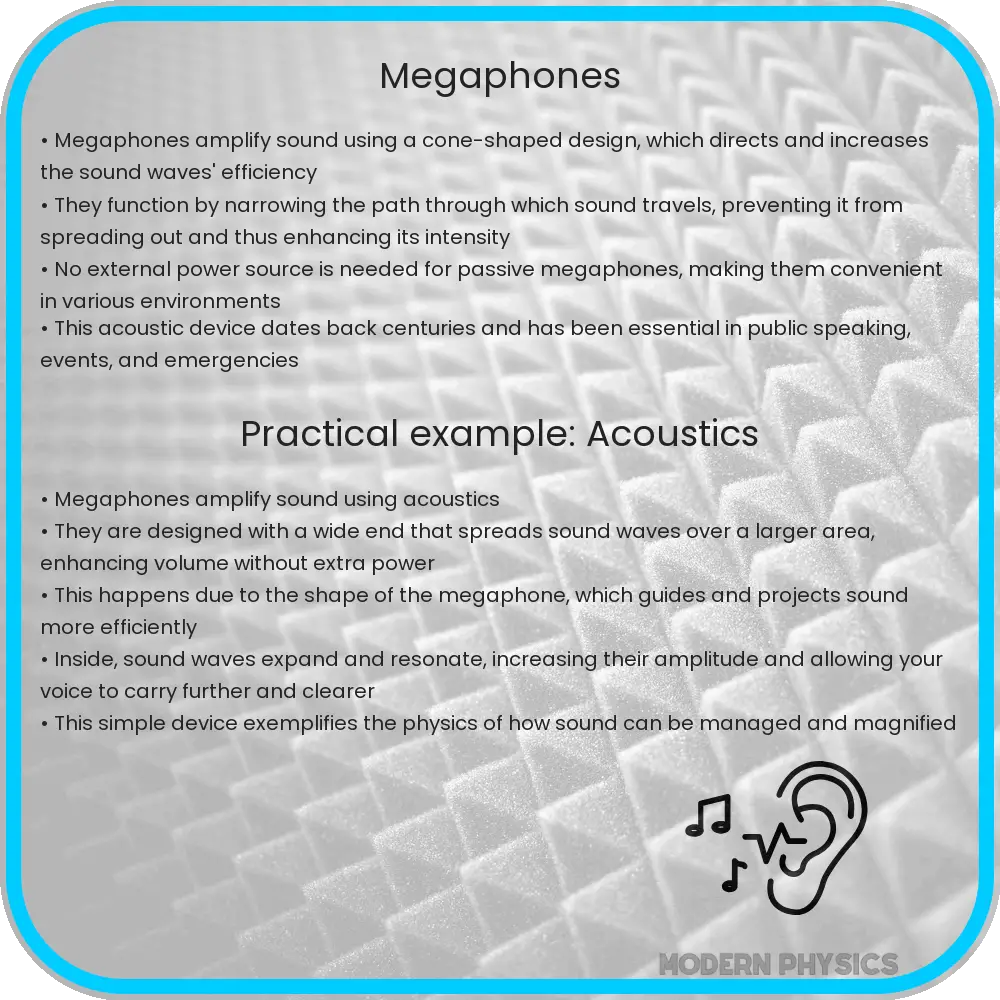
At its core, a megaphone increases the volume of sound by focusing and directing the waves as they move from the source (e.g., a person’s mouth) outward. The basic principle is governed by the conservation of energy. Rather than allowing the sound waves to spread out in all directions, a megaphone channels them in a specific direction, which significantly increases the sound intensity in that direction.
The process begins with the user speaking into the narrower end of the megaphone. Here, the sound waves are collected and then funnel through an expanding tube. This design helps in maintaining the sound wave’s energy, directing it forward rather than letting it dissipate sidewards.
Acoustic Design Elements
The effectiveness of a megaphone can be attributed to several key design elements:
- Flared Shape: The megaphone’s iconic conical shape plays a crucial role. The gradual widening of the cone, known scientifically as “flaring,” aids in the efficient transmission of sound waves. By controlling how sound waves expand, it minimizes the loss of sound energy and reduces sound dispersion.
- Material: The choice of material also impacts a megaphone’s performance. Hard materials like metals or hard plastics help in reflecting sound waves more efficiently than softer materials, which might absorb some of the sound energy.
- Length and Diameter: The length and the opening diameter of the megaphone also determine how much sound can be amplified. Longer megaphones with larger mouths can project the sound farther, albeit at the cost of increased weight and less portability.
Maximizing Range and Clarity
To maximize the range and clarity of the sound transmitted through a megaphone, engineers focus on optimizing its design. The angle of the flare, the length of the cone, and the material used are all tweaked to enhance performance. For clarity, ensuring that the sound does not become distorted as it is amplified is crucial. This depends largely on the smoothness of the inner surface of the megaphone and the gradual nature of the flare.
Meanwhile, the range is primarily affected by the diameter of the larger end and the overall shape of the megaphone. A wider exit end allows for a greater spread of sound over a larger area, which is particularly useful in situations where messages need to be delivered over long distances.
In conclusion, the design of megaphones is a brilliant example of applied physics and engineering. By understanding the properties of sound waves and how they interact with various shapes and materials, engineers can create devices that significantly enhance the power and reach of our voices.
Practical Applications of Megaphones
Megaphones are not only used for increasing volume but are crucial in various settings where clear communication is essential. Here are some common uses of megaphones:
- Emergency Situations: In emergencies, clear communication can save lives. Megaphones are used by firefighters, police officers, and emergency response teams to deliver instructions over noise and confusion.
- Sports Events: Coaches and referees use megaphones to communicate with players across large fields during sports events, ensuring commands are heard clearly and promptly.
- Public Gatherings: During rallies, protests, and public addresses, speakers use megaphones to amplify their messages to large crowds, making sure every word is heard.
Future of Acoustic Devices
With advancements in technology, the future of acoustic devices like megaphones looks promising. Innovations may include integration with digital technology to enhance sound quality and directional accuracy. For instance, incorporating microphone arrays and digital signal processing could tailor sound amplification to specific environments, improving the functionality of megaphones in noisy or acoustically challenged spaces.
Furthermore, the development of materials at the nanoscale could lead to lighter, more efficient designs that are easier to carry and use in various situations, potentially expanding their utility even further.
Conclusion
Megaphones are fascinating devices that showcase the clever application of physics and engineering principles in everyday life. By understanding and manipulating sound waves through design tweaks and material selection, these tools transform how we project our voices across distances. Whether it’s directing crowds, managing events, or saving lives, the humble megaphone remains a testament to the power of focused sound. As technology evolves, so too will the capabilities of these essential tools, making them even more versatile and effective in breaking through the noise.