
Explore the intriguing world of Many-Body Localization in quantum systems, its impact on quantum computing, and the dynamics of non-equilibrium phases.
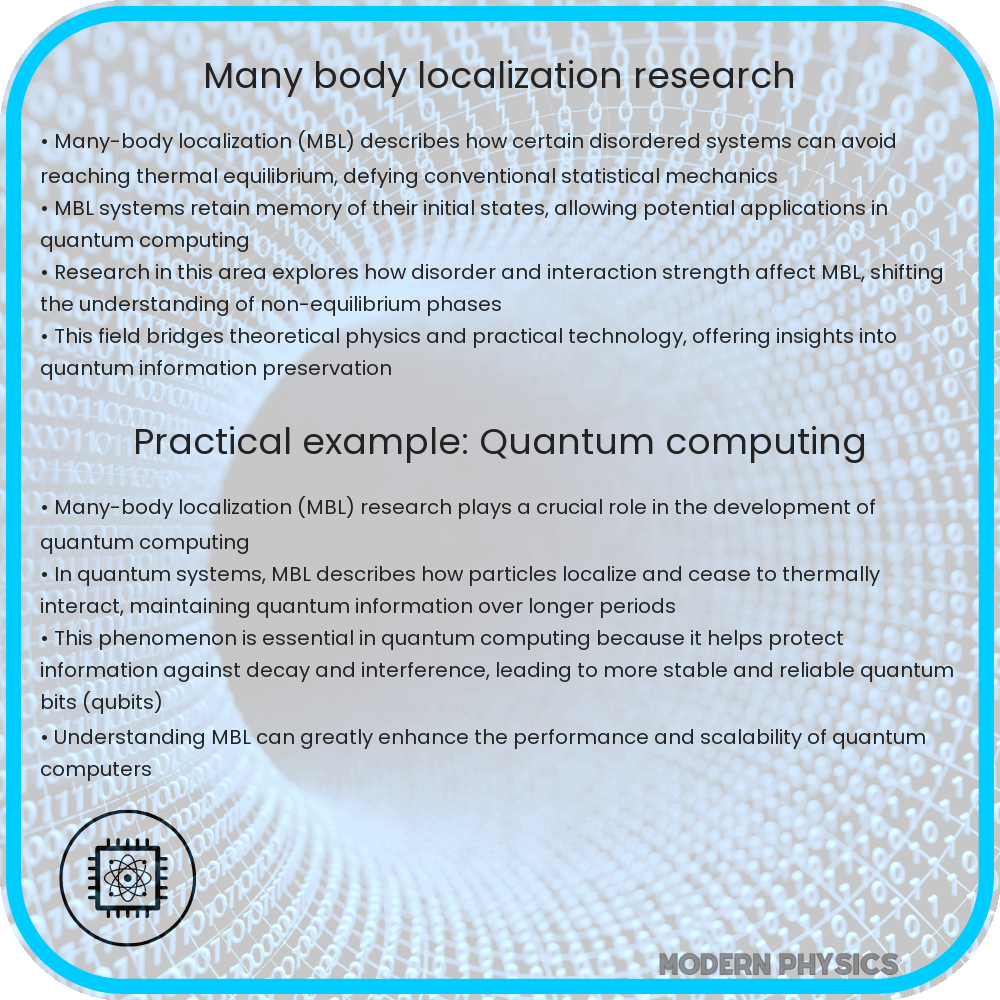
Exploring the Intricacies of Many-Body Localization in Quantum Systems
Many-Body Localization (MBL) presents a fascinating phenomenon in quantum physics, challenging the conventional understanding of thermalization in isolated systems. It emerges as a pivotal concept linking quantum mechanics, complexity science, and dynamical systems, offering profound implications for both theoretical and practical aspects of quantum computing and information processing.
At its core, MBL pertains to the behavior of non-equilibrium systems of interacting particles. Unlike typical systems that reach thermal equilibrium, where properties like temperature become uniform throughout, MBL systems resist this trend due to strong disorder and interactions. This defiance against thermalization is not just a theoretical curiosity; it holds significant potential for maintaining quantum coherence in quantum computers, a fundamental challenge in the field.
Quantum Mechanics and MBL: A Synergistic Relationship
In quantum mechanics, MBL manifests as a resistance to the entanglement and spreading of information across a system. When particles are highly entangled, information about one particle can reveal information about others. However, in an MBL phase, this entanglement is drastically limited, preserving the local information despite the presence of interactions among particles. This characteristic is crucial in quantum computing, where maintaining the integrity of quantum states is paramount.
The Role of Disorder and Interaction in MBL
Disorder and interaction play central roles in MBL. Disorder, often introduced through random variations in the system, leads to localization—a phenomenon first observed in single-particle systems, famously known as Anderson Localization. However, the addition of interactions among multiple particles in a disordered system gives rise to MBL, extending the concept of localization to a many-body context. This interplay between disorder and interaction results in a rich landscape of dynamical behavior, challenging our understanding of quantum phase transitions and non-equilibrium dynamics.
Understanding MBL is not just an academic pursuit; it has practical implications in designing robust quantum systems. For instance, in quantum computers, preventing decoherence—a process where quantum information is lost due to interaction with the environment—is crucial. MBL offers a natural way to protect quantum information, as the localized states are inherently resistant to external perturbations.
Complexity and Dynamics in MBL Systems
The complexity in MBL systems arises from the intricate interplay between disorder and interaction. This complexity is not just quantitative but qualitative, leading to new phases of matter and transitions. For example, the transition from a delocalized to a localized phase in an MBL system is not merely a change in degree but a fundamental shift in the system’s behavior. Understanding these transitions is key to unlocking the secrets of quantum thermodynamics and statistical mechanics in non-equilibrium systems.
Experimental Progress and Challenges
Experimentally studying MBL is challenging due to the precise control and isolation required. Recent advances in cold atom experiments and ion traps have opened new avenues for observing MBL in controlled settings. These experiments not only validate theoretical predictions but also provide insights into the nature of quantum phase transitions under realistic conditions.
MBL and Quantum Information Processing
MBL is not just a theoretical construct; it has practical implications for quantum information processing. In quantum computing, where coherence and entanglement are resources, MBL provides a natural mechanism to preserve these properties. By exploiting MBL, it is possible to design quantum systems that are less prone to decoherence and more robust against environmental interference.
Future Directions and Potential Applications
The study of MBL is still in its infancy, with many open questions and unexplored territories. One promising direction is the application of MBL principles in error correction for quantum computers. Moreover, understanding MBL could lead to the development of new materials with unique electronic properties, potentially revolutionizing the field of materials science.
Conclusion
Many-Body Localization stands at the crossroads of quantum mechanics, complexity science, and dynamical systems, offering a unique perspective on the behavior of quantum systems. Its implications extend far beyond theoretical curiosity, holding the potential to revolutionize quantum computing and materials science. As research in this field advances, the depth and breadth of its impact are likely to unfold, revealing new understanding and applications of quantum phenomena in the real world.