
Explore magnetohydrodynamics (MHD) and its role in cosmic phenomena, from solar flares to astrophysical jets, and its applications in engineering and energy.
Introduction to Magnetohydrodynamics and Cosmic Phenomena
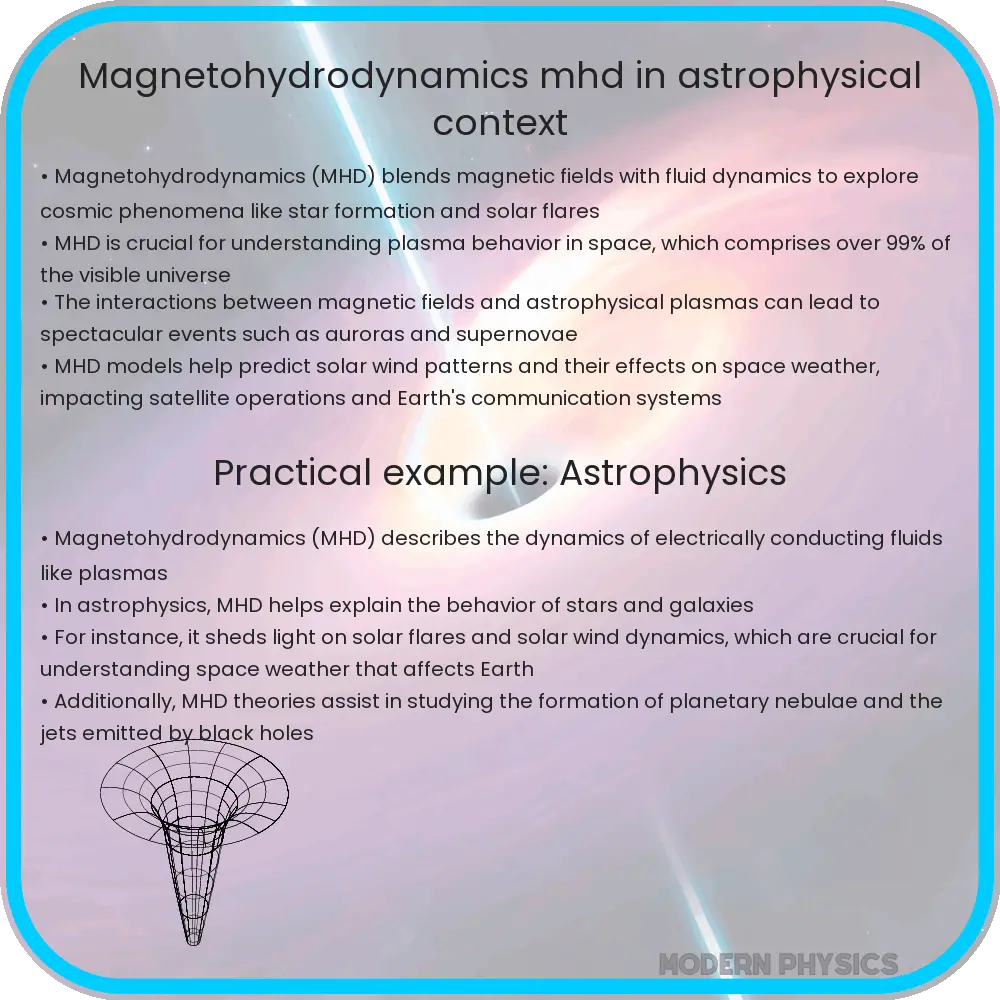
Magnetohydrodynamics (MHD) is a fascinating field that combines principles from both magnetism and fluid dynamics to explain how magnetic fields interact with electrically conductive fluids. This interdisciplinary science plays a crucial role in understanding various cosmic phenomena, including plasma dynamics, solar flares, and astrophysical jets.
Understanding Plasma and MHD
Plasmas, often referred to as the fourth state of matter, are ionized gases consisting of free electrons and ions. They are unique because they can conduct electricity and are influenced by magnetic fields. In the universe, plasmas are the most common state of matter, found in stars, the interstellar medium, and in the accretion disks around black holes.
MHD describes the behavior of plasma under the influence of magnetic fields. The equations of MHD combine Maxwell’s equations, which describe electromagnetism, with the Navier-Stokes equations, which describe fluid motion. This combination allows scientists to understand how the plasma’s velocity field and the magnetic field interact.
Plasma Dynamics in Space
In space, plasma dynamics are influenced by the interactions between plasma and magnetic fields. For example, the sun’s surface is a hotbed of plasma activity, with magnetic fields twisting and turning, leading to phenomena like solar flares and coronal mass ejections. These solar events can have profound effects on space weather, affecting satellite operations, communication systems, and even power grids on Earth.
Further from our solar system, plasma dynamics are key to understanding the formation and behavior of astrophysical jets. These are highly focused, high-speed streams of plasma that are ejected from the regions around black holes or neutron stars. The mechanisms that create and sustain these jets are complex and involve a combination of gravitational, electromagnetic, and hydrodynamic forces.
The study of magnetohydrodynamics extends beyond just theoretical research; it has practical applications in engineering and energy production, particularly in the development of nuclear fusion reactors. Understanding how plasma behaves in magnetic confinement systems is crucial for advancing fusion technology, which promises a nearly limitless source of clean energy.
Advancements in MHD and Cosmic Exploration
Recent advancements in magnetohydrodynamics have been propelled by both theoretical developments and technological innovations. Advanced computer simulations have become a cornerstone in MHD research, enabling scientists to model complex plasma interactions and magnetic field dynamics with unprecedented detail. These simulations help researchers predict solar activity, understand the structure of the interstellar medium, and decipher the dynamics within accretion disks around compact objects like black holes and neutron stars.
Moreover, space missions and telescopes have provided empirical data that enrich our understanding of plasma phenomena in the cosmos. Instruments aboard satellites like the Solar Dynamics Observatory (SDO) and the Parker Solar Probe have offered insights into the Sun’s plasma behavior, contributing significantly to space weather forecasting. Similarly, observations from the Event Horizon Telescope have given scientists valuable information on plasma jets from supermassive black holes, challenging and refining existing MHD models.
MHD in Engineering and Beyond
On Earth, magnetohydrodynamics has practical applications in various engineering fields, notably in the design of magnetohydrodynamic drives for marine propulsion and in the development of efficient cooling systems for electronic devices. The principles of MHD are also fundamental in the ongoing research and development of controlled thermonuclear fusion reactors, such as the International Thermonuclear Experimental Reactor (ITER). By harnessing the same processes that power the sun, fusion energy promises to be a clean, sustainable energy source, with magnetohydrodynamics playing a central role in achieving this goal.
Conclusion
Magnetohydrodynamics is a multidisciplinary field that bridges the gap between fluid dynamics and electromagnetism, providing crucial insights into the behavior of plasmas in both celestial and terrestrial settings. From enhancing our understanding of cosmic phenomena like solar flares and astrophysical jets to contributing to the advancement of clean energy technologies on Earth, MHD continues to be at the forefront of scientific research and technological innovation. As computational capabilities grow and space exploration advances, the future of magnetohydrodynamics promises even deeper insights into the universe’s most enigmatic processes and the development of groundbreaking technologies for humanity’s benefit.