
Explore the benefits of magnetic bearings: frictionless, durable, precise. Ideal for industry, energy, aerospace, and medical applications.
Magnetic Bearings: Revolutionizing Mechanical Systems
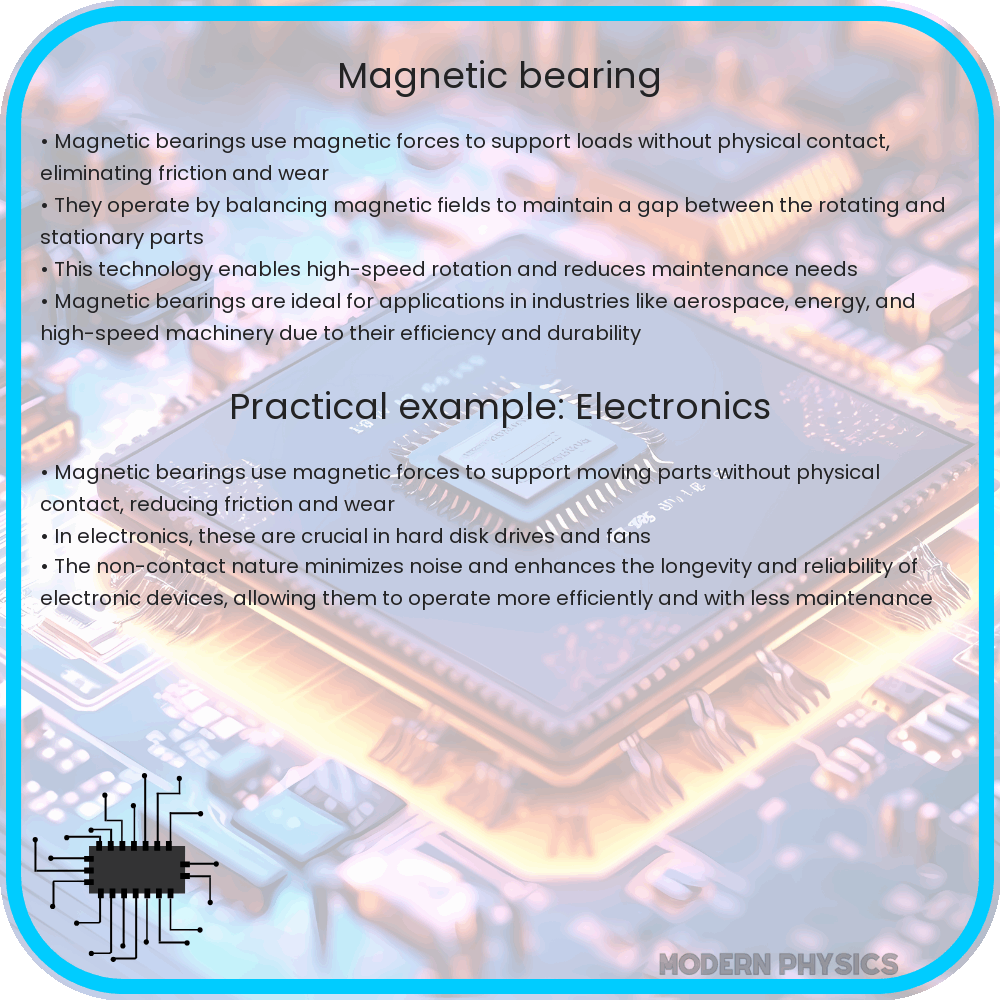
Magnetic bearings represent a significant advancement in mechanical system design, offering frictionless operation, enhanced durability, and unparalleled precision. These innovative bearings employ magnetic forces to levitate and stabilize rotating components, eliminating direct contact and thus, the friction typically associated with conventional bearings. This cutting-edge technology finds applications in various fields, from high-speed turbines to precision medical equipment.
Frictionless Operation: The Core Advantage
The absence of physical contact in magnetic bearings is their most striking feature. By levitating the rotating shaft, these bearings eliminate friction, a major source of wear and tear in traditional bearings. This frictionless operation not only extends the lifespan of the machinery but also reduces the need for lubrication, leading to cleaner and more environmentally friendly operations.
Durability: Withstanding the Test of Time
Magnetic bearings are designed for longevity. The lack of mechanical contact means there is minimal wear, making these bearings exceptionally durable. This durability is especially beneficial in applications where maintenance is challenging or costly, such as in aerospace or underwater environments. Additionally, magnetic bearings can withstand extreme temperatures and hostile environments, where traditional bearings would quickly degrade.
Precision: Enabling High-Performance Applications
Precision is another hallmark of magnetic bearings. By finely controlling the magnetic fields, these bearings can maintain extremely tight tolerances and stable operation, even at very high speeds. This precision is crucial in applications like high-speed machining, where even a minute deviation can result in product defects. Moreover, the ability to adjust the bearing characteristics in real-time allows for optimal performance under varying load conditions.
Understanding the Technology
At the heart of magnetic bearings are electromagnets that generate a controlled magnetic field. This field is carefully modulated to maintain the position of the rotating shaft. Advanced sensors continuously monitor the shaft’s position, and sophisticated control systems adjust the magnetic field to keep the shaft perfectly centered. This dynamic system allows for real-time adjustments, ensuring smooth and efficient operation.
In conclusion, magnetic bearings offer a leap forward in mechanical system design. Their frictionless operation, durability, and precision make them ideal for a wide range of applications, pushing the boundaries of what is mechanically possible.
Advanced Applications of Magnetic Bearings
Magnetic bearings are not just limited to industrial machinery; their unique properties have paved the way for innovative applications in various sectors. In the field of energy, they are crucial in the design of high-speed turbines and generators, contributing to more efficient power generation. The aerospace industry benefits from their use in jet engines and spacecraft, where reliability and precision are paramount. Additionally, in the medical field, magnetic bearings are instrumental in the functioning of high-speed centrifuges used for blood analysis and other critical diagnostic procedures.
Eco-Friendly and Energy-Efficient
Another significant advantage of magnetic bearings is their positive impact on the environment. Their frictionless operation means less energy is required to overcome resistance, leading to lower energy consumption. This efficiency translates into reduced carbon footprints for industries employing these bearings. Furthermore, the lack of lubricants not only cuts down on maintenance costs but also eliminates the potential for environmental contamination often associated with oil-based lubricants.
The Future of Magnetic Bearings
The future of magnetic bearings looks promising as ongoing research and development continue to expand their capabilities. Innovations in material science and electromagnetic design are expected to lead to even more efficient, smaller, and more affordable magnetic bearing systems. This evolution will likely open up new applications in areas where traditional bearings are currently the norm, further revolutionizing mechanical and industrial design.
Conclusion
Magnetic bearings stand at the forefront of mechanical engineering innovation. Their ability to operate without friction, their exceptional durability, and unmatched precision have already made them indispensable in several high-tech applications. As technology progresses, we can anticipate broader adoption across various industries, making them a key component in the pursuit of efficiency, sustainability, and performance in mechanical systems. The ongoing evolution of magnetic bearings promises not only enhanced industrial capabilities but also a significant contribution to environmental conservation and energy efficiency. In summary, magnetic bearings are not just a technological advancement; they are a leap towards a more efficient, sustainable, and precise future in mechanical design.