
Explore magnetic balance in tech: Uncover its role in enhancing precision, stability, and efficiency in industries from transport to healthcare.
Magnetic Balance: Enhancing Precision, Stability, and Efficiency
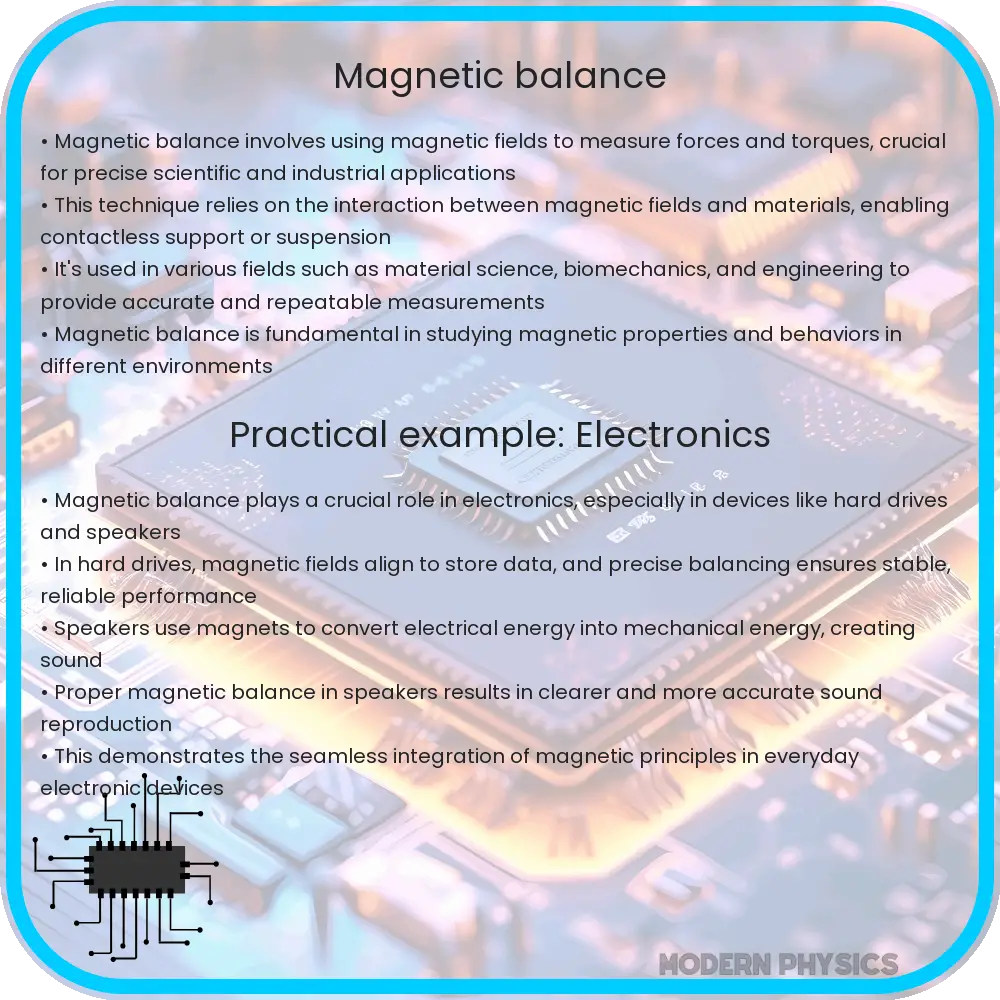
The concept of Magnetic Balance plays a pivotal role in various scientific and industrial applications. By leveraging the principles of magnetism, this technology promises enhanced precision, stability, and efficiency in systems ranging from electric motors to magnetic levitation.
Understanding Magnetic Forces
At its core, magnetic balance involves the manipulation of magnetic forces. These forces are generated by magnets, which are materials that produce a magnetic field. This field can attract or repel other magnets and certain types of metal. Magnets have two poles, north and south, and the magnetic force is strongest at these poles. The fundamental law of magnetism states that opposite poles attract, while like poles repel each other.
Applications in Precision Devices
In precision devices like gyroscopes and accelerometers, magnetic balance is critical. These devices are essential in various fields, from aerospace to consumer electronics, where they help in navigation and motion sensing. By employing magnetic forces, these devices achieve a higher degree of accuracy and stability. This is particularly important in applications where precise measurements are critical, such as in satellite positioning and aircraft navigation.
Magnetic Levitation: A Case Study in Stability
Magnetic levitation (maglev) is a striking example of magnetic balance in action. This technology, used in high-speed trains, employs magnetic forces to lift, propel, and guide the train over the tracks. This levitation eliminates friction between the train and the track, leading to smoother, faster, and more efficient travel. Moreover, the absence of mechanical contact reduces wear and tear, thereby enhancing the longevity and reliability of the system.
Enhancing Efficiency in Electric Motors
Electric motors are another area where magnetic balance is crucial. In motors, magnetic forces are used to convert electrical energy into mechanical energy. By optimizing the magnetic balance within these motors, it is possible to improve their efficiency, reduce energy consumption, and minimize heat generation. This is especially vital in industries where motors are used extensively, such as manufacturing and transportation.
The principle of magnetic balance is also being explored in renewable energy applications. For instance, in wind turbines, achieving optimal magnetic balance in the generators can lead to more efficient energy conversion and less mechanical stress, resulting in a longer operational lifespan.
Next, the article will delve deeper into the technological advancements and future prospects of magnetic balance, highlighting its impact on energy conservation, environmental sustainability, and the development of cutting-edge technologies.
Technological Advancements and Future Prospects
The ongoing research and development in magnetic balance technology are opening new frontiers in various sectors. Advanced materials like rare earth magnets, which possess exceptionally strong magnetic fields, are being increasingly used. These materials allow for smaller, more efficient designs in applications ranging from electric vehicles to medical devices. Additionally, superconducting magnets offer opportunities for even greater efficiency, particularly in high-energy physics experiments and magnetic resonance imaging (MRI) machines.
Impact on Energy Conservation and Environmental Sustainability
Magnetic balance technology plays a significant role in promoting energy conservation and environmental sustainability. In renewable energy systems, such as wind turbines and solar panels, improved magnetic balance can lead to more effective and sustainable energy production. This technology is instrumental in reducing the carbon footprint of energy-intensive industries and contributes to the global effort in combating climate change.
Developing Cutting-Edge Technologies
The potential of magnetic balance extends to the development of cutting-edge technologies. In the field of transportation, magnetic levitation is not only used in trains but also being explored in personal and commercial vehicles, promising a future of frictionless, energy-efficient travel. In space exploration, magnetic balance technologies are critical in the development of satellite systems and propulsion methods for spacecraft, enabling more precise and reliable space missions.
Challenges and Future Directions
Despite its advantages, the implementation of magnetic balance technology faces challenges. The cost and availability of rare earth magnets, and the need for sophisticated control systems to manage magnetic forces accurately, are significant hurdles. Future research is focused on overcoming these challenges, potentially through the development of new materials and more advanced control algorithms.
Conclusion
Magnetic balance represents a convergence of physics, engineering, and innovation, offering significant benefits in precision, stability, and efficiency. Its applications span a diverse range of fields, from transportation and energy to healthcare and space exploration. As research progresses, we can expect to see even more remarkable uses of this technology, fundamentally changing how we interact with and harness the power of magnetism. The advancements in magnetic balance not only signify a leap in technological capabilities but also echo a commitment to a more sustainable and efficient future.