
Explore the importance of Lyman-Alpha emission in astrophysics: techniques, impacts on understanding the universe, challenges, and technological advances.
Understanding Lyman-Alpha Emission in Astrophysics
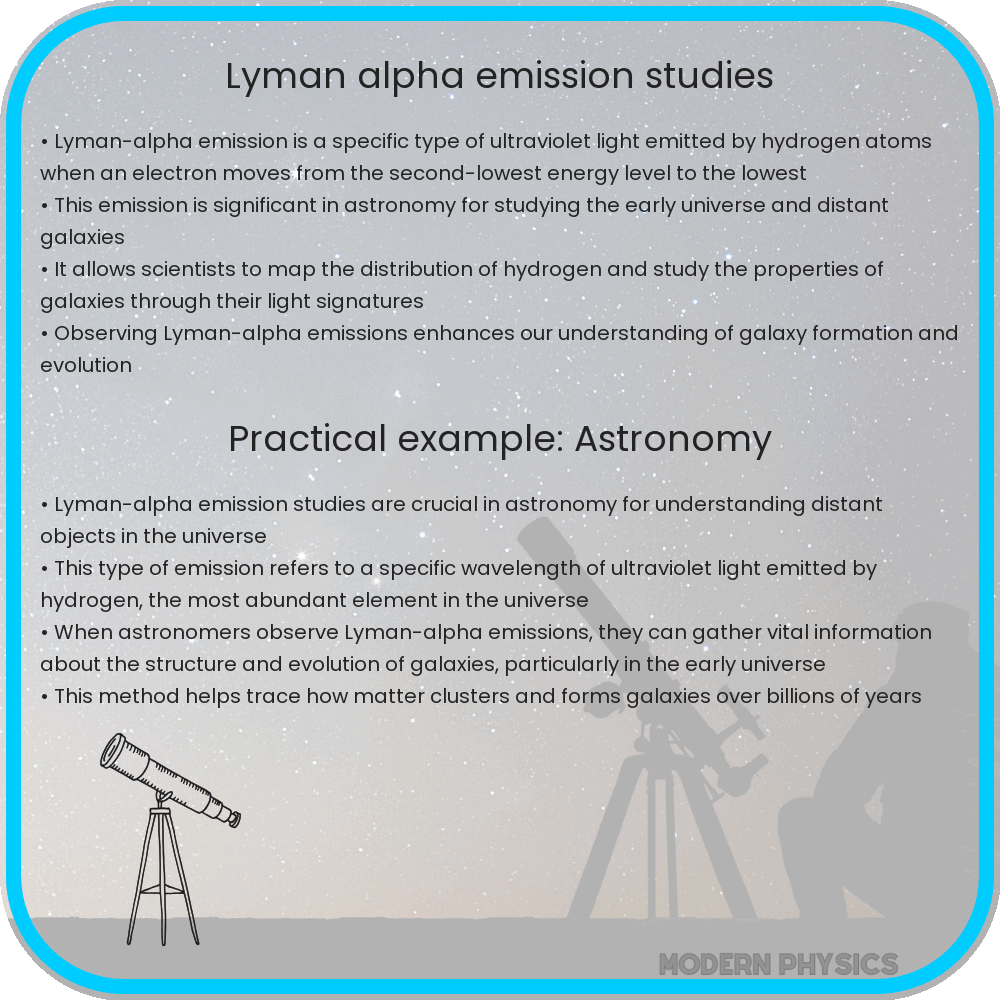
Lyman-Alpha emission, a significant concept in astrophysics, offers critical insights into the understanding of the universe’s early stages and the structure of remote celestial objects. This phenomenon is associated with the Lyman series, where electrons in a hydrogen atom drop from higher energy levels to the n=1 level, emitting ultraviolet radiation at a wavelength of 121.6 nanometers. This specific wavelength is known as the Lyman-Alpha (Lyα) line, a pivotal tool in astronomical observations.
Techniques in Lyman-Alpha Emission Studies
The study of Lyman-Alpha emissions employs various advanced techniques, pivotal for unraveling the mysteries of the cosmos. One primary method involves spectroscopy, which dissects the light from distant objects to identify their composition, temperature, density, and motion. Spectroscopic studies of the Lyα line enable astronomers to trace vast, elusive clouds of hydrogen gas and to assess the rate of star formation in early galaxies.
Another essential technique is imaging, which uses special filters to isolate the Lyα emissions from other light sources. This method provides a clearer picture of the structure and extent of hydrogen clouds surrounding young galaxies. Additionally, telescopes equipped with ultraviolet capabilities, such as the Hubble Space Telescope, play a crucial role in detecting Lyα emissions, given their ability to observe the high-energy ultraviolet light that Earth’s atmosphere absorbs.
Impact of Lyman-Alpha Studies in Astrophysics
The implications of Lyman-Alpha emission studies are profound and far-reaching in the field of astrophysics. They provide invaluable information on the early universe, particularly during the “Epoch of Reionization” – a period when the cosmic “fog” of neutral hydrogen was ionized by the first stars and galaxies. Understanding Lyα emissions helps astronomers piece together the timeline and mechanics of this pivotal era in cosmic history.
Furthermore, Lyman-Alpha emissions serve as a cornerstone for exploring galaxy formation and evolution. By examining these emissions, scientists can infer the properties of galaxies at various stages of their development, offering clues about the processes that governed the early universe and shaped its structure and composition.
Challenges and Advances in Lyman-Alpha Emission Research
Despite their significance, studies of Lyman-Alpha emissions face several challenges. One major hurdle is the Earth’s atmosphere, which absorbs ultraviolet light, thereby necessitating space-based observatories for clear observations. Additionally, the interpretation of Lyman-Alpha signals can be complex due to their scattering in intergalactic media, which can alter the original emission characteristics. Researchers must carefully account for these effects to extract accurate information from the data.
Advances in technology and methodologies continue to address these challenges. Innovations in telescope design, such as the development of more sensitive ultraviolet detectors and the launch of next-generation space telescopes, promise to enhance the resolution and depth of Lyman-Alpha studies. Moreover, sophisticated computer simulations and theoretical models are being developed to better understand the intricate processes that affect Lyman-Alpha emissions, aiding in the accurate interpretation of observational data.
Conclusion
Lyman-Alpha emission studies represent a cornerstone of modern astrophysics, offering unparalleled insights into the early universe, the lifecycle of stars, and the formation and evolution of galaxies. Despite the challenges inherent in observing and interpreting these emissions, ongoing technological and methodological advancements continue to illuminate the dark corners of the cosmos. As we stand on the precipice of new astronomical discoveries, the study of Lyman-Alpha emissions remains a beacon guiding our quest to understand the vast, intricate tapestry of the universe. With each Lyman-Alpha study, we inch closer to unraveling the mysteries of the cosmic dawn, making it not only a field of rich academic interest but also a crucial window into our collective cosmic heritage.