
Explore the revolutionary Light Sheet Fluorescence Microscopy (LSFM) – its principles, advantages, applications, and future in high-resolution 3D imaging.
Introduction to Light Sheet Fluorescence Microscopy
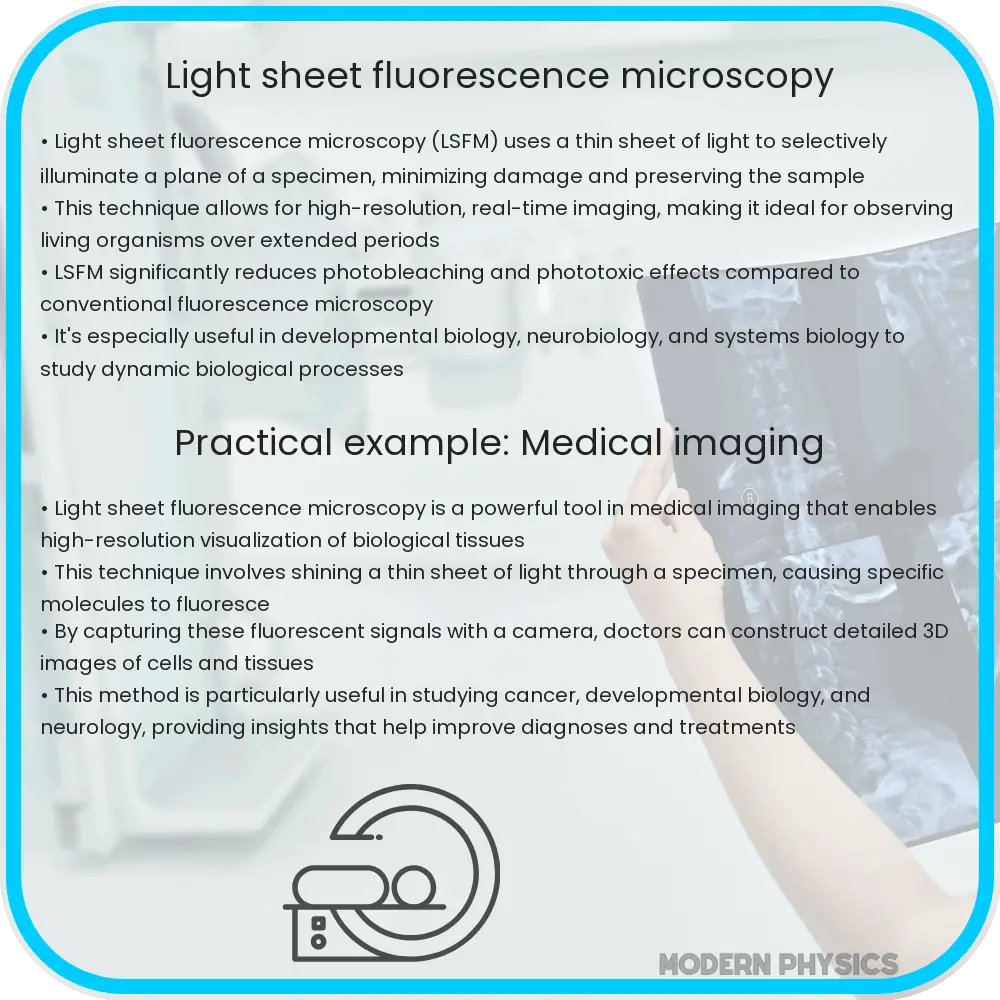
Light Sheet Fluorescence Microscopy (LSFM), also known as selective plane illumination microscopy (SPIM), represents a revolutionary advancement in the field of optical imaging. This technique allows for high-resolution, fast imaging, and detailed 3D visualizations of live specimens, making it an invaluable tool for researchers in biology, medicine, and materials science. By illuminating the specimen with a sheet of light rather than the entire volume, LSFM significantly reduces photodamage and photobleaching, thereby preserving the viability of live samples over extended periods.
How LSFM Works
At the core of LSFM technology is the unique way it illuminates the sample. Unlike traditional fluorescence microscopy, which floods the specimen with light from all directions, LSFM uses a thin sheet of laser light that intersects the sample. This selective illumination confines the excitation light to the focal plane of interest, drastically reducing the exposure of the entire specimen to intense light. An orthogonally positioned detection lens then captures the emitted fluorescence from the illuminated plane. This setup allows for rapid acquisition of images with minimal photodamage, enabling long-term observations of dynamic biological processes.
Advantages of LSFM
- High Resolution: LSFM provides exceptional axial resolution and contrast by illuminating only the plane of interest, which enhances the quality of the 3D images produced.
- Fast Imaging: The method’s ability to quickly acquire images of different planes makes it possible to observe live specimens and dynamic processes in real time.
- Reduced Photodamage: By limiting light exposure to the focal plane, LSFM significantly minimizes photobleaching and phototoxicity, extending the viability of live samples.
- Deep Tissue Penetration: The technique’s efficient light-sheet illumination enables deeper penetration into specimens with reduced scattering and absorption, offering detailed insights into volumetric structures.
LSFM’s innovative approach to specimen illumination and image capture has opened new avenues for research, offering unprecedented views into the intricate workings of cells and tissues. With its ability to provide high-resolution, fast, and non-invasive 3D imaging, LSFM stands as a cornerstone technology in the advancement of scientific understanding and discovery.
Applications of Light Sheet Fluorescence Microscopy
Light Sheet Fluorescence Microscopy’s unique capabilities have found diverse applications across various scientific disciplines. In developmental biology, LSFM has been pivotal in studying the embryonic development of organisms, enabling researchers to visualize complex cellular processes in real time. Neuroscientists utilize LSFM to map the architecture of the brain, tracing neural connections and understanding the structure-function relationships within neural networks. Moreover, the method is also applied in immunology, cancer research, and plant sciences, where its ability to image thick specimens without physical sectioning provides valuable insights into tissue organization and function.
Technical Considerations and Future Directions
While LSFM offers numerous advantages, it also presents challenges that need to be addressed. The technique requires transparent specimens or the use of clearing techniques to reduce light scattering. Moreover, the alignment of the light sheet and detection optics can be complex, necessitating sophisticated equipment and expertise. Advances in LSFM are focused on improving light sheet delivery and detection methods, expanding the range of usable fluorophores, and integrating computational techniques to enhance image resolution and quality.
The future of LSFM lies in its integration with other imaging modalities and the development of new fluorescent probes and sample preparation techniques. This integration will enable more comprehensive studies across scales, from single molecules to whole organisms. Furthermore, computational advances, including machine learning and artificial intelligence, are set to further enhance the capabilities of LSFM, enabling automatic data analysis and real-time image processing.
Conclusion
Light Sheet Fluorescence Microscopy represents a paradigm shift in optical imaging, offering a unique combination of high-resolution, speed, and gentle imaging capabilities. Its ability to provide detailed 3D visualizations of live specimens with minimal photodamage has made it an indispensable tool in the arsenal of modern scientific research. As technology advances, LSFM is expected to unlock new possibilities in our quest to understand the complexities of life at the microscopic level. The ongoing developments in this field promise to further broaden its application scope, making LSFM a cornerstone in the future of microscopy and biological research.