
Explore the fascinating world of light deflection in astrophysics: its methods, accuracy, and role in validating Einstein’s Relativity theory.
Understanding Light Deflection: A Cornerstone of Relativity
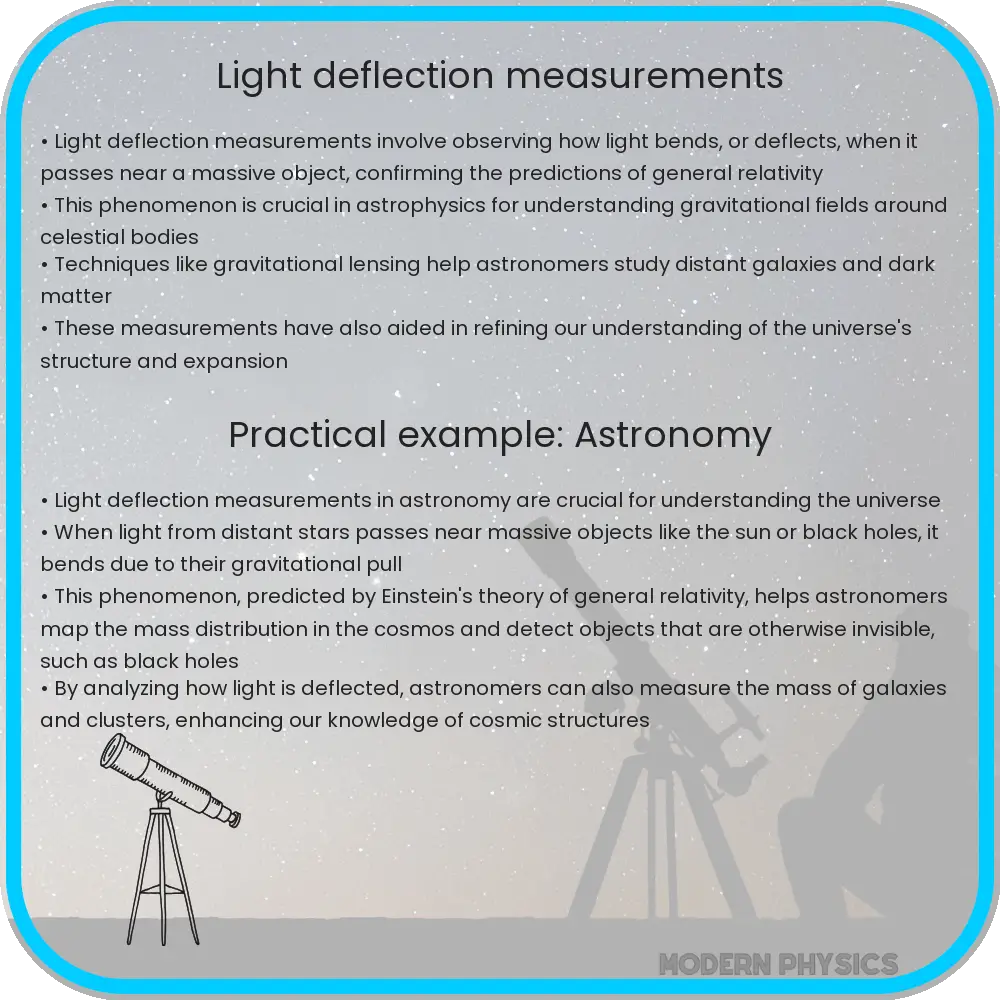
The phenomenon of light deflection has been a fundamental aspect of astrophysics and cosmology, providing critical insights into the nature of spacetime and gravity. This concept, central to Einstein’s theory of General Relativity, posits that light bends when it passes near a massive object. The accuracy of these measurements not only substantiates the theory but also aids in understanding the universe’s structure.
Methods of Measuring Light Deflection
Light deflection measurements are predominantly conducted using two main methods: astronomical observations and gravitational lensing. Astronomical observations involve the precise measurement of star positions during a solar eclipse, when their light passes close to the sun. This method was first used by Arthur Eddington in 1919, providing the earliest confirmation of Einstein’s predictions. Gravitational lensing, on the other hand, utilizes the bending of light from distant galaxies or quasars around massive objects like galaxy clusters, providing a ‘lens’ effect.
The Role of Accuracy in Light Deflection Measurements
The accuracy of these measurements is paramount. Technological advancements, such as the Hubble Space Telescope and Very Long Baseline Interferometry (VLBI), have significantly enhanced precision. These high-precision instruments allow astronomers to measure the bending of light with unprecedented accuracy, leading to more refined models of gravitational fields and spacetime curvature.
Relativity and Light Deflection
Light deflection is deeply intertwined with Albert Einstein’s General Theory of Relativity. According to this theory, mass warps the fabric of spacetime, and light follows the curvature created by this mass. The famous equation E = mc2 is just one part of this comprehensive theory. The accuracy of light deflection measurements not only supports the theory but also provides insights into the mass distribution in the universe, such as the presence of dark matter.
In conclusion, the study of light deflection is a dynamic field that bridges theoretical physics and astronomical observations. Its accurate measurement continues to challenge and refine our understanding of the cosmos, proving to be a critical tool in the ongoing quest to unravel the mysteries of the universe.
Advanced Techniques in Light Deflection Studies
Recent advancements in technology have introduced new techniques for measuring light deflection. One such method is the use of space-based telescopes, like the James Webb Space Telescope, which offers higher precision due to its location beyond Earth’s atmosphere. Additionally, radio astronomy has become increasingly important, using radio waves instead of visible light to measure the bending effect around celestial bodies.
Challenges in Light Deflection Measurements
Despite technological progress, challenges remain in light deflection measurements. One of the primary difficulties is the need for extreme precision. Even small errors in measurement can lead to significant inaccuracies in understanding gravitational fields. Additionally, distinguishing between the bending caused by gravitational effects and other phenomena, like refraction in the Earth’s atmosphere, is a crucial challenge.
Impact on Astrophysics and Cosmology
The implications of accurate light deflection measurements extend far beyond confirming Einstein’s theories. They play a vital role in mapping the distribution of dark matter, as its gravitational effects can be observed through light bending. These measurements also contribute to our understanding of the expansion rate of the universe and provide insights into the properties of black holes and neutron stars.
Future Prospects
Looking forward, the field of light deflection is poised for significant advancements. Upcoming missions and telescopes, like the European Extremely Large Telescope (E-ELT) and Laser Interferometer Space Antenna (LISA), promise even more precise measurements. These developments could potentially lead to new discoveries in gravitational physics and cosmology, further enhancing our understanding of the universe.
Conclusion
In summary, the study of light deflection is a critical area in modern astrophysics, offering deep insights into the nature of gravity and the fabric of the cosmos. From confirming the fundamental principles of General Relativity to exploring the unseen matter in the universe, these measurements serve as a powerful testament to human ingenuity and curiosity. As technology continues to evolve, the precision and scope of light deflection studies are bound to expand, continuing to illuminate the mysteries of our vast universe.