
Explore the Laughlin Wave Function’s role in quantum states, topology, and QFT, revealing the intersections of physics and mathematics.
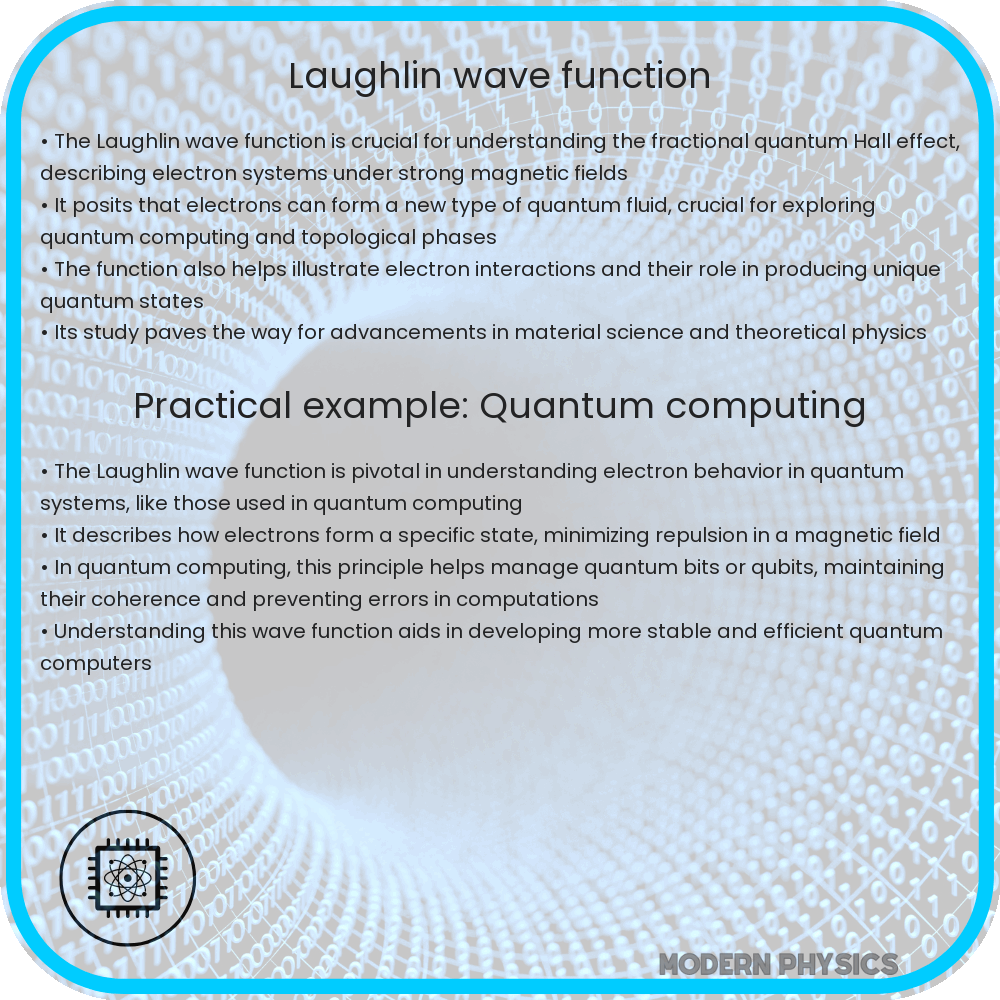
Understanding the Laughlin Wave Function: A Key to Quantum States and Topology in Quantum Field Theory
The Laughlin wave function, introduced by Robert B. Laughlin in the early 1980s, is a significant concept in the realm of quantum physics, particularly in the study of quantum states, topology, and Quantum Field Theory (QFT). This wave function has played a pivotal role in explaining the fractional quantum Hall effect, a phenomenon observed in two-dimensional electron systems subjected to strong magnetic fields. The Laughlin wave function is not just a solution to a complex problem in quantum physics; it’s a window into understanding the strange and counterintuitive world of quantum mechanics.
At its core, the Laughlin wave function is a mathematical expression that describes the quantum state of a system of electrons in a two-dimensional plane under a strong perpendicular magnetic field. The formula for the wave function is as follows:
\[ \Psi(\mathbf{r}_1, \mathbf{r}_2, \ldots, \mathbf{r}_N) = \prod_{i Here, \( \mathbf{r}_i \) represents the position of the \( i \)-th electron in a complex plane, and \( z_i \) is the complex coordinate corresponding to \( \mathbf{r}_i \). The exponent \( m \) is an odd integer, which ensures the antisymmetry of the wave function, a requirement for fermions like electrons due to the Pauli exclusion principle. The beauty of the Laughlin wave function lies in its ability to capture the essence of electron correlations in a highly magnetic environment. It proposes a novel quantum liquid state, where electrons form a highly correlated system that differs fundamentally from classical fluids or solids. This quantum state exhibits fascinating properties, such as quantized Hall conductance and the emergence of fractionally charged quasiparticles, phenomena that are deeply intertwined with the concepts of topology in QFT. Topology in QFT is a crucial aspect when studying the Laughlin wave function. The topological nature of the fractional quantum Hall effect implies that certain properties of the system are invariant under smooth deformations, reflecting a deep connection between quantum mechanics and geometric concepts. These topological aspects are not just mathematical curiosities but provide a robust framework to understand phenomena that are impervious to local perturbations, such as disorder and impurities in the material. In the context of Quantum Field Theory, the Laughlin wave function and the associated quantum states offer a playground for exploring the interplay between quantum mechanics, statistical physics, and topology. QFT provides the tools to understand how these quantum states emerge from the interactions of particles and fields, bridging the gap between microscopic particle physics and macroscopic phenomena observed in experiments. The exploration of the Laughlin wave function extends into the fascinating realms of topology and Quantum Field Theory (QFT). These fields provide a profound understanding of the underlying principles governing the behavior of quantum systems. Topology, a branch of mathematics concerned with properties that remain constant through deformations, stretching, and bending, plays a crucial role in understanding the quantum states described by the Laughlin wave function. In the context of the fractional quantum Hall effect, topology helps explain why certain properties of the system, like the Hall conductance, remain quantized and unchanged under various perturbations. Quantum Field Theory further enriches this understanding. QFT, which combines quantum mechanics with special relativity, offers a framework for describing how particles like electrons interact with fields, such as electromagnetic fields. In the case of the Laughlin wave function, QFT aids in comprehending how electrons in a strong magnetic field can give rise to new, emergent phenomena like anyons – particles that are neither fermions nor bosons. These anyons exhibit fractional statistics, a concept that is deeply rooted in both topology and QFT. This relationship underscores the fundamental nature of the Laughlin wave function as a bridge between abstract mathematical concepts and tangible physical phenomena. Moreover, the study of the Laughlin wave function through the lens of topology and QFT has led to significant advancements in condensed matter physics. It has spurred the development of new theoretical models and experimental techniques to study other exotic quantum states of matter. These include topological insulators and superconductors, which hold potential for revolutionary applications in quantum computing and other technologies. In conclusion, the Laughlin wave function is more than just a solution to a quantum mechanical problem; it represents a crucial intersection of various disciplines within physics. Its study encompasses complex interactions in quantum states, the subtle nuances of topology, and the comprehensive framework provided by Quantum Field Theory. This wave function has not only enhanced our understanding of phenomena like the fractional quantum Hall effect but has also paved the way for future discoveries in quantum physics. The ongoing exploration of its implications continues to reveal the intricacies of the quantum world, demonstrating the beauty and complexity of the universe at its most fundamental level. As research progresses, the Laughlin wave function remains a key subject of interest, symbolizing the rich interplay between theory and experiment in physics. Its study illustrates how abstract mathematical concepts can have profound real-world implications, highlighting the ever-evolving nature of our understanding of the quantum realm.Delving Deeper: The Role of Topology and Quantum Field Theory in Understanding the Laughlin Wave Function
Conclusion