
Lattice Quantum Electrodynamics (QED) simulations explore electromagnetic interactions and the behavior of quarks within atomic nuclei using advanced algorithms.
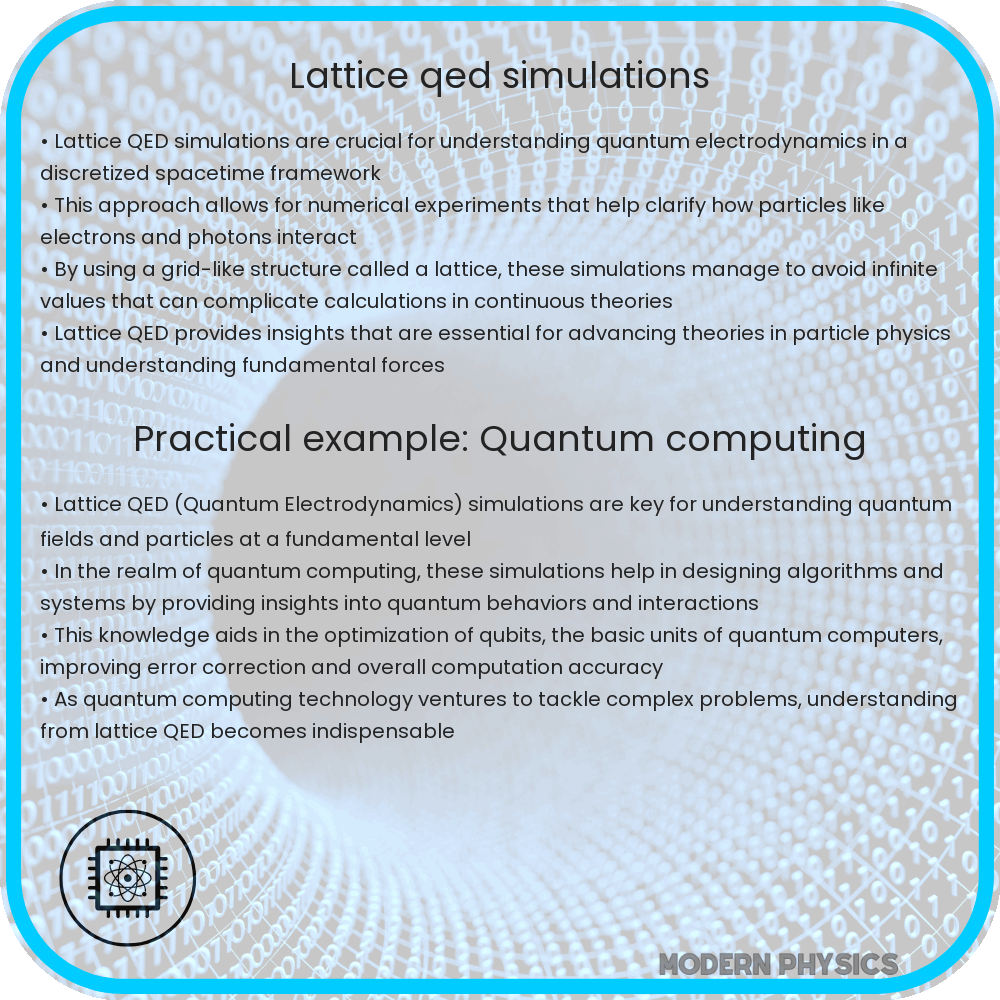
Understanding Lattice QED Simulations
Lattice Quantum Electrodynamics (QED) simulations provide a rich framework for investigating the quantum aspects of electromagnetic fields and the interactions involving charged particles, primarily electrons and positrons. These simulations leverage the principles of lattice gauge theory, a cornerstone in our understanding of fundamental interactions at the quantum level. This article delves into the precision of these simulations, the complex algorithms that drive them, and their crucial role in studying quarks within the atomic nucleus.
Precision in Lattice QED Simulations
The precision of lattice QED simulations is pivotal, particularly in theoretical physics where exact solutions are rare. Precision in these simulations relates directly to how finely the space-time continuum is divided into a lattice. This discretization introduces an inherent approximation, as it replaces the smooth fabric of space-time with a grid of points connected by links. The key to enhancing precision lies in making the lattice spacing finer and employing advanced numerical techniques to solve the equations describing the interactions of quantum fields.
Algorithms Powering Lattice QED
Algorithms are the backbone of lattice QED simulations. The most commonly used algorithm is the Monte Carlo method, which relies on random sampling to obtain numerical results. This stochastic approach is suited for the high-dimensional integrals prevalent in quantum field calculations. However, the complexity of QED interactions demands enhancements to simplistic Monte Carlo techniques. Improved algorithms such as the Hybrid Monte Carlo and the Heat Bath algorithm provide better efficiency and convergence in capturing the dynamics of quarks and gluons in a lattice framework.
- Hybrid Monte Carlo: This algorithm integrates molecular dynamics with Monte Carlo methods, which helps in effectively exploring the phase space of the lattice gauge theory.
- Heat Bath Algorithm: It simplifies the process of updating the gauge fields on the lattice by randomly choosing new field configurations according to a specific probability distribution related to the action density.
Role of Quarks in Lattice QED Simulations
In the realm of subatomic particles, quarks are fundamental constituents of matter. Understanding their behavior under the influence of electromagnetic and strong forces is critical. Lattice QED simulations extend into Quantum Chromodynamics (QCD), where the focus is not just on electromagnetic but also on the strong interactions that bind quarks inside protons and neutrons. These simulations help physicists explore how quarks distribute themselves within protons and how they contribute to the proton’s spin and other properties.
Advanced simulations allow for the examination of the vacuum polarization effects, where a quark-antiquark pair momentarily pops into existence. Such effects are crucial for understanding the anomalous magnetic moment of the muon, a current area of intense research that tests the Standard Model of particle physics.
Challenges and Computational Demands
While lattice QED simulations are a powerful tool, they come with considerable computational demands. The need for high-precision and the complex nature of quantum calculations necessitate the use of supercomputers or high-performance computing clusters. Compounding the challenge, the finer the lattice used in simulations, the greater the computational power required. This means that enhancements in computational technology directly influence the potential for more precise simulations.
The continual development of algorithms and computational hardware paves the way for more detailed and accurate simulations, driving forward our understanding of the fundamental forces and particles that constitute the universe.
Future Prospects and Technological Advances
As computing power continues to grow, so too does the potential for more refined lattice QED simulations. Future advancements in quantum computing may revolutionize these simulations by addressing current limitations in computational speed and capacity. Additionally, developments in artificial intelligence and machine learning could lead to more intelligent algorithms capable of handling complex, high-dimensional data more efficiently, further enhancing the accuracy of simulations.
Emerging technologies also have the potential to improve the accessibility and scalability of lattice simulations, making these valuable tools available to a broader scientific community. This could facilitate a deeper understanding and new discoveries in particle physics, potentially leading to breakthroughs in materials science, quantum mechanics, and other related fields.
Conclusion
Lattice QED simulations represent a significant achievement in the field of theoretical physics. They offer profound insights into the quantum world, allowing scientists to study interactions that are otherwise too small and fast to observe directly. Despite their computational demands and the challenges associated with refining these simulations, the ongoing advancements in computing technology and algorithms hold promise for even greater accuracies and discoveries in the future.
With their ability to explore fundamental particles and forces at a quantum level, lattice QED simulations not only deepen our understanding of the universe’s building blocks but also underscore the critical interplay between theoretical physics and cutting-edge technology. As research continues and technologies evolve, these simulations will undoubtedly remain indispensable in the quest to uncover the deepest secrets of the cosmos. Ultimately, the journey through lattice QED simulations is not just about observing the quantum realm but about enhancing our overall capability to model and understand the very fabric of reality.