
Explore how lasers are revolutionizing precision measurement, quantum control, and innovation in science and technology in this insightful article.
The Intersection of Lasers, Precision, and Quantum Control
In the realm of modern science and technology, lasers have emerged as a pivotal tool, especially in the fields of precision measurement and quantum control. This article delves into how lasers are revolutionizing these areas and the innovative applications they are fostering.
Laser Technology: A Brief Overview
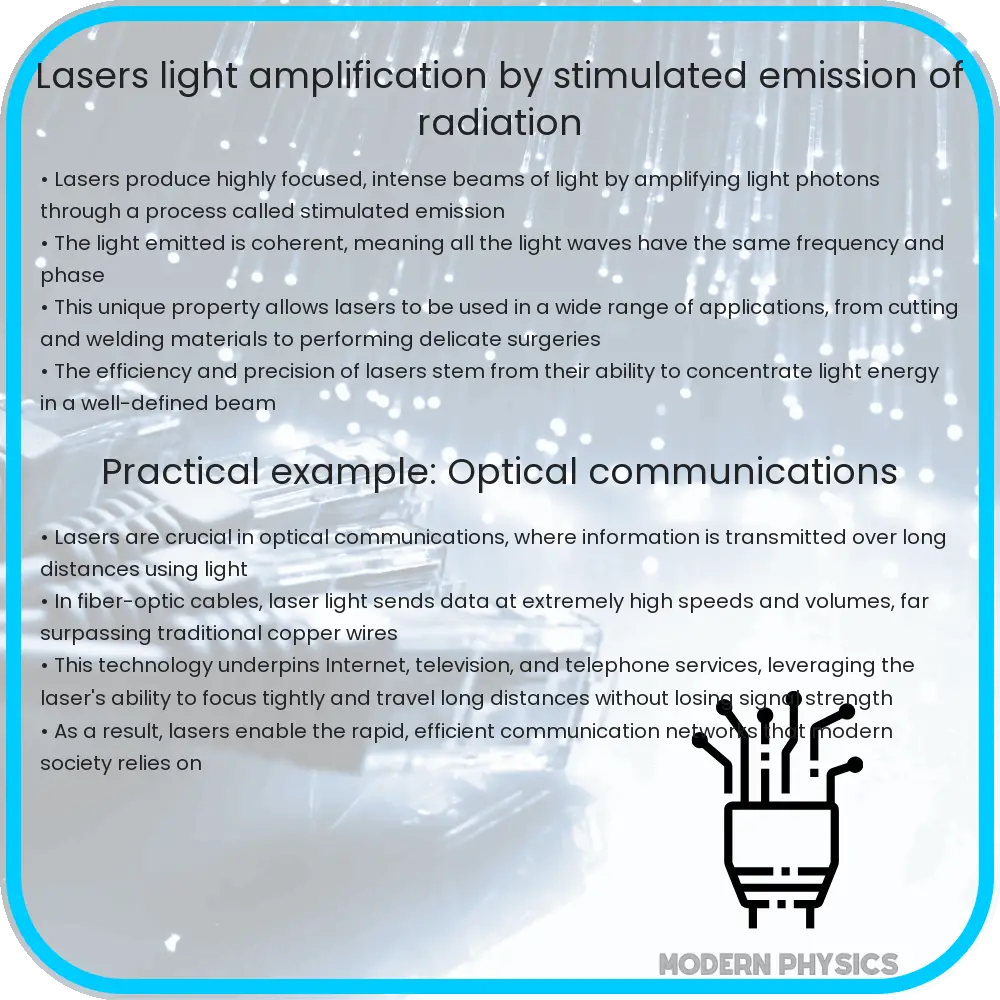
Lasers, an acronym for Light Amplification by Stimulated Emission of Radiation, produce highly directional, coherent, and monochromatic light. This unique combination of properties is what makes lasers so effective in precision tasks. They operate on the principle of stimulated emission, where an external source energizes atoms or molecules in a medium (like gas, liquid, or solid), leading to the emission of photons.
Precision and Measurement
One of the most significant contributions of lasers is in the field of precision measurement. Lasers provide an unparalleled level of accuracy in measuring distances, alignments, and positioning. For instance, in industries such as construction or manufacturing, laser-guided tools ensure millimeter-level precision. Moreover, in scientific research, lasers are crucial in experiments requiring exact measurements, such as in the detection of gravitational waves where minute changes in distance are critical.
Quantum Control and Manipulation
In the quantum world, lasers are instrumental in manipulating and controlling quantum states. Quantum control involves the use of lasers to steer the dynamics of quantum systems, like atoms, molecules, or photons, in a desired way. This is fundamental in quantum computing, where lasers are used to manipulate qubits, the basic unit of quantum information.
Lasers enable the precise control of qubit states through techniques such as optical pumping or laser cooling. Optical pumping uses laser light to transfer populations of atoms or molecules from one energy state to another, a critical process in creating controlled quantum states. Laser cooling, on the other hand, is a method to reduce the thermal motion of atoms or ions, allowing for more precise control and measurement at the quantum level.
The development of ultrafast lasers has further enhanced quantum control. These lasers can produce pulses of light that last only a few femtoseconds (1 femtosecond is 10-15 seconds), allowing scientists to observe and manipulate quantum phenomena that occur at extremely fast timescales.
Innovations in laser technology continue to push the boundaries of precision and quantum control, opening up new avenues for research and practical applications in various fields.
Innovative Applications of Laser Technology
Laser technology is not just confined to laboratories; it has found its way into various practical applications. In the medical field, lasers are employed for precise surgical procedures, offering minimally invasive alternatives to traditional surgery. In telecommunications, optical fibers use laser light for the transmission of data over long distances with minimal loss. Environmental monitoring also benefits from lasers, as they can detect trace gases and pollutants with high accuracy.
Challenges and Future Directions
Despite their numerous applications, challenges remain in the field of laser technology. One of the primary concerns is the energy efficiency of lasers, especially in high-power applications. Research is ongoing to develop lasers that consume less power without compromising their performance. Another challenge lies in miniaturizing laser technology for portable and wearable devices, expanding their potential uses in everyday life.
Future directions in laser technology are incredibly promising. Quantum communication and computing are areas where lasers are expected to play a critical role, potentially leading to breakthroughs in secure communication and problem-solving capabilities beyond classical computing. In addition, the integration of laser technology with artificial intelligence and machine learning could open up new frontiers in both data processing and material science.
Conclusion
Laser technology, known for its precision and ability to control quantum states, has become a cornerstone in the advancement of numerous scientific and industrial fields. From enabling groundbreaking research in quantum mechanics to enhancing precision in manufacturing and medical procedures, lasers have proven to be versatile and indispensable tools. The ongoing innovations and research in laser technology promise to further expand its applications and efficiency, heralding new possibilities in science and everyday technology. As we look to the future, the potential of laser technology continues to grow, promising to shape the next generation of scientific discovery and technological innovation.