
Explore the fundamentals, applications, and latest advancements in laser technology, from medical uses to cutting-edge research in quantum mechanics.
Laser Theory: The Underlying Principles
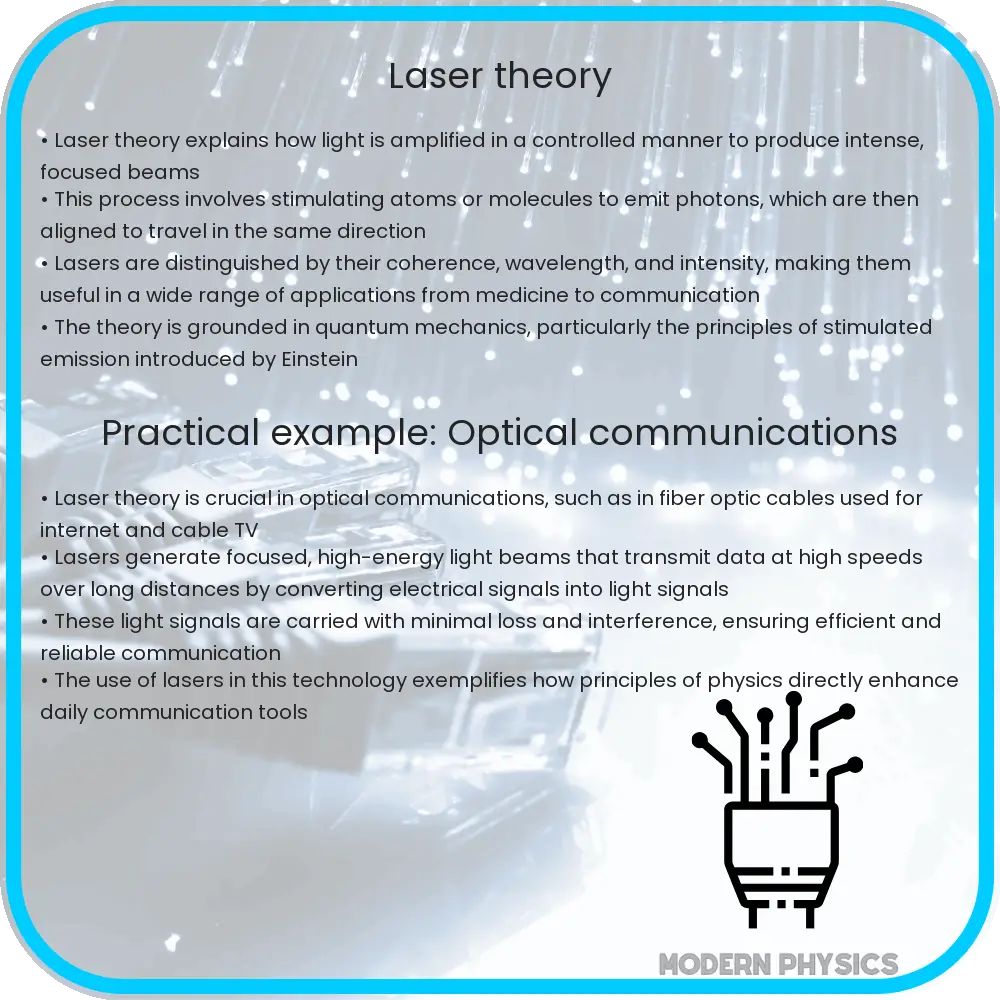
Laser, an acronym for Light Amplification by Stimulated Emission of Radiation, operates on the fundamental principle of quantum mechanics. The core mechanism involves energizing electrons in a medium (such as gas, liquid, or solid) to a higher energy level. When these electrons return to their original state, they emit photons, creating coherent light.
Key Components of a Laser
Every laser consists of three primary components: an energy source (also known as the pump), a gain medium, and an optical cavity. The energy source injects energy into the gain medium to promote electrons to higher energy levels. The gain medium, the material within which light amplification occurs, can vary widely—from gases like CO2 to solids like ruby or neodymium-doped yttrium aluminum garnet (Nd:YAG). The optical cavity, a pair of mirrors at each end of the gain medium, reflects photons back and forth, amplifying the light with each pass through the gain medium.
Stimulated Emission: The Core Process
At the heart of laser operation is the process of stimulated emission, first proposed by Albert Einstein in 1917. This process differentiates lasers from other light sources by producing light that is coherent, monochromatic, and highly directional. When an atom’s electron, excited to a higher energy state, encounters a photon of a specific energy, it is stimulated to drop to a lower energy level, emitting a second photon identical in phase, frequency, direction, and polarization.
Applications of Laser Technology
- Communications: Lasers are crucial in optical fiber communications, enabling high-speed internet connections.
- Medicine: In the medical field, lasers are used for surgeries, eye treatment (LASIK), and skin treatments.
- Manufacturing: Lasers are employed for cutting, welding, and material processing, offering precision unachievable by traditional methods.
- Research: Scientists use lasers to study the fundamental properties of matter, in fields such as quantum computing and holography.
This exploration of laser theory and its components sets the stage for understanding the vast applications and ongoing advancements in laser technology.
Advancements in Laser Technology
Recent years have witnessed remarkable advancements in laser technology, pushing the boundaries of science, manufacturing, and medicine. Innovations such as quantum cascade lasers have expanded the capabilities of lasers into the mid- and far-infrared regions of the electromagnetic spectrum. This has opened new avenues in spectroscopy, allowing for the precise detection of various gases and chemicals. Furthermore, the development of ultrafast laser pulses, with durations measured in femtoseconds (10-15 seconds), has revolutionized the study of rapid physical and chemical processes at the atomic and molecular levels.
Challenges and Future Directions
Despite the significant progress, there remain challenges that scientists and engineers are working to overcome. The quest for more efficient, powerful, and compact laser systems continues, with research focused on discovering new gain materials and optimizing laser designs. One promising area is the development of solid-state lasers that leverage rare-earth-doped materials, offering greater efficiency and power scaling capabilities. Additionally, the integration of laser technology with emerging fields such as nanotechnology and biotechnology presents a frontier ripe with potential, promising innovative applications ranging from nano-scale fabrication to targeted cancer therapies.
Environmental and Safety Considerations
As laser applications proliferate, considerations of environmental impact and safety become increasingly important. The development of energy-efficient lasers and the minimization of hazardous materials in laser construction are key areas of focus. Moreover, strict safety protocols and standards are essential to protect users from potential hazards, such as eye damage and skin burns, associated with laser use.
Conclusion
Laser technology, grounded in the principles of quantum mechanics and stimulated emission, has evolved from a theoretical concept to a cornerstone of modern science and technology. Its applications, ranging from telecommunications to medical treatments, underscore its versatility and transformative potential. The ongoing advancements in laser technology, driven by relentless innovation and interdisciplinary research, promise to unlock new possibilities and address some of the most pressing challenges facing society today. As we continue to explore the frontiers of laser applications and technology, the future of lasers is not only bright but also holds the promise of illuminating uncharted territories in science and engineering.