
Explore the precision of Laser-Induced Fluorescence (LIF) in analysis and optics, its challenges, advancements, and future applications.
Introduction to Laser-Induced Fluorescence (LIF)
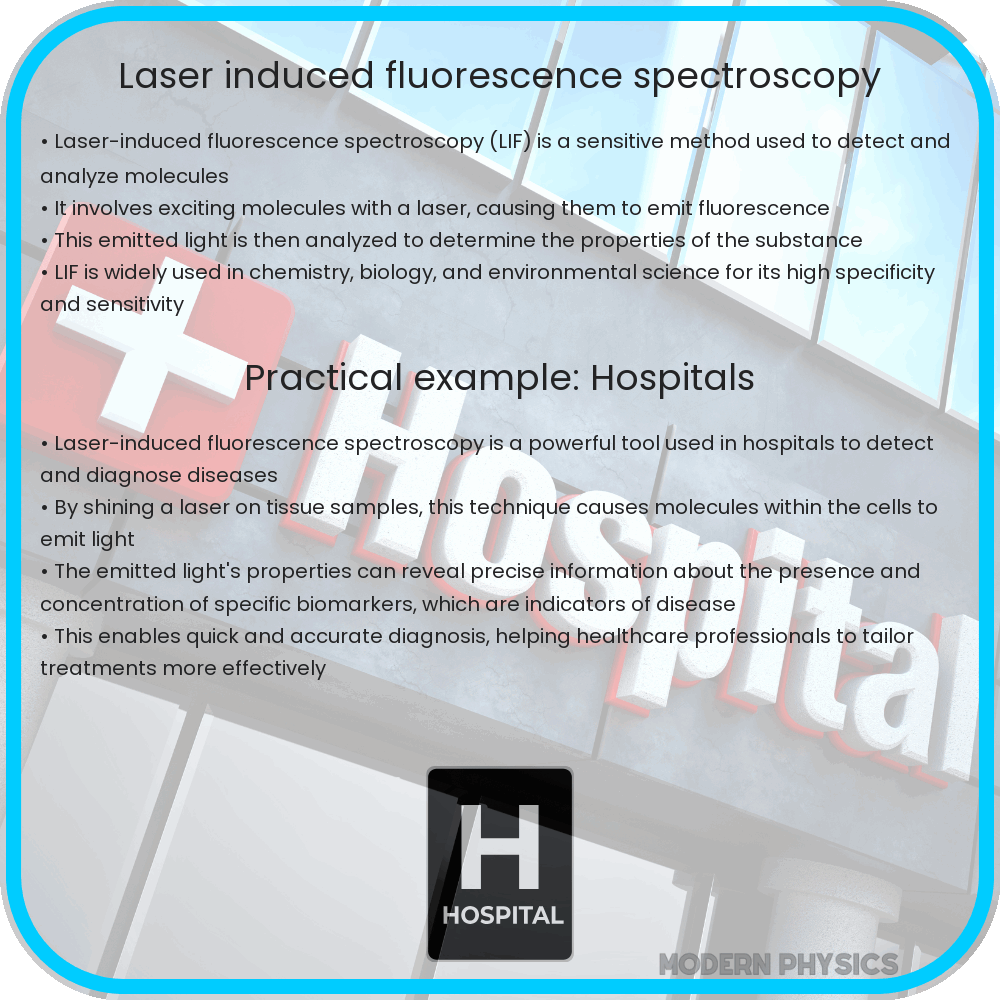
Laser-Induced Fluorescence (LIF) is a sophisticated analytical technique widely used in various scientific fields, including chemistry, biology, and physics. This method involves the use of laser light to excite molecules in a sample, leading to the emission of fluorescence. This fluorescence is then analyzed to provide detailed information about the molecular composition, structure, and dynamics of the sample. LIF is renowned for its high sensitivity and specificity, making it an invaluable tool in precision measurements and analysis.
Principles of LIF
At the core of LIF is the interaction between laser light and molecules. When a molecule absorbs light, it transitions to an excited electronic state. The transition typically occurs with specific wavelengths, making LIF an excellent tool for studying molecular properties. After excitation, the molecule returns to its ground state, emitting a photon with a characteristic wavelength. This emitted light, or fluorescence, is then detected and analyzed. The wavelength and intensity of the fluorescence provide insights into the molecular structure and environment.
Applications in Chemical Analysis
LIF is extensively used in chemical analysis due to its high sensitivity and ability to detect minute quantities of substances. It’s particularly useful in the identification of specific compounds within a complex mixture. The technique can detect substances at concentrations as low as parts per trillion (ppt), making it ideal for environmental monitoring, forensic analysis, and pharmaceutical research.
Optics in LIF
The optical components of a LIF system play a crucial role in its performance. The laser source must provide a stable and precise wavelength of light, typically in the ultraviolet or visible spectrum. The fluorescence emitted by the sample is collected and focused onto a detector using various optical elements, including lenses and mirrors. Advanced optical systems can further enhance the sensitivity and resolution of LIF, allowing for more detailed and accurate analysis.
Advancements in LIF Technology
Recent advancements in laser technology and optics have significantly improved LIF’s capabilities. The development of new laser sources with greater power and tunability has expanded the range of applications for LIF. Additionally, improvements in detector technology have enhanced the sensitivity and accuracy of fluorescence measurements.
Enhancing Precision in LIF
The precision of LIF is continually being enhanced through technological advancements. For instance, the integration of digital signal processing and sophisticated algorithms allows for more accurate interpretation of fluorescence data. This leads to better discrimination of closely related chemical species and finer analysis of complex samples. Furthermore, the use of pulsed lasers enables time-resolved measurements, allowing scientists to study dynamic processes at the molecular level.
Challenges and Solutions
Despite its advantages, LIF faces challenges such as photobleaching and interference from background fluorescence. Photobleaching occurs when a fluorescent molecule loses its ability to fluoresce due to prolonged exposure to the laser light. This challenge is addressed by optimizing laser power and exposure duration. Background interference, often caused by impurities or other fluorescent species, can be mitigated using spectral filtering techniques and advanced data processing.
Future Perspectives in LIF
The future of LIF is promising, with potential applications expanding into new areas like single-molecule detection and in vivo biological imaging. Advances in laser technology and optics are expected to further boost the sensitivity and resolution of LIF, opening doors to previously unexplored applications. Integration with other analytical techniques, such as mass spectrometry, could lead to even more powerful and comprehensive analysis tools.
Conclusion
Laser-Induced Fluorescence stands as a pillar of modern analytical techniques, valued for its precision, sensitivity, and versatility. The continuous evolution of laser and optical technologies enhances its capabilities, making it an indispensable tool in scientific research and industry. Despite facing challenges like photobleaching and background interference, ongoing innovations in LIF promise to overcome these hurdles and expand its applications. The future of LIF is bright, with its potential only limited by the imagination and ingenuity of scientists and engineers who continue to push the boundaries of this fascinating field.