
Explore the transformative impact of laser cooling on precision and efficiency in modern optics, unlocking new possibilities in science and technology.
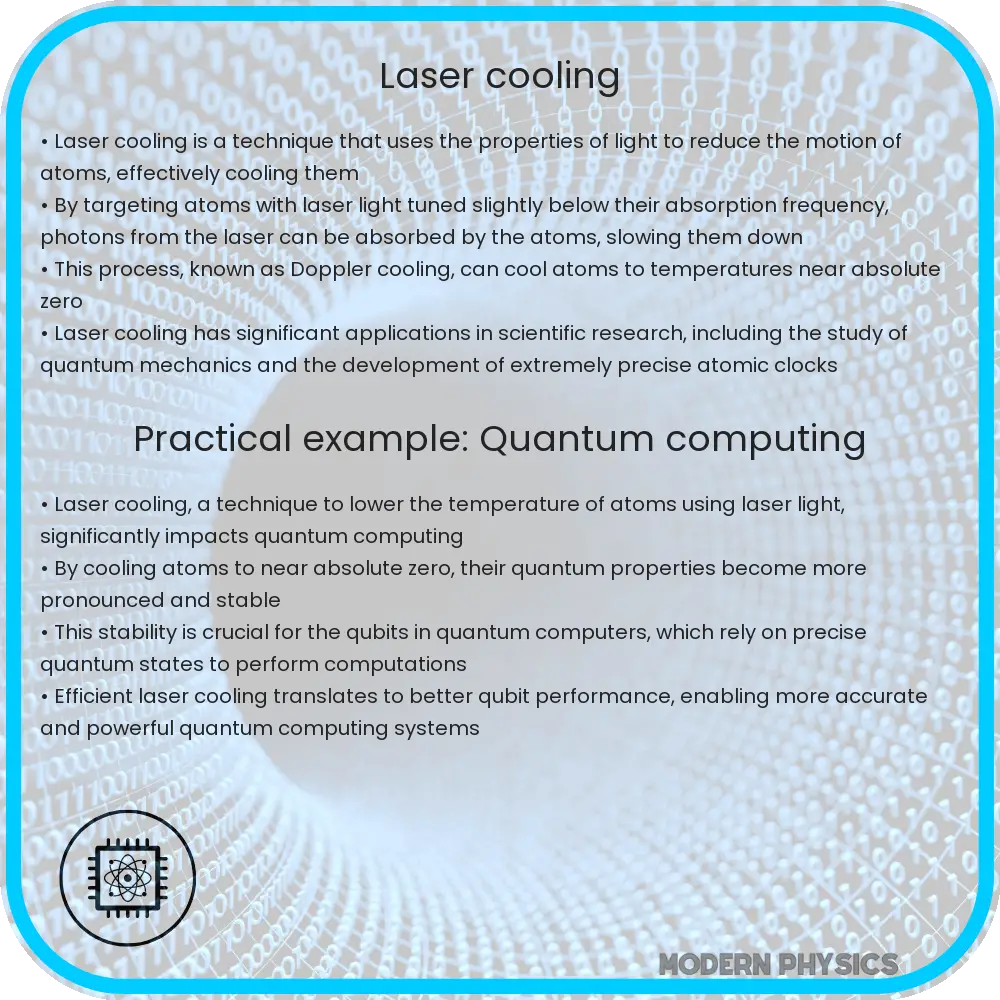
Laser Cooling: Revolutionizing Precision in Modern Optics
Laser cooling represents a significant breakthrough in the field of atomic physics, offering a method to dramatically reduce the kinetic energy of particles, thereby cooling them to temperatures near absolute zero. This advanced technique has not only expanded our understanding of quantum mechanics but also paved the way for precise and efficient applications in various scientific and technological fields.
Understanding the Basics
At its core, laser cooling involves the use of laser light to slow down atoms, reducing their motion and consequently decreasing their temperature. The fundamental principle relies on the Doppler effect, where the frequency of light changes for an observer moving relative to the source of the light. By carefully tuning the frequency of the lasers slightly below the natural absorption frequency of the atoms, only those atoms moving towards the laser light (and thus experiencing a Doppler shift to higher frequencies) can absorb the photons. Upon absorbing these photons, the atoms experience a force in the opposite direction of their motion, effectively slowing them down.
Techniques and Applications
Several methods have been developed to implement laser cooling, including magneto-optical trapping (MOT), Doppler cooling, and sub-Doppler cooling techniques. Each method has its unique advantages and is suited for different applications. For instance, MOT combines magnetic fields with laser cooling to trap and cool atoms in a specific region of space, making it invaluable for experiments requiring high precision and stability.
Laser cooling has found applications in a myriad of areas, from atomic clocks, which benefit from the increased precision of atomic measurements at lower temperatures, to quantum computing, where it is used to prepare qubits in a well-defined state. Additionally, it has significant implications for the development of more accurate and efficient optical lattice clocks, Bose-Einstein condensates, and even in the study of ultracold molecules, which can shed light on chemical reactions at the quantum level.
This groundbreaking technology not only demonstrates the power of light in manipulating the fundamental constituents of matter but also heralds a new era in the precision and efficiency of modern optics and beyond.
Challenges and Future Directions
Despite its impressive capabilities, laser cooling is not without its challenges. One of the primary obstacles is the limited set of atoms that can be directly cooled using this method, primarily due to the specific electronic transitions required for effective cooling. However, researchers are continually developing innovative techniques, such as sympathetic cooling, where a mixture of gases allows indirectly cooled atoms to transfer their kinetic energy to directly cooled atoms, expanding the range of particles that can be manipulated.
Another challenge lies in the cooling limit, known as the Doppler limit, which is determined by the balance between cooling and heating processes within the system. Advanced methods like Sisyphus cooling and evaporative cooling have been developed to overcome this limit, allowing particles to reach even lower temperatures and enabling new states of matter, such as Bose-Einstein condensates, to be explored and utilized.
The Impact of Laser Cooling on Research and Industry
The implications of laser cooling extend far beyond the laboratory. In telecommunications, the enhanced precision in optical clocks translates to better synchronization in global communication networks. In the field of metrology, laser-cooled atomic standards are setting new benchmarks for measurement accuracy, impacting everything from GPS technology to electrical standards.
Moreover, the exploration of quantum phenomena facilitated by laser cooling is leading to the development of new materials with tailored properties, potentially revolutionizing sectors such as energy, computing, and materials science. The ability to control atomic and molecular processes with unprecedented precision opens up new avenues for research in chemistry, biology, and medicine, promising innovative solutions to some of the most pressing challenges in these fields.
Conclusion
Laser cooling stands as a testament to the ingenuity and persistence of scientists in pushing the boundaries of what is possible with light and matter. By mastering the ability to cool particles to near absolute zero, researchers have unlocked new realms of physics, enabling the exploration of quantum mechanics in ways that were once thought impossible. The advancements in precision, efficiency, and control offered by laser cooling have far-reaching implications, impacting a wide range of scientific disciplines and industries. As we continue to explore and refine these techniques, the future of laser cooling promises not only to deepen our understanding of the quantum world but also to drive innovation across the technological landscape, heralding a new era of scientific discovery and technological advancement.