
Explore the world of Langmuir-Blodgett films: their structure, applications in sensors and optoelectronics, analysis techniques, and future prospects.
Introduction to Langmuir-Blodgett Films
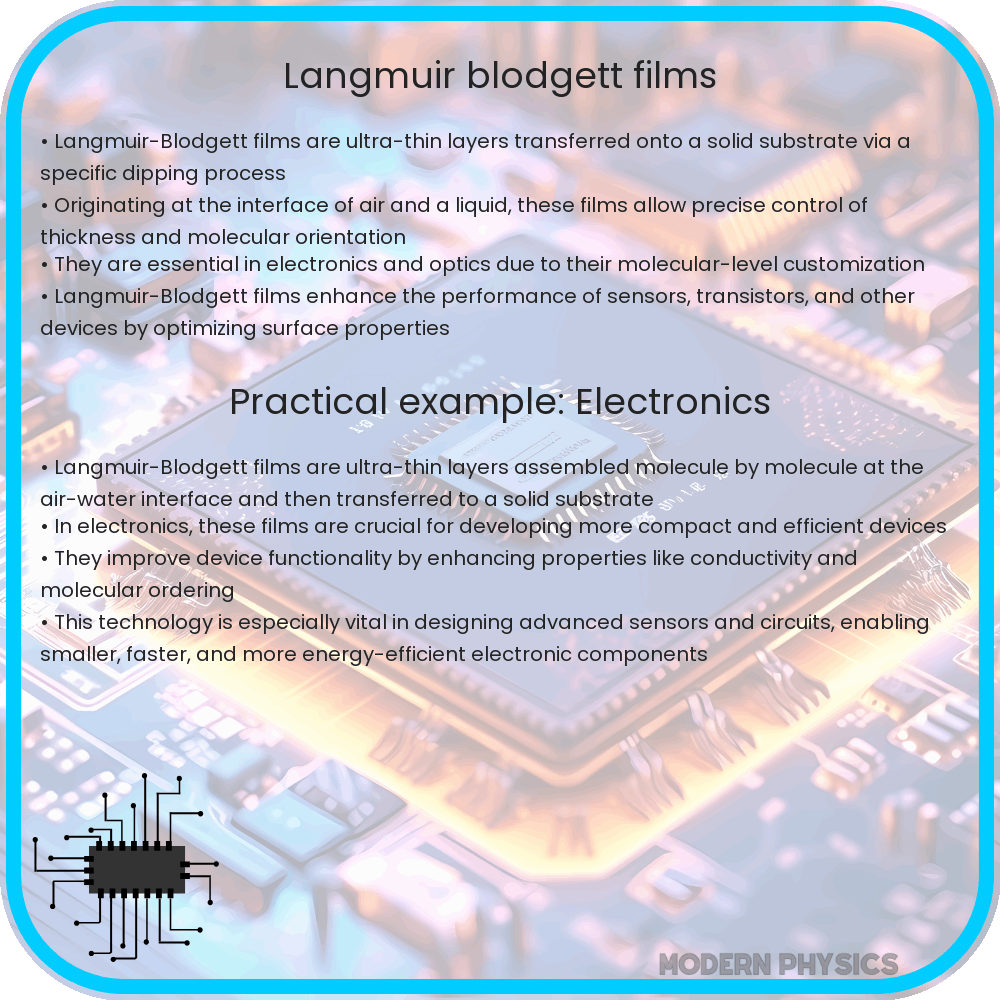
Langmuir-Blodgett (LB) films represent a unique class of structured thin films, crafted through a layer-by-layer deposition process. This technique allows for the precise control of film thickness and molecular organization, offering significant advantages for a variety of scientific and industrial applications.
Structure and Formation
The fundamental structure of LB films is based on amphiphilic molecules, which contain both hydrophilic (water-attracting) and hydrophobic (water-repelling) components. These molecules are spread on the water surface in a Langmuir trough, creating a monolayer. By controlling the surface pressure, the molecules are compressed to form a densely packed layer. Subsequently, this monolayer can be transferred onto a solid substrate, stacking layer upon layer to form a multilayered LB film.
Applications of Langmuir-Blodgett Films
- Sensors: LB films are widely used in the development of sensors for detecting environmental pollutants, gases, and ions due to their high sensitivity and selectivity.
- Optoelectronics: In the realm of optoelectronics, these films are integral for creating components in devices such as organic light-emitting diodes (OLEDs) and photovoltaic cells, where controlled film thickness is crucial.
- Biomolecular Engineering: The ability of LB films to incorporate biological molecules makes them suitable for biosensors and drug delivery systems.
Analysis Techniques for LB Films
To understand and optimize the properties of LB films, several analytical techniques are employed:
- Surface Pressure-Area Isotherms: This technique measures the pressure-area relationship of the monolayer on the water surface, providing insights into the molecular packing and phase transitions.
- Ellipsometry: Ellipsometry is used to determine the thickness and refractive index of the films, which are critical for their application in optical devices.
- Atomic Force Microscopy (AFM): AFM provides topographical images of the film surface at the nanometer scale, revealing the organization and defects within the film.
Challenges and Innovations in LB Films
Despite their advantages, LB films face challenges such as environmental stability and large-scale production. However, ongoing research focuses on improving the robustness and scalability of these films through advanced materials and deposition techniques. Innovations include incorporating nanoparticles and conducting polymers to enhance the electrical and optical properties of LB films.
Environmental Impact and Sustainability
Environmental considerations are increasingly becoming a priority in the development of LB films. Researchers are exploring eco-friendly materials and processes to minimize the ecological footprint of these films. Biodegradable and non-toxic materials are being integrated into LB film production to foster sustainable practices in the industry.
Future Prospects
The future of LB films is promising, with potential breakthroughs in nanotechnology, medicine, and environmental science. As researchers continue to unlock the full potential of these films, we can anticipate novel applications ranging from advanced medical diagnostics to energy-efficient devices and beyond.
Conclusion
Langmuir-Blodgett films stand out as a pivotal innovation in material science, offering unparalleled precision in molecular assembly. Their unique structure and customizable properties enable wide-ranging applications, from sensors to optoelectronics and beyond. Despite facing challenges like environmental stability and production scalability, ongoing advancements are paving the way for more durable, efficient, and eco-friendly solutions. As we delve deeper into the capabilities of LB films, their integration into new technologies continues to expand, heralding a new era of scientific exploration and technological development.