
Explore the fascinating world of Lagrangian Points in space: their dynamics, stability, and pivotal role in advancing space exploration and research.
Lagrangian Points: Gateways in Space
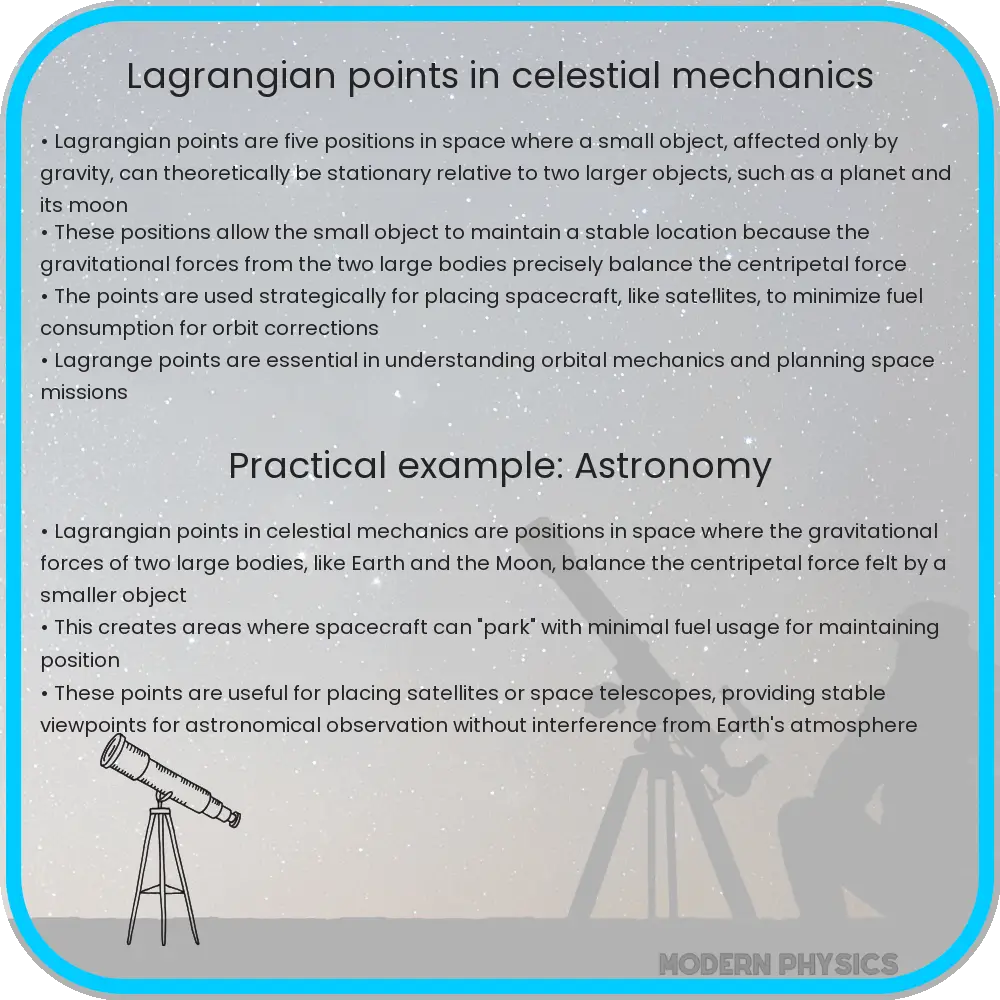
Lagrangian Points, named after Italian-French mathematician Joseph-Louis Lagrange, are unique positions in a two-body system, like the Earth and the Moon, where the gravitational forces and the orbital motion of the bodies balance each other. Understanding these points is essential for space exploration and satellite deployment.
Understanding the Five Points
There are five Lagrangian Points, labeled L1 to L5. L1, L2, and L3 lie along the line connecting the two large bodies. L1 is between them, L2 is on the far side of the secondary body, and L3 is on the far side of the primary body. L4 and L5 form an equilateral triangle with the two bodies and lead or trail in the orbit by 60 degrees.
Stability and Orbital Dynamics
Lagrangian Points L4 and L5 are stable due to a phenomenon called the Kozai mechanism, which allows objects at these points to maintain their position relative to the two larger bodies. Conversely, L1, L2, and L3 are unstable, requiring constant adjustments to keep a spacecraft in place. This instability arises from the complex interplay of gravitational forces and the orbital motion of the bodies involved.
Uses in Space Exploration
Lagrangian Points have become pivotal in space exploration. For instance, the James Webb Space Telescope is positioned at L2, providing an unobstructed view of the cosmos. L1 is ideal for solar observation satellites like the Solar and Heliospheric Observatory (SOHO), as it allows continuous observation of the Sun. Moreover, L4 and L5 points are considered potential sites for space colonies due to their stability.
Orbital Dynamics and Long-term Stability
The intricacies of orbital mechanics around Lagrangian Points are a subject of ongoing research. The long-term stability of objects at these points, especially L4 and L5, is influenced by various factors, including the mass ratio of the two primary bodies and perturbations from other celestial bodies. Understanding these dynamics is crucial for future missions planning to utilize these unique regions in space.
Overall, Lagrangian Points offer intriguing possibilities for space exploration and understanding cosmic dynamics, making them a topic of great interest in astrophysics and aerospace engineering.
Advanced Applications and Future Prospects
The potential applications of Lagrangian Points extend beyond current uses. These points could serve as staging areas for deep space missions, providing a gravitational ‘sweet spot’ for spacecraft assembly or refueling before venturing further into the solar system. Additionally, they present opportunities for astronomical observatories, offering stable platforms far from Earth’s interference to study the universe in unprecedented detail.
Challenges in Utilizing Lagrangian Points
Despite their advantages, exploiting Lagrangian Points comes with challenges. The unstable nature of L1, L2, and L3 requires advanced propulsion and navigation systems for precise station-keeping. Moreover, the remoteness of these points poses logistical difficulties in terms of communication and servicing missions, especially for human-crewed outposts envisioned at L4 and L5.
Environmental Considerations
As interest in Lagrangian Points grows, so do concerns about space debris accumulation, especially around the more accessible L1 and L2 points. Ensuring sustainable use of these areas is crucial, requiring international cooperation and adherence to space debris mitigation guidelines.
The Role of Lagrangian Points in Understanding Cosmic Mysteries
Lagrangian Points also play a role in enhancing our understanding of cosmic phenomena. For example, missions like the Lagrange mission are planned to monitor and study the Sun-Earth interaction, providing critical data on solar winds and their impact on Earth’s magnetosphere. Such studies are vital for predicting space weather events that can affect satellite communications and power grids on Earth.
Conclusion
In summary, Lagrangian Points represent not just a marvel of celestial mechanics but also a gateway to advanced space exploration and research. Their unique position allows for innovative applications, from deep space gateways to unparalleled observatories, offering a glimpse into the future of human endeavors in space. However, realizing their full potential requires overcoming technical challenges and ensuring their sustainable use. As we continue to explore and utilize these special points in space, they stand as a testament to human ingenuity and our endless quest to understand and explore the universe.