
Understanding Klystrons: Specialized vacuum tubes that amplify high-frequency radio waves, crucial in radar, satellite communications, and particle accelerators.
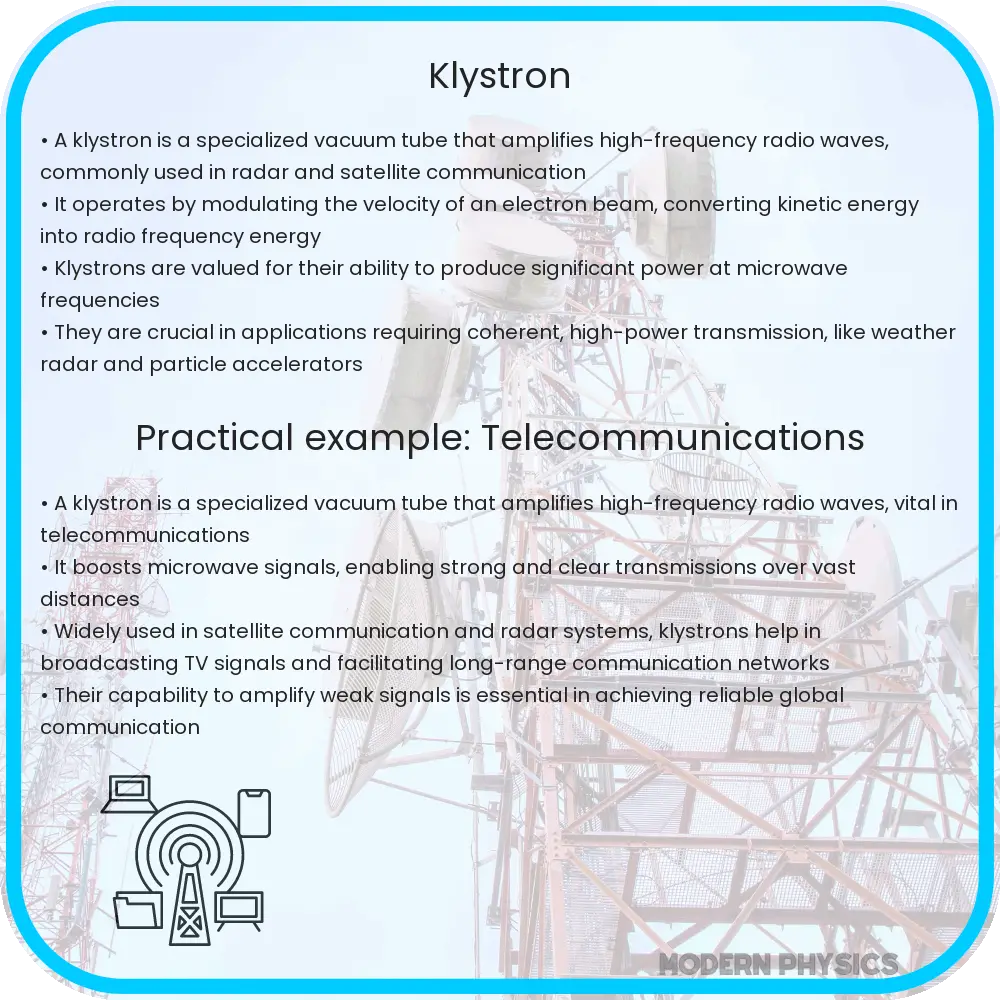
Understanding Klystrons: Pioneers in Microwave Amplification
Klystrons are specialized vacuum tubes that amplify high-frequency radio waves, primarily microwaves. Since its invention in the 1930s by the Varian brothers, Russell and Sigurd, the klystron has played an essential role in various applications, including radar technology, satellite communication, and particle accelerators. Its ability to generate and amplify microwave signals at high power levels makes it invaluable in both scientific research and practical engineering solutions.
The Basic Principles of Klystron Operation
A klystron operates through the interaction between an electron beam and radio waves. The device consists of several key components: a cathode and anode that produce and accelerate an electron beam, one or more resonant cavities that modulate the speed of the electrons, and an output cavity where the amplified signal is extracted. The process involves several stages:
- Electron Emission: The cathode heats up, emitting electrons, which are then accelerated towards the anode, forming a high-velocity electron beam.
- Velocity Modulation: As the beam passes through the first cavity (called the “buncher”), it interacts with a small input signal. The electric field within the cavity accelerates or decelerates electrons depending on their phase relative to the microwave signal, creating bunches of electrons.
- Energy Transfer: These bunched electrons then travel through a drift tube to the next cavity (the “catcher”). The bunched structure of the beam causes it to emit microwave radiation more intensely than the unbunched beam. In the catcher cavity, the energy from the electron bunches is transferred to the microwave field, amplifying the signal.
This process can be understood in terms of the conservation of energy; the kinetic energy lost by the electron beam is converted into microwave energy, enhancing the intensity of the electromagnetic wave.
Applications of Klystrons
Klystrons have a wide range of applications, owing to their ability to produce powerful, high-quality microwave signals. Some of the key applications include:
- Radar Systems: Klystrons are used in radar transmitters to generate high-power pulses that can travel long distances and provide detailed information about the position and movement of objects.
- Communication: In satellite communication, klystrons amplify the signals transmitted and received from earth stations, ensuring clear communication over thousands of kilometers.
- Particle Accelerators: High-energy physics research relies on particle accelerators, where klystrons are used to generate the electromagnetic fields necessary to accelerate subatomic particles to high speeds.
The versatility of klystrons in handling high power outputs while maintaining signal integrity makes them indispensable in these fields.
Design Considerations for Klystron Development
Designing a klystron requires careful consideration of several factors to achieve optimal performance. Key design aspects include:
- Efficiency: Maximizing the energy transfer from the electron beam to the microwave signal is crucial for efficient klystron operation. This involves optimizing the shape and size of the cavities and the electron beam.
- Frequency Stability: The resonant cavities must be precisely engineered to maintain a stable frequency, as small deviations can significantly affect performance in sensitive applications.
- Power Capacity: Depending on the application, klystrons need to handle varying levels of power. High-power applications require robust materials that can withstand intense electromagnetic fields without degrading.
The design and performance of klystrons continue to evolve with advancements in material science and electromagnetic theory, pushing the boundaries of what is possible in high-frequency microwave amplification.
Future Trends in Klystron Technology
As technology advances, the future of klystrons looks promising with several developments on the horizon. Innovations in material science and manufacturing techniques are expected to lead to more efficient, durable, and compact klystrons. Some potential advancements include:
- Miniaturization: Efforts are being made to scale down the size of klystrons to enable their integration into portable devices and expand their applications in mobile communications and other areas.
- Increased Efficiency: Research into better cathode materials and more precise fabrication techniques promises to enhance the overall efficiency of klystrons, reducing power consumption and heat generation.
- Broadband Capabilities: Developing klystrons that can operate over a broader range of frequencies could revolutionize their use in multi-band communication systems and radar applications.
These innovations not only aim to improve the performance of klystrons but also to ensure they meet the growing demands of modern technology in areas like 5G telecommunications, autonomous vehicles, and beyond.
Conclusion
Klystrons have been fundamental in advancing a wide array of technologies since their inception in the early 20th century. From enhancing long-distance communication signals to facilitating cutting-edge scientific research in particle physics, the role of klystrons cannot be overstated. Understanding the mechanics of klystron operation, from electron emission to signal amplification, provides insight into the complex interplay of physics and engineering that drives innovation. As we move into an increasingly high-tech future, the evolution of klystron technology continues to be integral in shaping the capabilities of various high-frequency and high-power applications. With ongoing research and development, klystrons will remain pivotal in the progression of scientific and communication frontiers, illustrating the dynamic and transformative nature of this remarkable technology.