
Kilo-voltage Cone Beam Computed Tomography (kV-CBCT) is an advanced medical imaging technology that produces high-resolution 3D images for precise diagnosis and treatment planning.
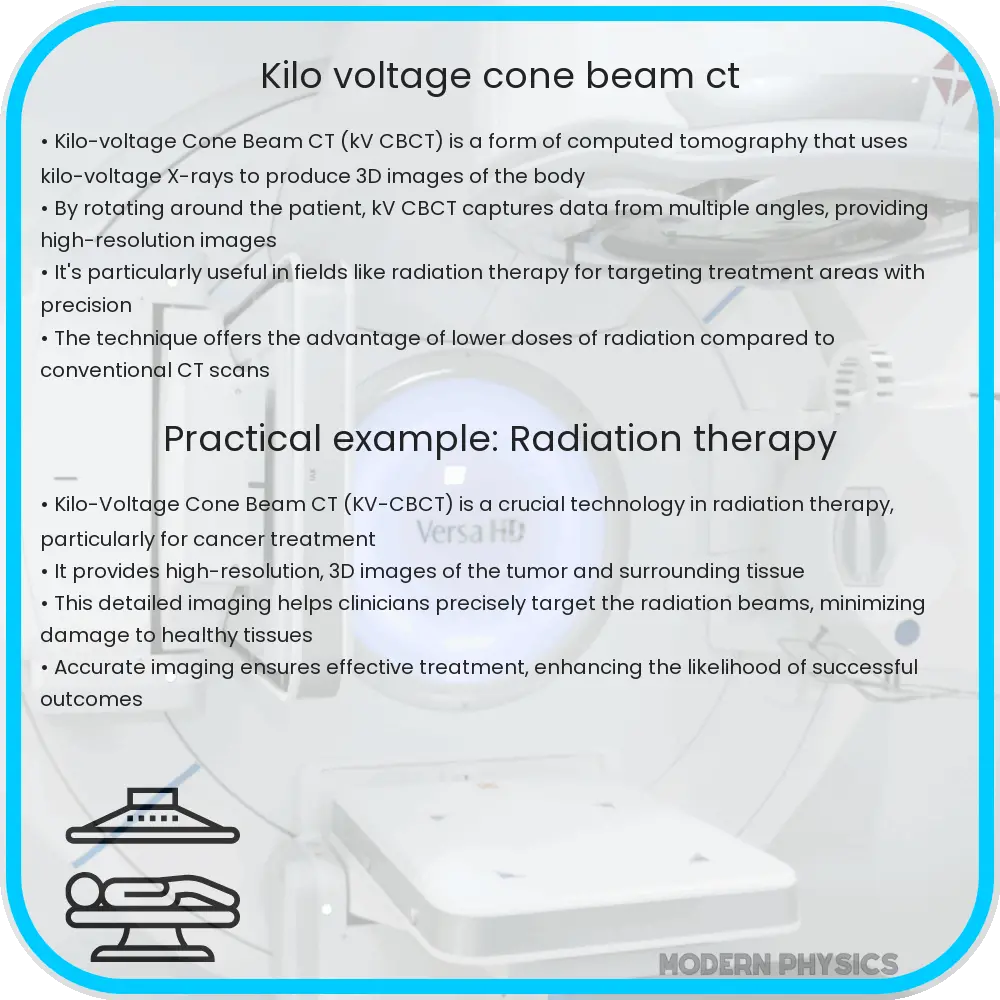
Kilo-Voltage Cone Beam CT: Precision, Safety, and Imaging Clarity
Kilo-voltage Cone Beam Computed Tomography (kV-CBCT) represents a technological leap in medical imaging, offering enhanced precision and clarity that aids significantly in the diagnosis and treatment of various conditions. This system is particularly influential in fields such as radiology, oncology, and orthopedics, where detailed imagery is paramount for effective treatment planning and outcome evaluation.
Understanding Kilo-Voltage Cone Beam CT
Cone Beam Computed Tomography (CBCT) utilizes a cone-shaped X-ray beam that rotates around the patient, capturing data from different angles. This data is then reconstructed to produce a three-dimensional image of the patient’s internal structures. The “kilo-voltage” in kV-CBCT refers to the energy level of the X-ray beam, generally around 60 to 120 kV. This level of energy is ideal for penetrating through soft tissue and bone, achieving high-resolution images that are critical for accurate diagnosis and treatment planning.
Advantages of kV-CBCT
- Enhanced Image Quality: One of the standout features of kV-CBCT is its ability to provide high-resolution images with outstanding clarity. This imaging quality is crucial for the accurate detection, diagnosis, and treatment of diseases.
- Precision in Treatment Planning: With its detailed and accurate 3D images, kV-CBCT allows healthcare providers to plan treatments with a higher degree of precision. This is particularly important in fields like oncology, where targeting cancerous tissues while sparing healthy ones is essential.
- Reduced Radiation Dose: Despite using kilo-voltage X-rays, advanced algorithms help optimize radiation exposure. This means that patients are subjected to lower doses of radiation compared to traditional CT scans, enhancing patient safety.
- Quick Scanning Times: The technology enables rapid acquisition of images, significantly improving the convenience for the patient and efficiency for the medical team. Quick scans are especially beneficial in emergency situations where time is of the essence.
The Role of Precision in Safety and Efficacy
The precision of kV-CBCT plays a pivotal role not only in diagnosing and planning but also in the actual treatment phase of various medical procedures. Precise images allow for better delineation of tumors in cancer treatment, leading to more effective radiation therapy with minimal impact on surrounding healthy tissues. Similarly, in surgeries, especially those involving complex structures or delicate areas, kV-CBCT imagery ensures that surgeons can navigate with more confidence and accuracy.
Moreover, the clarity of kV-CBCT imaging helps in identifying the earliest stages of disease, which is often crucial for successful treatment outcomes. Early detection made possible by detailed imagery can significantly alter the course of treatment, making less invasive options viable and increasing the likelihood of recovery.
Implementation in Clinical Settings
The integration of kV-CBCT in clinical practice has revolutionized patient care by facilitating rapid and precise assessments. This imaging technology is increasingly used in dynamic environments like operating rooms and cancer treatment centers. Practitioners rely on real-time imaging capabilities to make adjustments during procedures, enhancing outcomes and reducing the need for repeat interventions.
In orthopedics, for instance, kV-CBCT assists surgeons during complex joint surgeries or spinal repairs by providing clear images of bone structures. This level of detail supports precise implant placements and adjustments during surgeries, decreasing the risk of post-surgical complications.
Challenges and Future Directions
Despite its many benefits, the adoption of kV-CBCT does face challenges. The cost of these systems and the requisite training for staff represent significant hurdles for some healthcare facilities. Additionally, ongoing research is crucial to further reduce radiation doses without compromising image quality.
Future advancements in kV-CBCT technology are likely to focus on enhanced image processing algorithms, greater integration with other imaging modalities, and even more compact and versatile machines. These improvements aim to broaden the accessibility and utility of kV-CBCT, potentially transforming it into a staple diagnostic tool across more areas of medicine.
Conclusion
Kilo-voltage Cone Beam CT is a powerful imaging technology that has substantially enhanced the precision and safety of medical diagnostics and treatments. With its ability to produce high-quality, detailed 3D images rapidly, kV-CBCT has become indispensable in several medical fields. The technology not only aids in accurate disease detection and treatment planning but also reduces radiation exposure to patients, balancing efficacy with safety.
As kV-CBCT continues to evolve, its integration into a wider range of clinical applications seems inevitable. Its potential to improve surgical outcomes and cancer treatments exemplifies the critical role advanced imaging technologies play in modern medicine. Ensuring wide access to kV-CBCT could redefine standards in patient care and herald new advancements in medical science, ultimately benefiting populations worldwide.