
Explore the Kelvin Water Dropper: Learn about Lord Kelvin’s invention, its design, electrostatic principles, and educational value in physics.
Understanding the Kelvin Water Dropper: Principles and Applications
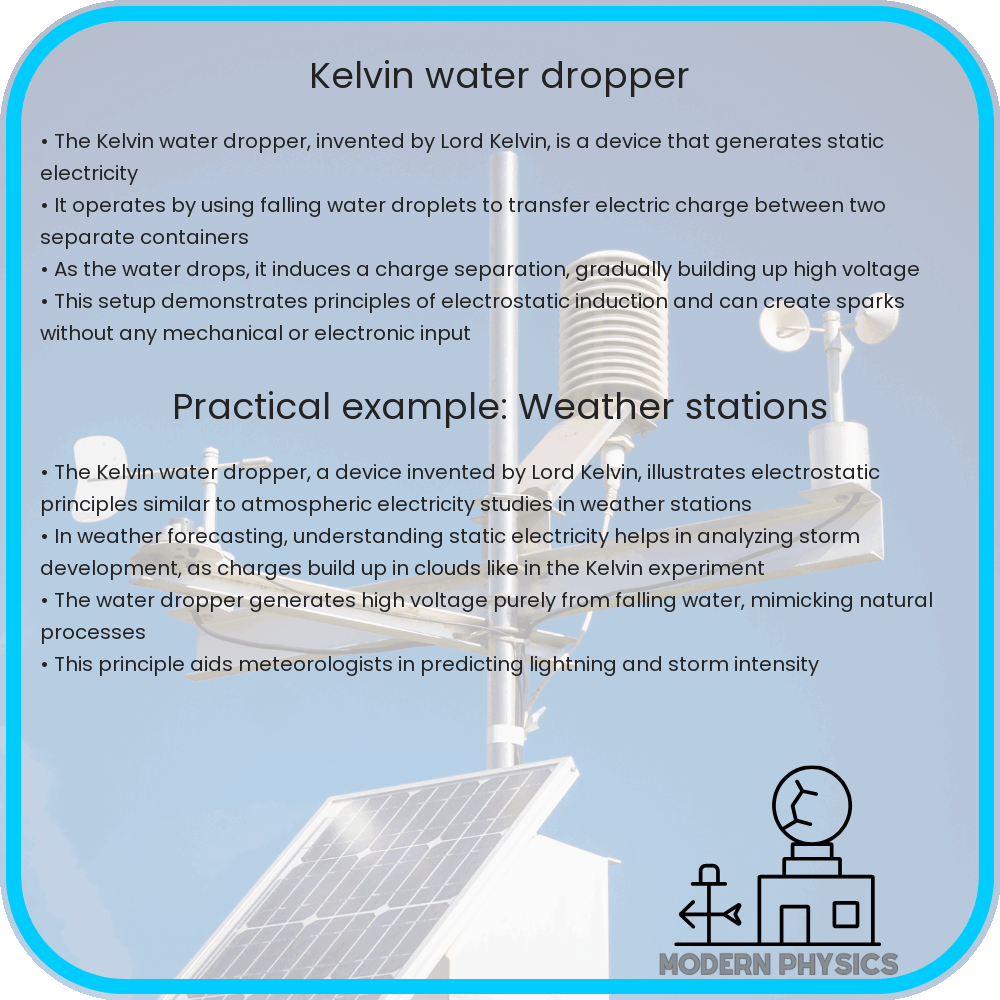
The Kelvin Water Dropper, also known as the Kelvin Hydroelectric Generator, is a fascinating experiment in the field of electrostatics. Invented by William Thomson, later known as Lord Kelvin, in the 19th century, it ingeniously demonstrates the conversion of gravitational potential energy into electrical energy. This simple yet profound device offers a window into the principles of electrostatic induction and charge separation.
Basic Design and Operation
At its core, the Kelvin Water Dropper consists of two containers placed at a height, filled with water. These containers have small holes at the bottom, allowing water to fall in thin streams. Below them, there are two metal cans, each aligned with one of the streams. The streams are intercepted by two metal rings connected to the opposite cans, creating a cross-connection. This setup forms a continuous loop where water acts as a conductor.
Electrostatic Induction and Charge Separation
The key to the Kelvin Water Dropper is the phenomenon of electrostatic induction. Initially, a slight imbalance in electrical charge—possibly from environmental factors or slight asymmetries in the setup—causes one of the metal cans to acquire a small positive or negative charge. As water droplets fall through the ring connected to this can, they carry away an opposite charge. When these charged droplets enter the can, they induce an opposite charge in the other can, reinforcing the initial imbalance. This process continues, with charges accumulating until the electrical potential difference is large enough to cause a spark between the cans.
Applications in Understanding Electrostatics
The Kelvin Water Dropper is more than a mere historical curiosity; it provides a tangible demonstration of several electrostatic principles. It illustrates the process of charge separation and induction, key concepts in understanding electrostatic phenomena. Additionally, it demonstrates the potential of gravitational energy to generate electrical charges, a principle that has implications in various fields of physics and engineering.
Experiment Setup and Safety Considerations
Setting up a Kelvin Water Dropper is relatively straightforward, requiring everyday materials like metal cans, water, and conductive wiring. However, safety is paramount, as the device can generate significant electrical charges. It’s essential to ensure proper insulation and to avoid handling the device when in operation, as the generated sparks can be dangerous.
In the following section, we will explore the historical context of the Kelvin Water Dropper, delve deeper into its scientific implications, and discuss its relevance in modern-day science education.
Historical Context of the Kelvin Water Dropper
William Thomson, known as Lord Kelvin, invented the Kelvin Water Dropper in the 1860s. His invention came at a time when the study of electricity was rapidly evolving. Kelvin, a prominent physicist and engineer, was deeply interested in thermodynamics and electromagnetism. His water dropper experiment played a crucial role in demonstrating the principles of electrostatics to a wider audience, making complex concepts more accessible and understandable.
Scientific Implications of the Experiment
The Kelvin Water Dropper is a prime example of how simple mechanisms can elucidate complex scientific principles. It demonstrates how a charge imbalance can be amplified to produce significant electrical forces. This concept is fundamental in various areas of physics, particularly in studying electrostatic phenomena and understanding the behavior of electric charges in different contexts. The experiment also serves as a rudimentary model for understanding how certain types of electrical generators work, using motion or other forms of energy to create an electrical charge.
Relevance in Modern Science Education
Today, the Kelvin Water Dropper continues to be a valuable educational tool. It is often used in classrooms to demonstrate the principles of electrostatics in a visually engaging and interactive manner. This experiment helps students grasp the concepts of charge induction and electrostatic generation, which are integral parts of the physics curriculum. Moreover, it encourages curiosity and experimental learning, allowing students to witness the principles of physics in action.
Conclusion
The Kelvin Water Dropper is a testament to the ingenuity of Lord Kelvin and his contributions to the field of physics. This simple yet effective experiment not only paved the way for further advancements in electrostatics but also continues to serve as an essential educational tool. It underscores the importance of experimental learning in science education and remains a fascinating demonstration of the principles of electrostatic induction and charge separation. By understanding and appreciating such historical experiments, we gain deeper insights into the fundamental laws that govern our physical world.