
Explore K-Correction in cosmology: a crucial tool for comparing intrinsic luminosities of celestial bodies across different redshifts, enhancing our understanding of the universe.
Understanding K-Correction in Cosmology
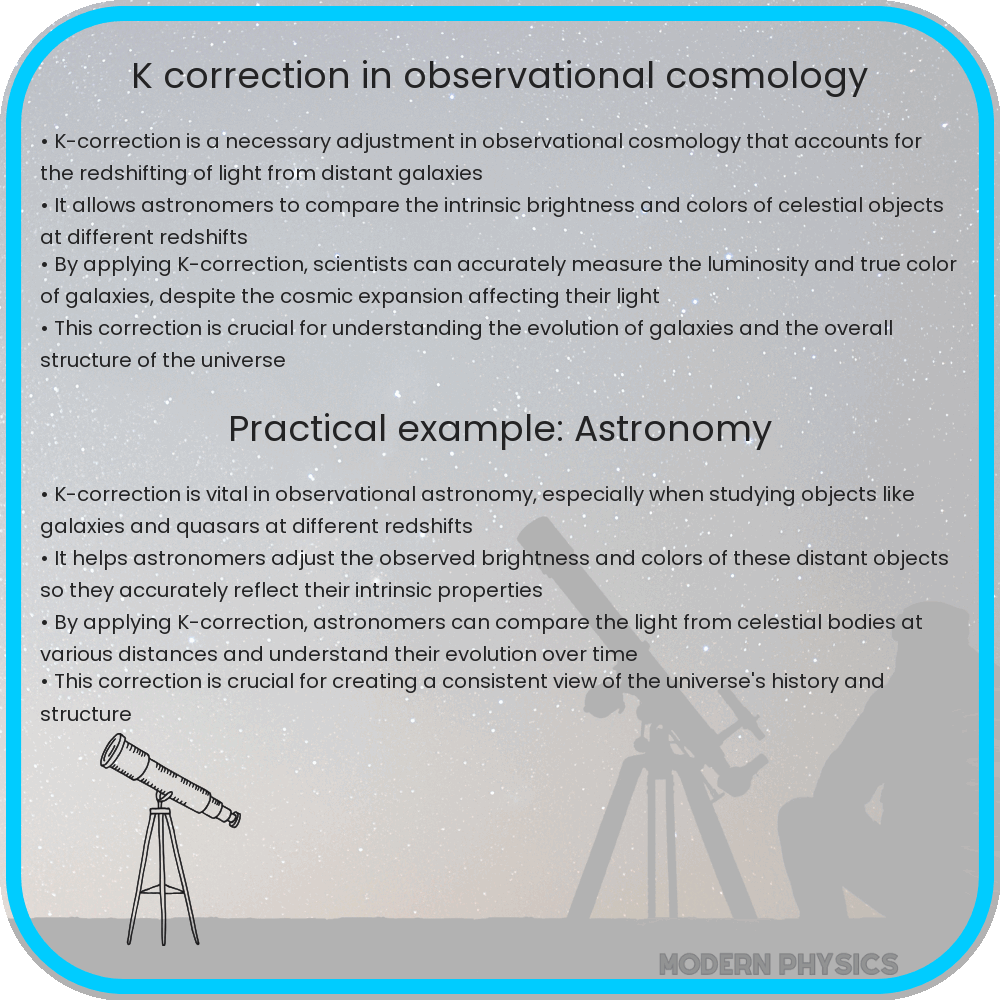
K-Correction, a fundamental concept in the field of cosmology, plays a critical role in understanding the vast universe. It is a correction applied to the observed magnitudes of astronomical objects to convert them into a common bandpass system, allowing astronomers to compare intrinsic luminosities of celestial bodies irrespective of their redshifts. This correction is vital for studies involving distant galaxies and quasars, which appear to us under the influence of cosmic redshift due to the expanding universe.
Essentials of K-Correction
At its core, K-Correction accounts for the difference in wavelength of the light received from an astronomical object and the light emitted by the object. The universe’s expansion stretches the wavelengths of light traveling through it, causing the observed light to shift towards the red end of the spectrum, known as the redshift. This effect is more pronounced in objects farther away from us, making K-Correction essential for accurate measurements and comparisons.
The process involves several steps: determining the redshift of the object, understanding the original spectral energy distribution (SED), and applying the correction to compare its brightness in a standardized filter system. This requires an understanding of the object’s SED and the transmission characteristics of the filters used in observations.
Impact of K-Correction in Observational Cosmology
K-Correction has profound implications in observational cosmology, particularly in the study of distant galaxies and cosmic evolution. Without this correction, the apparent brightness of galaxies would not accurately represent their true luminosities, leading to erroneous interpretations of their distances and, subsequently, the scale and structure of the universe. K-Correction enables astronomers to derive more accurate luminosity functions, mass-to-light ratios, and star formation rates, which are crucial for understanding the evolutionary history of the universe.
Use Cases of K-Correction
- Comparative Studies of Galaxy Properties: By applying K-Correction, astronomers can compare intrinsic properties of galaxies, such as luminosity and color, across different redshifts.
- High Redshift Surveys: K-Correction allows for the identification and study of high-redshift objects, aiding in the understanding of the early universe.
- Cosmic Distance Ladder: Accurate distance measurements to celestial objects, fundamental for cosmological scaling and mapping, rely on correct application of K-Correction.
Challenges and Advancements in K-Correction
Implementing K-Correction is not without its challenges. The accuracy of K-Corrections heavily depends on the precise measurement of redshifts and a deep understanding of the spectral energy distribution of celestial bodies. Misestimations in these areas can lead to significant errors in the corrected magnitudes. Moreover, the intrinsic variability of astronomical objects, such as supernovae or active galactic nuclei, can complicate the application of a standard correction.
Recent advancements in technology and methodology have led to improvements in K-Correction accuracy. Spectroscopic surveys and improved photometric redshift techniques have enhanced our understanding of distant objects’ SEDs. Additionally, the development of more sophisticated models and software tools has allowed astronomers to apply K-Corrections more efficiently and accurately.
Future Prospects and Importance of K-Correction in Cosmology
The future of K-Correction in cosmology looks promising as observational techniques continue to evolve. With the advent of next-generation telescopes and observational platforms, the data quality for distant celestial objects will improve, leading to more precise K-Corrections. This will enable more accurate studies of the universe’s structure and evolution and help answer fundamental questions about dark matter, dark energy, and the overall fate of the cosmos.
Furthermore, K-Correction plays a critical role in the development of cosmological models and the interpretation of cosmological phenomena. As we push the boundaries of our cosmic horizon, K-Corrections will remain essential in ensuring that our observations accurately reflect the realities of the universe.
Conclusion
K-Correction is an indispensable tool in the field of cosmology, enabling astronomers to make meaningful comparisons between celestial objects at different redshifts. Despite its challenges, advancements in observational technology and theoretical understanding continue to enhance its accuracy and applicability. As we venture further into the unknowns of the universe, the importance of K-Correction in interpreting the cosmos’s vast and varied phenomena will only grow. By refining and applying this critical correction, astronomers can continue to unravel the mysteries of the universe, providing deeper insights into its past, present, and future.