
Explore the Joule Expansion Apparatus: its role in thermodynamics, efficiency, precision in gas behavior studies, and educational applications.
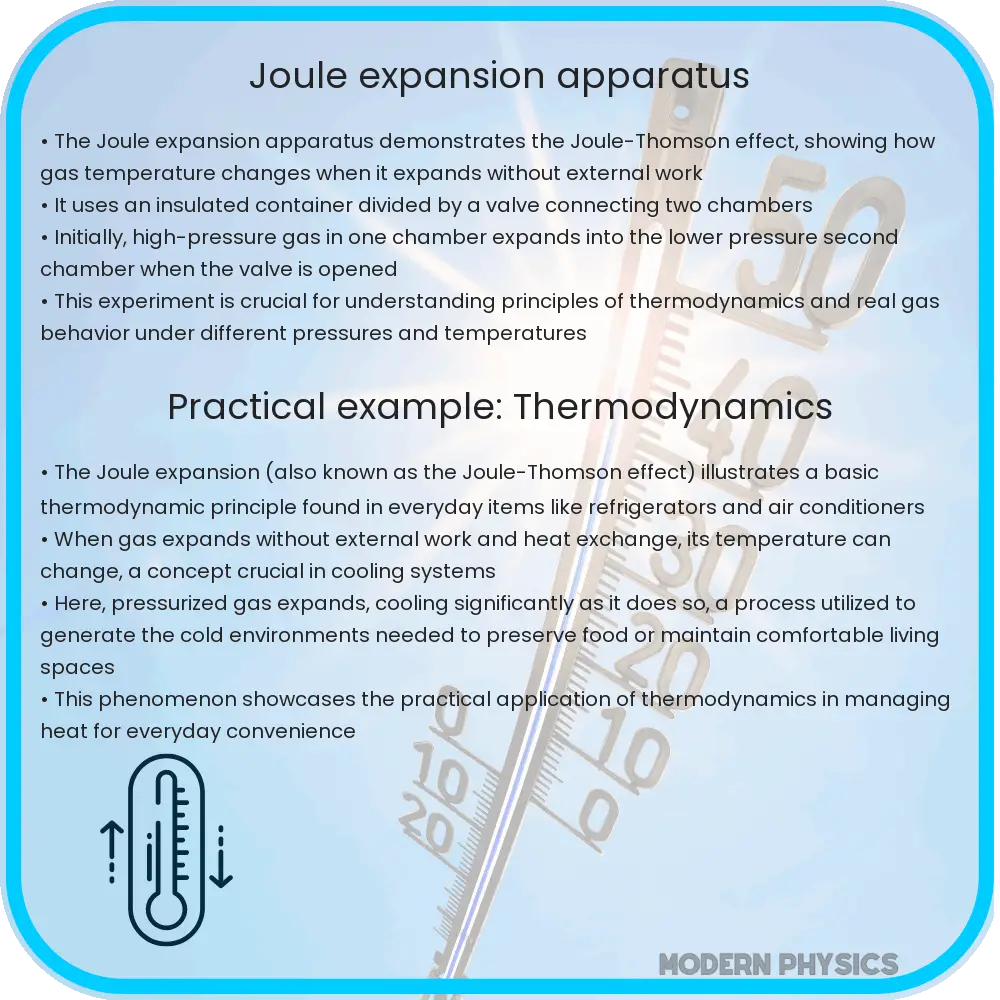
Joule Expansion Apparatus: Enhancing Efficiency and Precision in Thermodynamic Experiments
The Joule Expansion Apparatus plays a pivotal role in modern thermodynamic studies, especially in exploring the principles of gas expansion and thermodynamics. This sophisticated equipment is designed to demonstrate the Joule-Thomson effect and the ideal gas law, providing insights into how gases behave under different temperature and pressure conditions.
Understanding the Joule-Thomson Effect
The Joule-Thomson effect, named after physicists James Prescott Joule and William Thomson (Lord Kelvin), refers to the temperature change that a gas experiences when it is forced through a valve or porous plug while kept insulated so that no heat is exchanged with the environment. This phenomenon is crucial in various industrial processes, including the liquefaction of gases.
Design and Functionality of the Joule Expansion Apparatus
The core component of the Joule Expansion Apparatus is a thermally insulated chamber that is divided into two compartments by a valve. One side is highly pressurized, while the other is maintained at a lower pressure. The apparatus usually includes pressure gauges, a thermometer or temperature sensor, and sometimes a heating element to control the initial temperature of the gas.
During the experiment, the valve is opened, allowing the gas to expand from the high-pressure side to the low-pressure side. This process is adiabatic, meaning no heat is transferred to or from the surroundings. The temperature change of the gas is measured to analyze the Joule-Thomson effect and understand the behavior of real gases versus ideal gases.
Efficiency and Precision in Measurements
Modern Joule Expansion Apparatuses are equipped with advanced sensors and digital readouts to ensure precise measurements of pressure and temperature. The efficiency of the apparatus is vital in minimizing experimental errors, particularly in accurately determining the inversion temperature—the temperature at which the Joule-Thomson effect changes from cooling to heating.
Moreover, the apparatus allows for the exploration of the ideal gas law, PV = nRT, where P is pressure, V is volume, n is the amount of substance (moles), R is the ideal gas constant, and T is temperature. By observing the expansion of gases under controlled conditions, students and researchers can better understand the relationships between these variables.
In conclusion, the Joule Expansion Apparatus is an indispensable tool in the field of thermodynamics. Its design, which emphasizes efficiency and precision, offers valuable insights into the behavior of gases and the underlying principles of heat and energy transfer. In the next section, we will delve into the practical applications and educational significance of this apparatus in modern scientific studies.
Practical Applications and Educational Significance
The Joule Expansion Apparatus is not only a fundamental tool in academic research but also has practical applications in various industries. It aids in the understanding of gas behavior under different conditions, which is essential in fields like aerospace engineering, refrigeration, and natural gas processing. The knowledge gained from using this apparatus can be applied to design more efficient cooling systems and to optimize the processing and transportation of gases.
In educational settings, this apparatus provides a hands-on approach to learning. It helps students grasp complex concepts in thermodynamics, such as enthalpy, entropy, and the properties of real gases. The apparatus also demonstrates the limitations of the ideal gas law when applied to real gases, particularly at high pressures and low temperatures.
Enhancements in Modern Apparatuses
Recent advancements in the Joule Expansion Apparatus have focused on increasing control and precision. Digital temperature and pressure sensors provide more accurate readings, and computer interfaces allow for real-time data analysis and visualization. These enhancements not only improve the reliability of experimental results but also make the experiments more accessible and understandable for students.
Another significant improvement is the use of safer, more environmentally friendly gases. Earlier models often used gases like hydrogen or helium, which posed safety risks. Modern apparatuses tend to use safer alternatives, without compromising the quality of the results.
Conclusion
The Joule Expansion Apparatus is a cornerstone in the study and application of thermodynamics. Its ability to demonstrate the Joule-Thomson effect and explore the ideal gas law with high precision makes it an invaluable educational and research tool. The continuous improvements in its design and functionality reflect the evolving needs of both the scientific community and industry. By providing hands-on experience with real gases under controlled conditions, this apparatus not only enhances our understanding of fundamental thermodynamic principles but also bridges the gap between theoretical knowledge and practical application. As technology advances, we can anticipate even more sophisticated versions of this apparatus, further enriching our understanding of the natural world.