
Jitter in audio systems refers to the deviation from true periodicity of signal waveforms, impacting audio clarity and quality through noise and distortion.
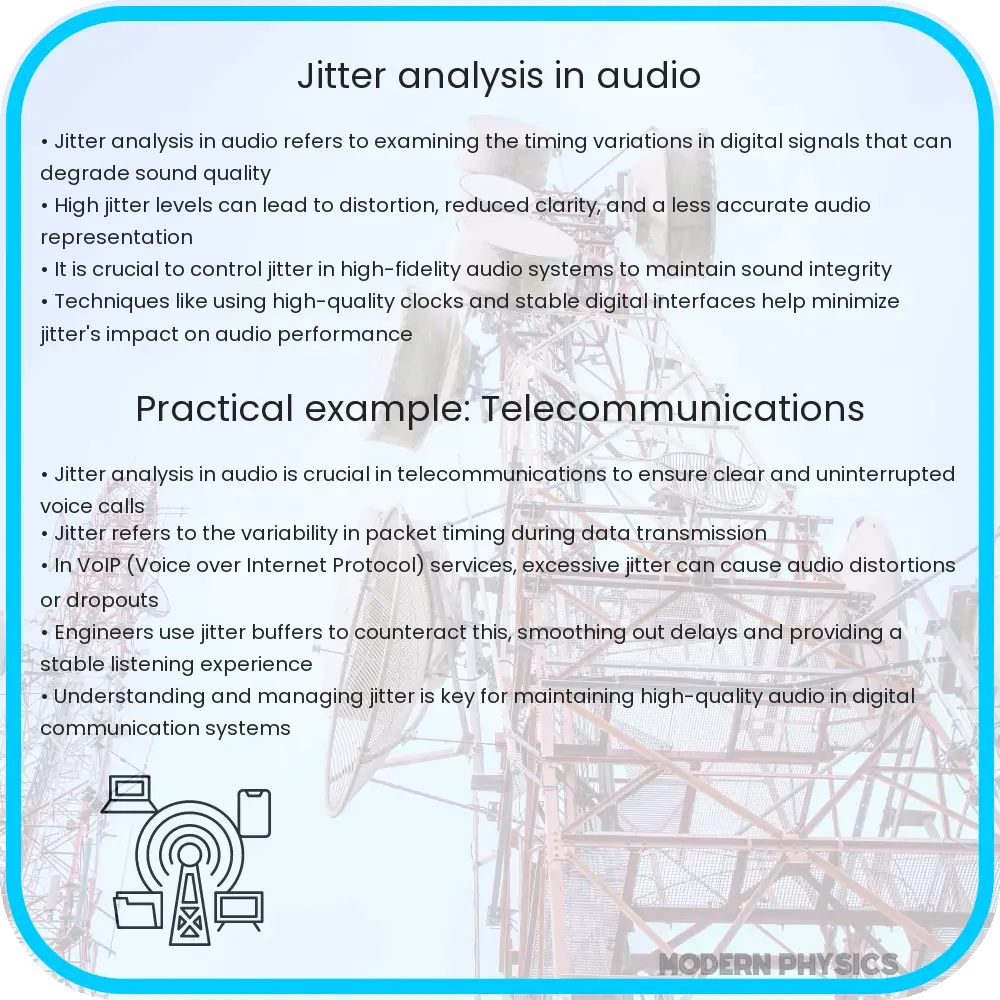
Understanding Jitter Analysis in Audio
Jitter refers to the temporal irregularity of a sequence of digital audio signals, which can significantly affect the clarity, accuracy, and performance of the audio output. When examining the impact of jitter in audio systems, it’s essential to not only comprehend its causes and effects but also the methods of measuring and mitigating it.
What is Jitter?
Jitter in audio systems can be described as the deviation from true periodicity of a theoretically correct signal waveform produced by a clock in digital audio equipment. Simply put, jitter is the timing inconsistencies that occur when digital audio data is converted to an analog signal. Its presence can degrade the quality of the audio experience by introducing noise, distortion, or other artifacts.
Causes of Jitter
There are several sources of jitter in audio systems, including:
- Electrical interference: Nearby electrical devices can induce unwanted signals into the audio processing environment.
- Mechanical vibrations: Mechanical components within audio devices, such as hard drives or fans, can also contribute to jitter through physical vibrations.
- Data transmission errors: Errors in transmitting data between different components of the audio system can cause misalignment of the digital audio signal.
Effects of Jitter on Audio Quality
Jitter can have various detrimental effects on audio quality, primarily manifesting as:
- Digital distortion: Timing errors can lead to inaccuracies in the sampling of the audio signal, which may result in distortion once the digital signal is converted to analog.
- Reduced dynamic range: Jitter can cause a compression in the signal’s dynamic range, making quiet sounds less discernible and reducing the overall fidelity of the audio.
- Noise and artifacts: Random fluctuations in signal timing can introduce unwanted noise and artifacts into the audio, further degrading its quality.
Measuring Jitter
To correctly assess and address jitter in audio systems, accurate measurement is crucial. Jitter measurement typically involves analyzing the digital signal to identify and quantify timing errors. This can be done using a variety of tools and technologies, including spectrum analyzers and specialized software designed for jitter analysis. Such tools facilitate a deeper understanding of how jitter impacts an audio system, supporting more effective troubleshooting and refinement of the audio output.
In the next section, we will explore various strategies employed to mitigate jitter and enhance audio performance, highlighting practical approaches used in both design and application stages of audio engineering.
Strategies for Mitigating Jitter
To enhance audio performance by reducing the effects of jitter, engineers employ several strategies. These approaches range from improving hardware design to employing sophisticated software algorithms. Here we discuss some of the most common and effective methods:
- Clock regeneration: Using a high-quality clock source and regenerating the clock at different stages of the audio signal path helps minimize jitter introduced by component variations and degradation over time.
- Isolation: Physical and electrical isolation of audio components can reduce interference from external sources and other parts of the circuit, which can otherwise contribute to jitter.
- Buffering: Implementing buffers can allow a system to re-time the digital audio stream, thus aligning the timing more accurately and reducing jitter.
- Enhanced data transfer protocols: Using robust data transfer methods such as low-jitter communication protocols can help in maintaining the integrity of the digital audio signal.
Each of these strategies can be tailored to fit specific types of audio systems, whether they’re for consumer home audio, professional studio settings, or live sound applications.
Conclusion
Jitter is a significant challenge in the field of audio engineering, impacting the accuracy and quality of sound in digital audio systems. Understanding the sources and effects of jitter is crucial for identifying appropriate measures to control it. Through methods like clock regeneration, isolation, buffering, and employing robust data transfer protocols, engineers can effectively mitigate jitter and enhance overall audio performance. By continually advancing our approaches to managing jitter, we strive to achieve clearer, more precise sound reproduction in various audio applications.
In conclusion, as our digital audio technology continues to evolve, so too must our strategies for combating imperfections like jitter. With ongoing research and development, we can anticipate further innovations in jitter mitigation techniques that will pave the way for even higher quality audio experiences in the future. This fundamental understanding and continual improvement are what drive the audio industry forward, ensuring that the digital transformation of sound remains both a science and an art.