
Explore the fascinating world of jet quenching in astrophysics, its theoretical insights, effects on cosmic phenomena, and implications for the universe.
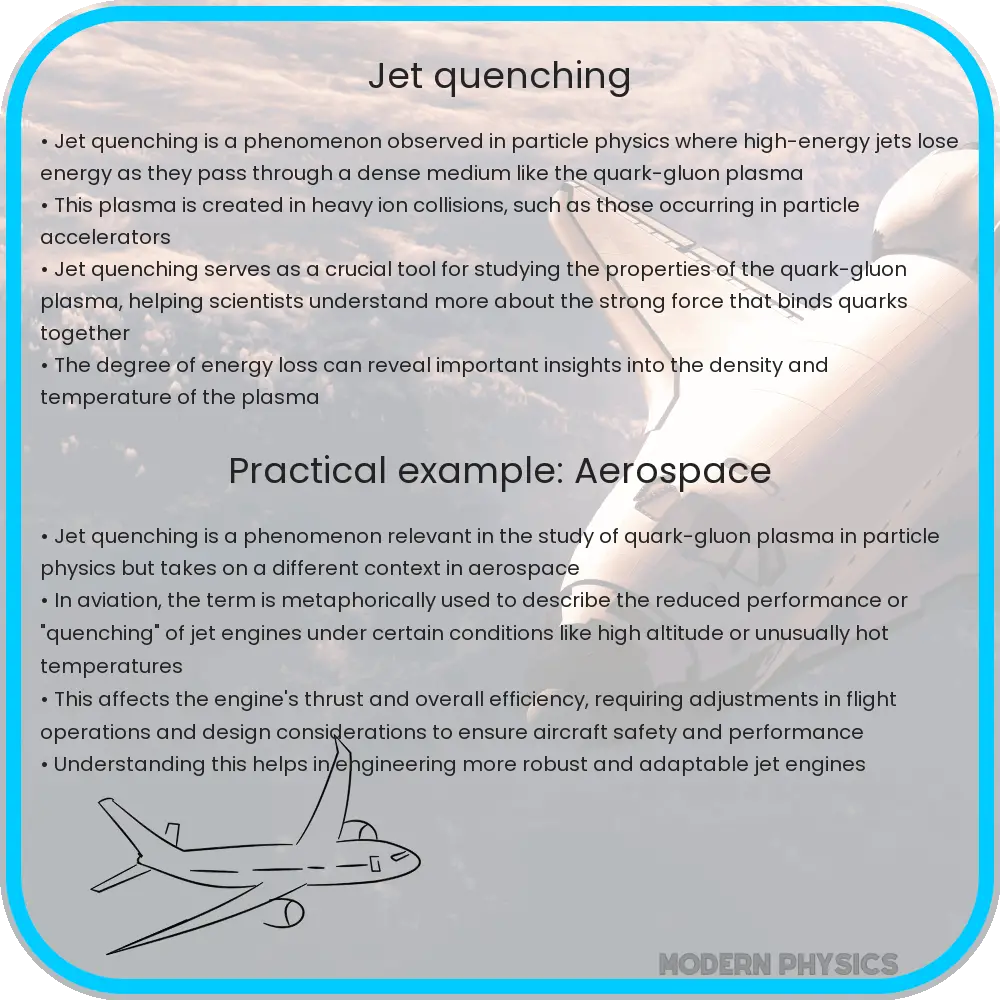
Understanding Jet Quenching in Astrophysics
Jet quenching is a pivotal phenomenon in the realm of astrophysics, particularly relevant within the study of high-energy particle collisions and quark-gluon plasmas. This concept primarily pertains to the suppression of jet particle production in heavy-ion collisions, offering insights into the properties of the hot and dense medium created in such events. As we delve deeper into this topic, we’ll explore the underlying theories and the significant effects jet quenching has on our understanding of the universe’s fundamental constituents.
Theoretical Insights
The theory behind jet quenching is deeply rooted in quantum chromodynamics (QCD), the field of physics that describes the strong interaction – one of the four fundamental forces – governing the behavior of quarks and gluons. In the high-energy collisions, such as those observed in particle accelerators, jets of particles are produced as a result of quark and gluon scattering. However, in a quark-gluon plasma, a state of matter thought to exist shortly after the Big Bang, these jets are noticeably dampened or ‘quenched’ due to their interactions with the surrounding dense medium.
Key Mechanisms and Effects
Several mechanisms contribute to jet quenching, including elastic energy loss, inelastic radiative energy loss, and parton scattering. The most significant of these is believed to be the radiative energy loss, where a parton (a constituent of hadrons, such as quarks and gluons) loses energy by emitting gluons as it traverses the plasma. This process is analogous to the energy loss experienced by a fast-moving electron passing through an ordinary material, a phenomenon known as bremsstrahlung.
The effects of jet quenching are manifold and profound. By studying jet suppression patterns, scientists can infer properties of the quark-gluon plasma, such as its temperature, density, and viscosity. Additionally, jet quenching serves as a crucial tool in testing the predictions of QCD under extreme conditions, contributing significantly to our understanding of the strong force and the early universe’s conditions.
Understanding Jet Quenching in Astrophysics
Jet quenching, a prominent phenomenon observed in high-energy astrophysical environments, plays a crucial role in understanding cosmic processes. This intriguing event occurs in the context of heavy-ion collisions, particularly within the ultra-hot, dense medium known as the quark-gluon plasma (QGP). In astrophysical terms, jet quenching can significantly influence the formation and evolution of galaxies, star systems, and even the very structure of the universe.
Theoretical Insights into Jet Quenching
The concept of jet quenching arises from quantum chromodynamics (QCD), the theory describing the strong interaction between quarks and gluons. In the extreme conditions where QGP forms, such as those found in collisions at Large Hadron Collider (LHC) or Relativistic Heavy Ion Collider (RHIC), jets of partons (quarks and gluons) are produced. As these jets traverse the QGP, they lose energy through a process known as parton energy loss, leading to the phenomenon of jet quenching. This energy loss can occur via elastic collisions or gluon radiation and is a direct consequence of the dense medium’s properties.
Effects and Implications of Jet Quenching
Jet quenching has profound implications for astrophysics and cosmology. In the context of heavy-ion collisions, it provides crucial information about the properties of QGP and the strong force. Moreover, understanding jet quenching is essential for interpreting the results of particle collisions and for testing the predictions of QCD under extreme conditions.
In astrophysical environments, jet quenching can affect the dynamics of accretion processes around black holes and the behavior of jets emitted by active galactic nuclei (AGN). By studying how jets interact with interstellar and intergalactic media, scientists can gain insights into the life cycle of galaxies and the distribution of matter in the universe.
Conclusion
Jet quenching remains a key focus of both theoretical and experimental astrophysics, offering a unique window into the high-energy universe. Its study bridges the gap between the microcosm of quantum particles and the macrocosm of cosmic structures, enhancing our understanding of the universe’s fundamental forces and components. By continuing to explore this phenomenon, scientists aim to unlock further secrets of the cosmos, from the inner workings of exotic astrophysical objects to the evolution of the universe itself.