
Isotropic universe models in cosmology assume uniformity in all directions, simplifying General Relativity equations and aiding in understanding the universe’s expansion.
Isotropic Universe Models | Relativity, Uniformity & Cosmology
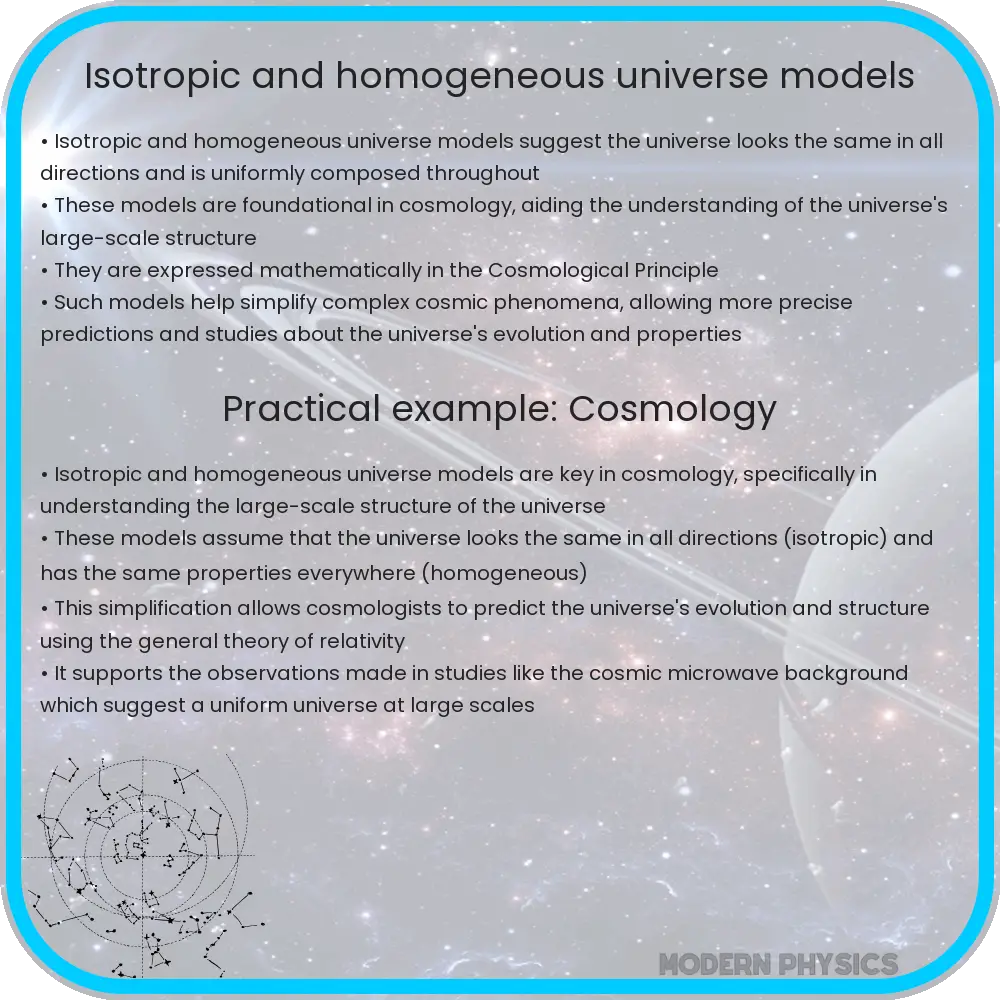
An isotropic universe model is a concept in cosmology that assumes the universe looks the same in all directions. This idea is crucial in understanding how the universe behaves on a large scale. Derived from the Greek words “isos” (equal) and “tropos” (way), isotropy implies uniformity in every direction, making it a key principle in cosmology.
Uniformity and Cosmology
In cosmology, isotropy is often discussed alongside homogeneity. While isotropy refers to uniformity in all directions, homogeneity means uniformity in all locations. Together, these concepts form the Cosmological Principle, which states that on a large scale, the universe is both homogeneous and isotropic. This principle simplifies the complex equations of General Relativity, making it possible to model and understand the universe’s evolution.
For example, if we observe the Cosmic Microwave Background (CMB) radiation, it appears almost identical in every direction, supporting the notion of an isotropic universe. This observation provides strong evidence for the Big Bang theory and helps cosmologists develop more accurate models of the universe.
- Homogeneity: The universe is the same everywhere on a large scale.
- Isotropy: The universe looks the same in all directions.
- Cosmological Principle: Combining homogeneity and isotropy, stating the universe is uniform in every direction and location on a large scale.
Relativity and Isotropy
Einstein’s theory of General Relativity significantly impacts our understanding of isotropic universe models. The field equations of General Relativity describe how matter and energy influence the curvature of spacetime. In an isotropic universe, these equations simplify, allowing cosmologists to find solutions that describe the universe’s expansion.
One such solution is the Friedmann-Lemaître-Robertson-Walker (FLRW) metric, which models a homogeneous and isotropic expanding universe. The FLRW metric hinges on the simplified field equations in the context of the Cosmological Principle:
FLRW Metric:
\[ ds^2 = -c^2 dt^2 + a(t)^2 \left( \frac{dr^2}{1 – kr^2} + r^2 (dθ^2 + sin^2 θ dφ^2) \right)\]
where:
- a(t) is the scale factor, describing how distances in the universe change over time.
- k is the curvature of space, which can be -1, 0, or +1 for open, flat, or closed universes, respectively.
Implications of Isotropic Universes
The concept of an isotropic universe has profound implications for our understanding of cosmology. By assuming isotropy, scientists can make accurate predictions about the universe’s future and its past. Isotropy simplifies the complex interactions of matter and energy, allowing for more manageable mathematical models and simulations.
For example, isotropic models help in predicting the distribution of galaxies and dark matter in the universe. Since isotropy assumes uniformity in all directions, it supports the idea that galaxy clusters and voids are evenly distributed across different parts of the cosmos. This assumption aids astronomers and physicists in mapping the large-scale structure of the universe.
Challenges and Observations
While isotropy is a cornerstone of modern cosmology, some observations challenge this assumption. Cosmic anisotropies—small deviations from perfect isotropy—have been detected in the Cosmic Microwave Background (CMB). These deviations are tiny but significant, providing clues about the early universe’s conditions and the distribution of matter shortly after the Big Bang.
Scientists use these anisotropies to study the universe’s formation and evolution in greater detail. For instance, the temperature fluctuations in the CMB can reveal information about the density variations in the early universe. This data is crucial for understanding how galaxies and large-scale structures formed over time.
Conclusion
The isotropic universe model remains a fundamental concept in cosmology, offering a simplified, yet powerful, view of the universe. By assuming uniformity in all directions, it allows scientists to develop robust mathematical models and make accurate predictions. The combination of isotropy, homogeneity, and the Cosmological Principle forms the backbone of our understanding of the universe’s large-scale structure.
Despite some observational challenges, the isotropic universe model continues to provide invaluable insights into cosmology. As technology advances and observations become more precise, the isotropic assumption will likely be refined, deepening our understanding of the cosmos. Whether you are a student, a curious mind, or an aspiring physicist, exploring isotropic universe models offers a fascinating glimpse into the vast and uniform expanse of our universe.