
Learn about isoelectronic series, which involves species with the same number of electrons but differing nuclear charges, affecting their chemical and physical properties.
Understanding Isoelectronic Series: Trends and Stability
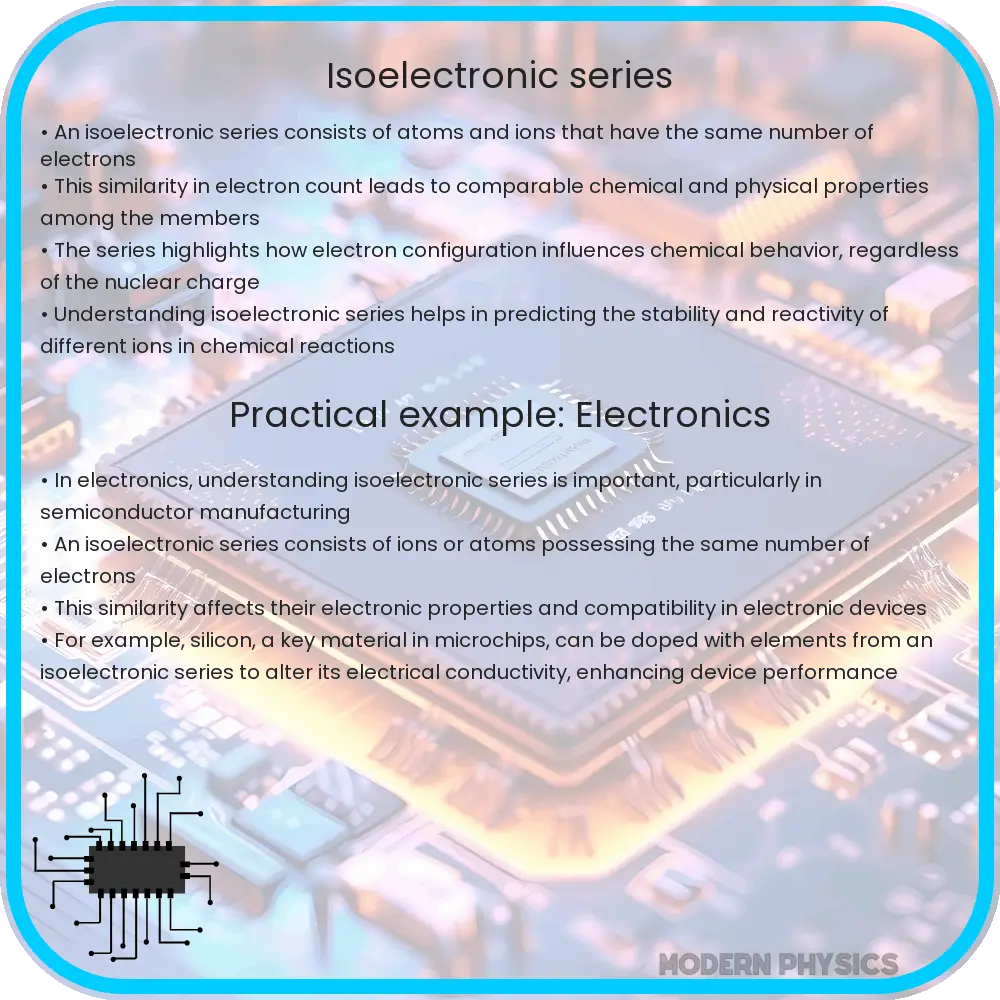
An isoelectronic series consists of ions, atoms, or molecules that have the same number of electrons, but different nuclear charges (the number of protons in the nucleus). This unique setup provides an excellent playground to explore and understand the stability and chemico-physical behaviors of atomic and molecular structures in chemistry and physics.
Defining Isoelectronic Series
Two or more species (atoms, ions, or molecules) are isoelectronic with each other if they contain an identical number of electrons. For example, N3-, O2-, F–, Ne, and Na+ all have 10 electrons each, making them isoelectronic. Despite having the same electron count, their nuclear charges vary, affecting their sizes, bonding characteristics, and other physical properties.
Size and Stability in Isoelectronic Species
In an isoelectronic series, the size of the species tends to decrease as the nuclear charge increases. This happens because a higher nuclear charge (more protons) pulls the electrons closer to the nucleus, reducing the radius of the atom or ion. This effect can be observed in the earlier example where the size decreases progressively from N3- to Na+.
- The ionic radius of N3- is the largest due to its lower nuclear charge.
- As we move towards Ne and Na+, the increasing nuclear charge pulls the electrons more strongly towards the nucleus, decreasing the ionic radii.
Electronic Configuration and Stability
The stability of isoelectronic species is greatly influenced by their electronic configuration. Having a complete valence shell, typically an s2p6 configuration like that of noble gases, often results in higher stability. This configuration is particularly stable due to the full occupancy of the valence shell, leading to minimal chemical reactivity.
For instance, Ne in the aforementioned series exhibits higher chemical inertness and stability compared to its isoelectronic counterparts. This stability arises from its complete outer shell, which makes it energetically unfavorable to gain or lose electrons.
Trends in Ionization Energy and Electron Affinity
Ionization energy (IE) and electron affinity (EA) are also critical factors that vary across an isoelectronic series. Ionization energy refers to the energy required to remove an electron from a gaseous atom or ion, while electron affinity is the energy change when an electron is added to a neutral atom in the gas phase.
- As the nuclear charge increases among isoelectronic species, the ionization energy tends to increase. This is because the electrons are held more tightly by the stronger nuclear pull.
- Electron affinity shows a more complex trend, often increasing with nuclear charge but also dependent on electron configuration and repulsion forces within the atom.
The interaction of ionization energy and electron affinity influences the overall stability and reactivity of isoelectronic species, playing a vital role in chemical reactions and bonding behaviors.
Practical Applications of Isoelectronic Series
Understanding isoelectronic series has practical implications in various scientific fields. In materials science, engineers and chemists can manipulate the properties of materials at the atomic level by tweaking the electron count and nuclear charge. For example, doping semiconductors with impurities that are isoelectronic with the host material can change the electrical properties without adding extra charges, often enhancing their performance.
In biochemistry, the knowledge of isoelectronic properties helps in designing drugs that can more effectively bind to specific active sites of enzymes or receptors, based on the size and electronic configuration of the drug molecules.
- Enhancement of LED efficiency by using isoelectronic impurities.
- Design of more effective pharmaceuticals with minimized side effects.
Conclusion
The concept of isoelectronic series not only deepens our understanding of chemical and physical properties of atoms and ions but also serves as a fundamental tool in advancing technology and healthcare. By examining the trends in size, stability, ionization energy, and electron affinity across isoelectronic species, we gain insights that are integral to innovation in materials science, semiconductor technology, and pharmaceuticals.
Ultimately, the detailed study of isoelectronic series highlights the meticulous balance of forces that govern atomic behavior, providing a clearer image of how materials can be engineered to meet specific requirements. This knowledge empowers scientists and engineers to create more efficient, effective, and sustainable technological solutions.