
Explore the ionosphere’s plasma, its dynamic characteristics, impacts on communication and navigation, and advancements in forecasting and technological resilience.
Understanding the Ionospheric Plasma
The ionosphere, a crucial layer of Earth’s upper atmosphere, extends from about 50 to 600 kilometers above the Earth’s surface. Dominated by ionized particles, this layer plays a pivotal role in atmospheric science and global communication systems. Ionospheric plasma is composed mainly of electrons, positively charged ions, and neutral gases. The dynamic nature of these components, influenced by solar and terrestrial factors, gives the ionosphere its unique characteristics and impacts.
Characteristics of Ionospheric Plasma
Ionospheric plasma is characterized by its density, temperature, and composition, which vary with altitude, latitude, time of day, and solar activity. The ionization process, primarily driven by solar ultraviolet (UV) radiation, generates free electrons and ions by stripping electrons from neutral atoms and molecules. This process is most intense during daytime and varies with the solar cycle. The ionosphere is divided into several layers (D, E, F1, and F2), each with distinct characteristics determined by the plasma density and ion composition. The F layer, reaching the highest altitudes, contains the highest concentration of free electrons and is crucial for long-distance radio communication.
Dynamics of Ionospheric Plasma
The dynamics of ionospheric plasma are influenced by both solar radiation and geomagnetic activity. Variations in solar output, such as solar flares and coronal mass ejections, can dramatically alter the density and composition of the ionosphere. Geomagnetic storms, caused by interactions between solar wind and Earth’s magnetic field, can lead to disturbances in ionospheric plasma, affecting satellite operations and radio communications. Additionally, diurnal and seasonal changes impact the ionosphere’s behavior, with greater ionization occurring during the day and in summer months.
Impact of Ionospheric Plasma
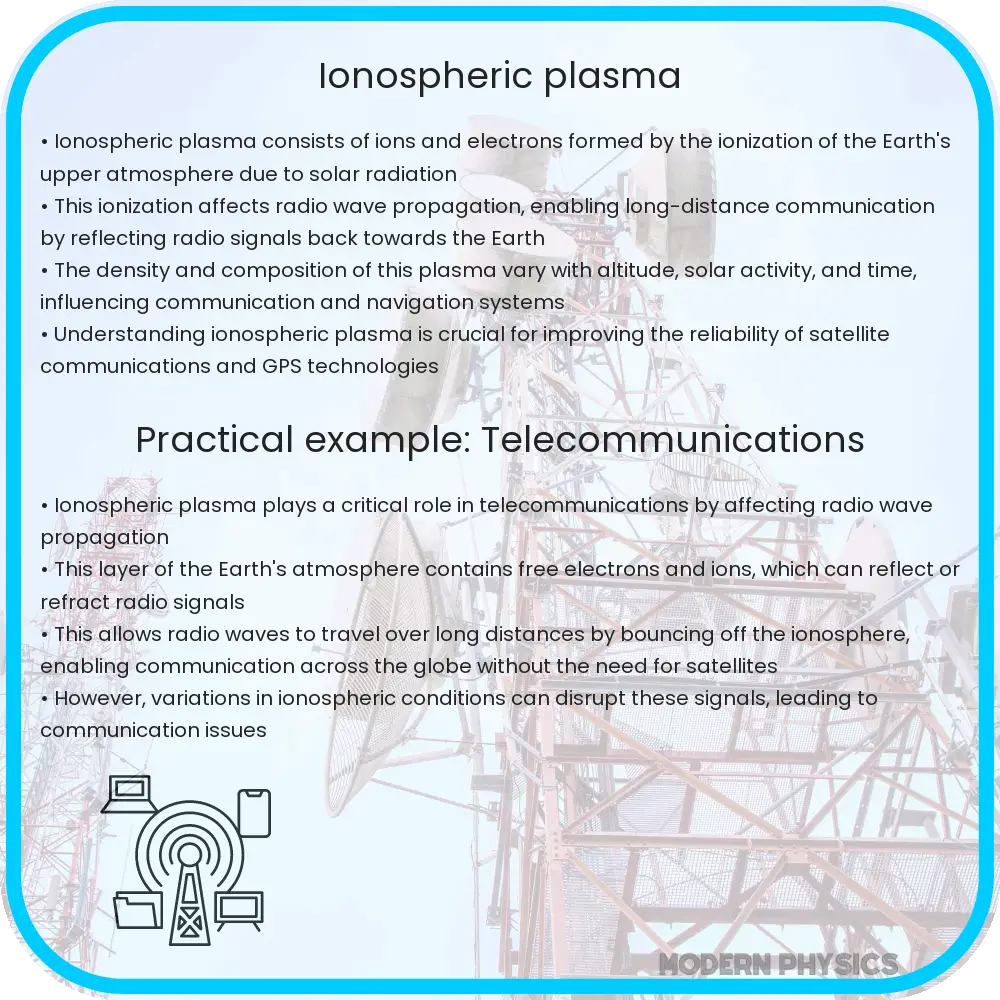
Ionospheric plasma has significant implications for Earth’s atmospheric system and human technology. Its ability to reflect and refract radio waves enables long-distance radio communication and supports the functionality of GPS and other satellite-based navigation systems. However, ionospheric disturbances can disrupt these communications, leading to significant challenges for aviation, maritime navigation, and emergency services. Understanding ionospheric plasma dynamics is thus critical for mitigating these impacts and improving the reliability of communication and navigation systems.
Exploring Ionospheric Plasma Variability
The ionosphere’s variability is a subject of ongoing research, particularly in understanding how terrestrial weather and space weather interact. Lower atmospheric phenomena can propagate upwards, affecting ionospheric conditions, while solar and geomagnetic activity can induce changes in the ionosphere that impact the lower atmosphere. This complex feedback loop is crucial for accurate weather prediction and climate models. Advances in technology and space missions are enhancing our ability to monitor and forecast ionospheric conditions, leading to better preparedness for space weather events.
Technological and Scientific Advancements
Recent advancements in ionospheric research have been driven by innovations in satellite technology, ground-based observation networks, and computational modeling. Satellites equipped with sophisticated instruments provide comprehensive data on ionospheric density, composition, and temperature. Ground-based ionosondes and GPS networks offer valuable insights into the ionosphere’s behavior over time and space. Computational models have become increasingly sophisticated, allowing scientists to simulate ionospheric processes and predict its behavior under different solar and geomagnetic conditions.
Future Directions
The future of ionospheric research holds promising advancements in understanding and mitigating the impacts of ionospheric plasma on technology and communication systems. Collaborative international efforts aim to improve real-time monitoring and forecasting capabilities, developing more resilient communication and navigation infrastructures. Furthermore, ongoing research into the coupling between Earth’s atmosphere and space weather will deepen our understanding of ionospheric dynamics, enabling better prediction models and strategies to cope with the challenges posed by space weather.
Conclusion
The study of ionospheric plasma encompasses its characteristics, dynamics, and the significant impact on Earth’s atmospheric system and human technology. As a critical component of the upper atmosphere, understanding the ionosphere is essential for enhancing global communication, navigation systems, and for predicting and mitigating the effects of space weather on these technologies. With ongoing advancements in observation and modeling, the scientific community continues to expand our knowledge of the ionosphere, striving for better preparedness against the challenges posed by its variability. As we look to the future, the intersection of atmospheric science, space research, and technological innovation will play a pivotal role in harnessing the benefits and overcoming the obstacles presented by the ionospheric plasma.