
Explore the role of ionization fronts in plasma physics, their types, applications in astrophysics and technology, and the challenges and future of research in this field.
Understanding Ionization Fronts in Plasma Physics
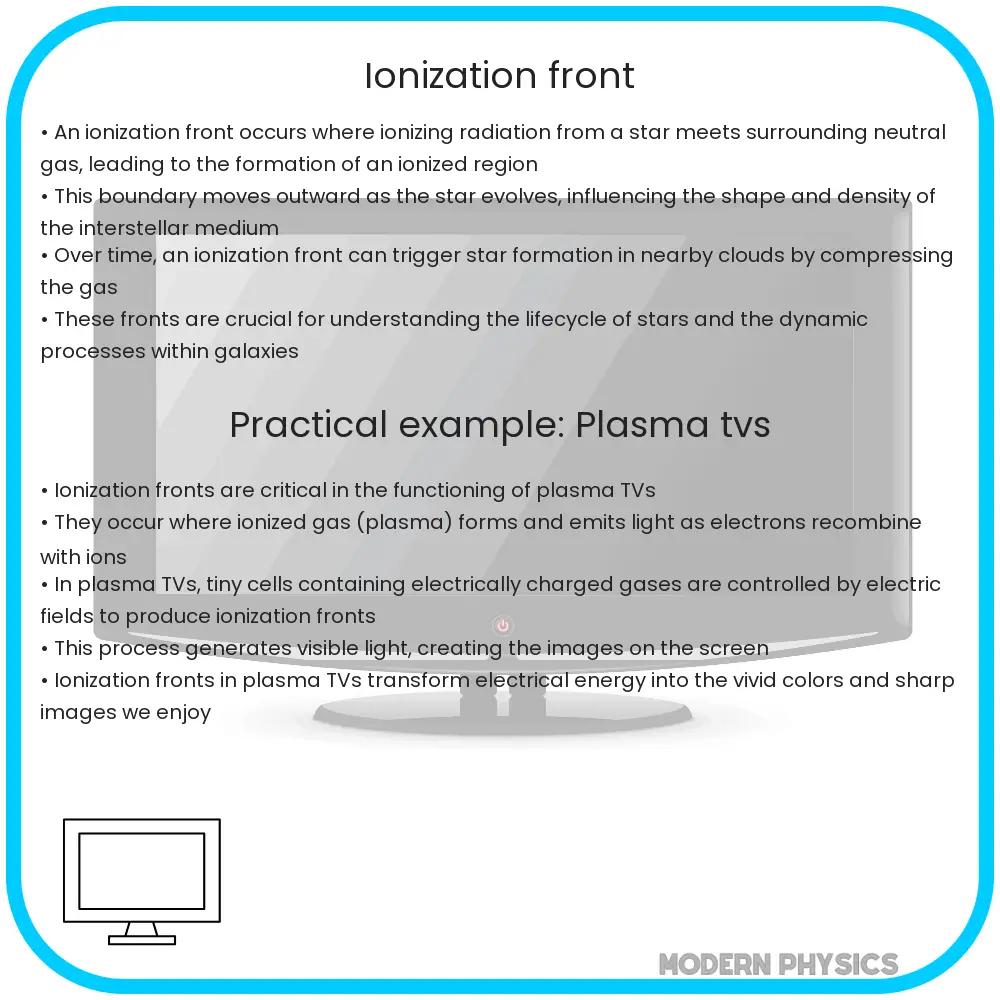
Ionization fronts play a pivotal role in the study of plasma physics, offering insights into the complex dynamics of ionized gases. These fronts are boundary layers that separate ionized regions from those that are not ionized in plasmas, such as those found in space or in laboratory experiments. Understanding these phenomena is crucial for advancing research in various fields, including astrophysics, controlled nuclear fusion, and plasma technology.
Formation and Types of Ionization Fronts
Ionization fronts form when a source of ionizing radiation, such as a star or a laser, emits energy into a surrounding medium, causing the atoms or molecules within that medium to lose electrons and become ionized. This process creates a moving boundary between the ionized and neutral regions. There are two primary types of ionization fronts based on their characteristics and behavior:
- R-type (Rarefied type) ionization fronts: These fronts move at speeds faster than the local sound speed in the ionized gas. They are characterized by their ability to quickly ionize neutral material without significantly affecting the gas dynamics.
- D-type (Dense type) ionization fronts: Moving at speeds slower than the local sound speed, these fronts are accompanied by a shock wave that precedes the ionization boundary. The shock wave compresses and heats the gas, making the ionization process more complex than in R-type fronts.
Applications and Research in Plasma Physics
The study of ionization fronts has profound implications for various scientific and technological advancements. In astrophysics, they are essential for understanding the structure and evolution of interstellar clouds, star formation, and the dynamics of nebulae. In the realm of controlled nuclear fusion, research on ionization fronts contributes to the development of more efficient and sustainable energy sources. Additionally, in plasma technology, they are crucial for improving the efficiency of plasma-based devices such as ion thrusters, which are used for spacecraft propulsion.
Recent advances in computational physics and high-resolution imaging have significantly enhanced our ability to study ionization fronts in detail. Researchers can now simulate the complex interactions within plasmas under various conditions, leading to a deeper understanding of their properties and behavior. This knowledge is instrumental in pushing the boundaries of plasma physics and its applications, from space exploration to clean energy solutions.
Challenges and Future Directions in Ionization Front Research
Despite significant progress, studying ionization fronts presents several challenges. One of the primary difficulties is the extreme conditions under which ionization fronts occur, such as high temperatures and densities, making experimental observations and measurements challenging. Furthermore, the intricate interplay between ionization processes, magnetic fields, and plasma dynamics requires sophisticated analytical and numerical methods to understand fully.
To address these challenges, researchers are increasingly relying on advanced computational models and high-power laser facilities. These tools allow for the simulation and recreation of ionization front conditions in controlled environments, providing valuable insights into their behavior and effects. Moreover, the development of new diagnostic techniques and instruments enables more accurate and detailed observations of ionization fronts in both laboratory and astrophysical settings.
Conclusion
Ionization fronts are a fundamental concept in plasma physics, bridging the gap between theoretical research and practical applications across multiple scientific disciplines. Their study illuminates the processes governing ionized gases in the universe, contributing to our understanding of stellar and galactic formation, advancing plasma technologies, and paving the way for future energy solutions. Despite the challenges inherent in studying these phenomena, ongoing advancements in computational physics and experimental methods continue to expand our knowledge and capabilities.
The future of ionization front research holds promising potential for breakthroughs in energy production, space exploration, and understanding the universe’s most fundamental processes. As scientists unravel the complexities of ionization fronts, we can anticipate significant contributions to plasma physics and related fields, driving innovation and discovery far into the future.