
Explore the fascinating world of ion acoustic waves in plasma physics, their dynamics, applications in technology, and the latest research insights in this comprehensive guide.
Understanding Ion Acoustic Waves
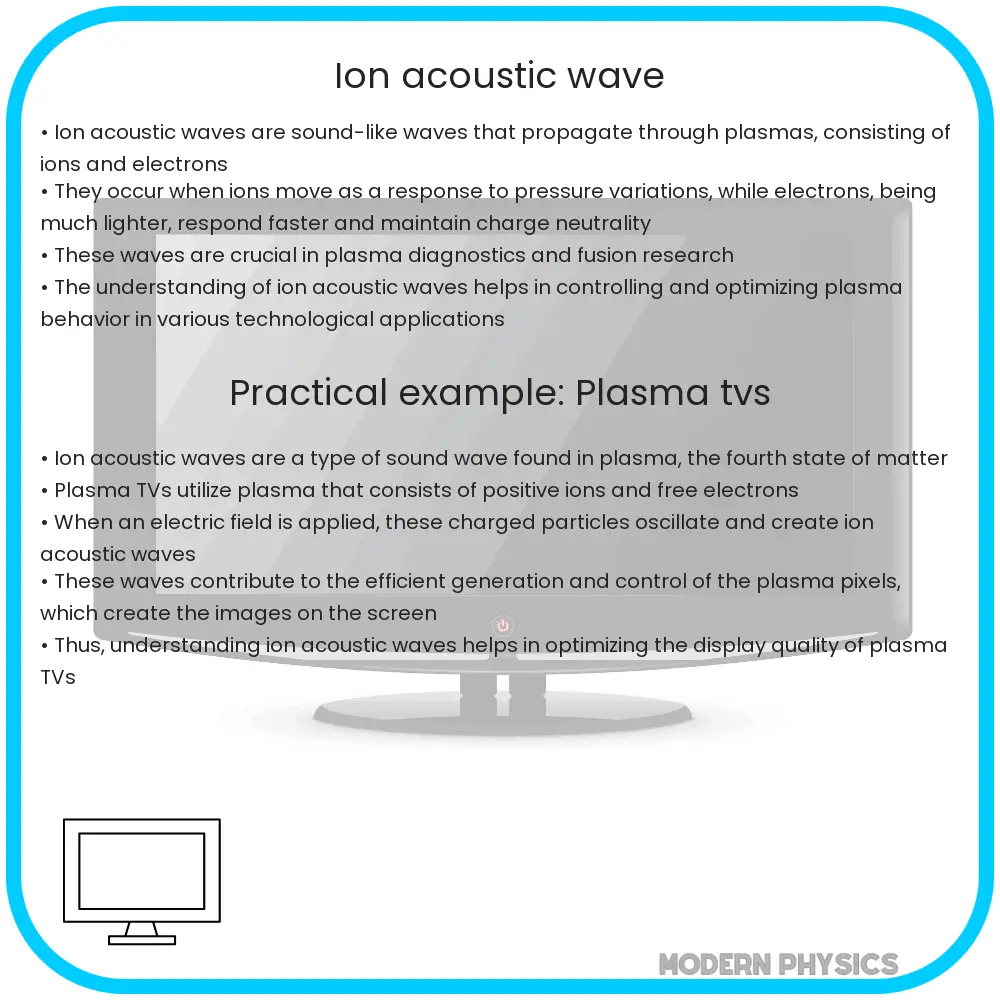
Ion acoustic waves are a fundamental concept in plasma physics, representing a type of longitudinal oscillation that occurs in a plasma due to the motion of its ions. These waves are crucial for understanding various plasma environments, from laboratory experiments to cosmic plasmas. The dynamics of ion acoustic waves provide insights into plasma behavior, energy transfer, and the mechanisms behind plasma instabilities and turbulence.
Essentials of Ion Acoustic Waves
At the core of ion acoustic waves is the interaction between ions and electrons in a plasma. A plasma, often referred to as the fourth state of matter, consists of free electrons and ions. When a disturbance occurs, such as a fluctuation in electric field, it can cause ions to oscillate at a specific frequency. This oscillation propagates through the plasma as a wave, with electrons responding much faster than ions due to their significantly lower mass. The disparity in response times between electrons and ions is what allows these waves to exist.
Dynamics of Ion Acoustic Waves
The speed of ion acoustic waves is determined by several factors, including the temperature of ions and electrons, and the mass of the ions. The wave speed can be approximated by the formula \(c_s = \sqrt{\frac{k_B(T_e + \gamma T_i)}{m_i}}\), where \(c_s\) is the speed of sound in the plasma, \(k_B\) is the Boltzmann constant, \(T_e\) and \(T_i\) are the temperatures of electrons and ions respectively, \(m_i\) is the ion mass, and \(\gamma\) represents the adiabatic index. This relationship illustrates the thermal and mass dependencies of wave propagation in a plasma.
Research and Applications
Ion acoustic waves are not just a theoretical curiosity; they have practical applications in various fields. In fusion research, understanding these waves helps in the development of controlled thermonuclear reactors. In space physics, they play a role in the dynamics of the solar wind and the interaction of planetary magnetospheres with the solar plasma. Additionally, ion acoustic waves are used in diagnostic techniques, such as laser-induced fluorescence and Thomson scattering, to probe plasma properties.
Recent research has focused on the nonlinear aspects of ion acoustic waves, exploring phenomena such as wave breaking, soliton formation, and the role of these waves in plasma heating and acceleration mechanisms. The ongoing study of ion acoustic waves continues to reveal the complex behavior of plasmas, offering insights into both fundamental physics and practical applications.
Nonlinear Dynamics and Advanced Research
The exploration of ion acoustic waves extends into the realm of nonlinear dynamics, where the interaction between waves can lead to the formation of stable, localized structures known as solitons. These solitons are of particular interest because they maintain their shape while traveling over long distances, making them ideal for studying transport phenomena in plasmas. Additionally, the investigation into the nonlinear regime has unveiled the occurrence of shock waves under certain conditions, further enriching the understanding of plasma dynamics.
Challenges and Future Directions
Despite the advances in understanding ion acoustic waves, several challenges remain. One of the primary difficulties is accurately modeling the complex interactions within plasmas that contain a mixture of different ion species. This complexity often requires sophisticated computational techniques and advanced diagnostics to unravel. Moreover, the extension of these studies to quantum plasmas, where quantum mechanical effects become significant, presents an exciting frontier for future research.
Further research is also focusing on enhancing the control over ion acoustic waves in experimental settings. This involves developing methods to generate and manipulate these waves more efficiently, enabling more precise investigations into plasma properties and interactions. Such advancements are expected to have significant implications for fusion energy research, space exploration, and the development of novel plasma-based technologies.
Conclusion
Ion acoustic waves play a pivotal role in the study and application of plasma physics. By facilitating a deeper understanding of plasma dynamics, these waves offer insights into a wide range of physical phenomena, from the behavior of astrophysical plasmas to the mechanisms underlying fusion energy. The research into ion acoustic waves has evolved from fundamental studies to encompass complex nonlinear phenomena and practical applications in technology and diagnostics. As the field advances, the challenges of accurately modeling and manipulating these waves in diverse plasma environments continue to spur innovation and discovery. With ongoing research and technological advancements, the study of ion acoustic waves promises to unlock further secrets of plasma physics and contribute to the development of future technologies.