
Discover the transformative power of Integral Photography in 3D imaging, enhancing clarity, precision, and depth for a truly immersive experience.
Exploring Integral Photography in 3D Imaging: Enhancing Clarity, Precision, and Depth
Integral Photography (IP) represents a pioneering approach in the realm of 3D imaging, offering a unique blend of clarity, precision, and depth that transforms the viewer’s experience. This technique, originally conceptualized in the early 20th century, has found new life with advancements in digital technology, making it a cornerstone for professionals and enthusiasts seeking to elevate their visual representations.
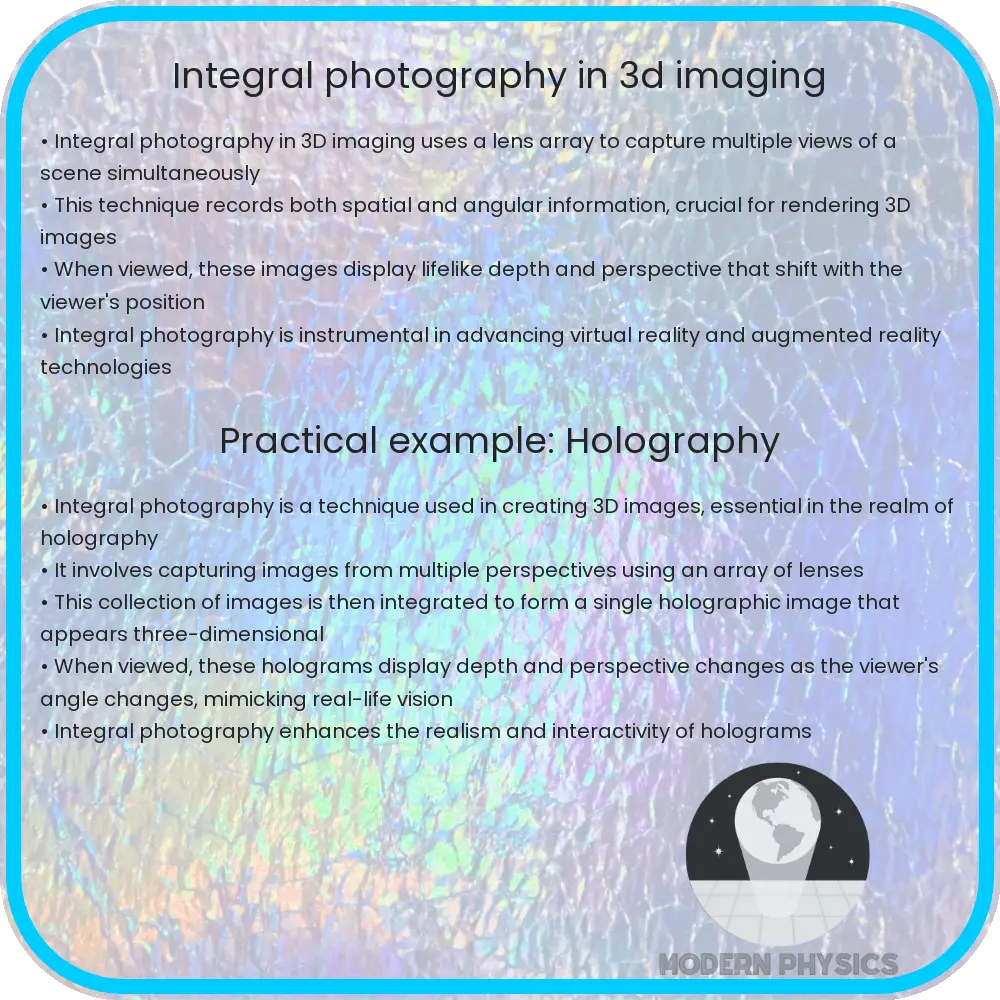
At its core, Integral Photography utilizes a lens array to capture multiple perspectives of a scene, each from a slightly different angle. When these images are combined, they produce a 3D representation that can be viewed without the need for special glasses. This method not only enhances the realism of the image but also imbues it with a depth that is palpable, offering a more immersive viewing experience.
The Science Behind Integral Photography
The science that underpins Integral Photography is both fascinating and complex. Each lens in the array captures light rays from the scene at various angles, encoding the spatial information of the object. This process is akin to recording a scene with multiple cameras simultaneously, each positioned at a different point in space. The resulting images, when processed, create a lenticular print or a digital display that can project these captured perspectives differently to each of the viewer’s eyes, creating the illusion of depth.
This technique’s advantage lies in its ability to produce images with a high degree of clarity and precision. Since each lens captures the scene from a unique angle, the composite image is rich in detail and offers a more comprehensive view than traditional 2D photography or even other 3D techniques. This results in images where the depth is not just implied but is tangibly present, allowing for a more engaging and realistic representation of the subject matter.
Moreover, Integral Photography excels in capturing the nuances of light and shadow, further enhancing the image’s depth. This capability makes it particularly valuable in fields where detail and depth perception are paramount, such as medical imaging, architectural visualization, and virtual reality applications.
Applications and Future of Integral Photography in 3D Imaging
The applications of Integral Photography in 3D imaging are as diverse as they are impactful. In the medical field, IP offers unparalleled precision in visualizing complex anatomical structures, aiding in diagnostics and surgical planning. Architects and designers benefit from IP’s ability to create lifelike models of buildings and interiors, facilitating a deeper understanding of spatial relationships and material properties. Furthermore, the entertainment and virtual reality industries are harnessing IP to produce more immersive and interactive experiences, pushing the boundaries of storytelling and gaming.
Advancements in computational photography and image processing technologies are continuously expanding the capabilities of Integral Photography. AI algorithms, for example, are being developed to enhance the resolution and depth accuracy of IP images, making them even more realistic and informative. Moreover, the advent of lightweight, high-resolution display technologies is making it easier to view IP images without the need for cumbersome equipment, broadening their accessibility and appeal.
Challenges and Considerations
Despite its numerous advantages, Integral Photography faces several challenges that must be addressed to unlock its full potential. The process of capturing and processing IP images requires significant computational resources and storage capacity, particularly for high-resolution imagery. Additionally, the creation of effective IP content demands a nuanced understanding of both the technology and the subject matter, necessitating specialized skills and knowledge.
There is also the ongoing challenge of standardization and compatibility across different viewing platforms. As Integral Photography continues to evolve, ensuring that IP images can be easily shared and viewed across a variety of devices will be crucial for its widespread adoption.
Conclusion
Integral Photography in 3D imaging stands at the intersection of art and science, offering a revolutionary approach to capturing and displaying images with remarkable clarity, precision, and depth. Its applications across medical imaging, architectural visualization, and entertainment highlight its versatility and potential to transform how we perceive and interact with digital content. While challenges remain in terms of computational demands and the need for standardization, the future of Integral Photography is bright. As technology advances, we can anticipate even more innovative uses of IP, further blurring the lines between the digital and the real, and enriching our visual experiences in unprecedented ways.