
Explore the fascinating world of hyperons, particles that unlock the mysteries of the cosmos and matter, revealing insights into the universe’s fundamental forces.
Hyperon Discovery: Unraveling the Mysteries of Matter and the Cosmos
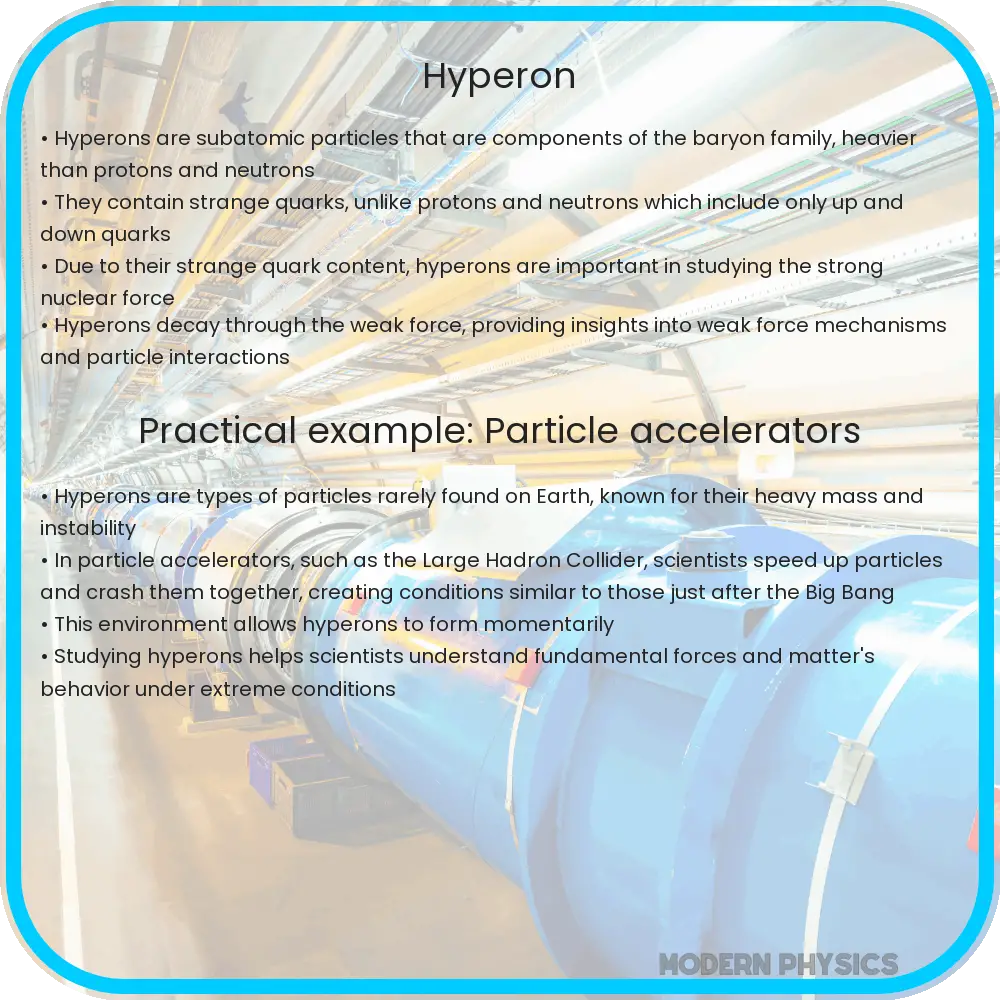
The discovery of hyperons represents a significant milestone in the field of particle physics, offering profound insights into the fundamental structures that compose the universe. Hyperons are types of baryons, particles that, along with mesons, constitute the family known as hadrons. Unlike their more well-known counterpart, the proton, hyperons are distinguished by their strange quark content, which imbues them with unique properties and makes them invaluable in studying the strong nuclear force and the conditions of the early universe.
Hyperons were first observed during cosmic ray experiments in the late 1940s and early 1950s. These particles, which include the Lambda (Λ), Sigma (Σ), Xi (Ξ), and Omega (Ω) particles, are heavier than protons and neutrons and possess a short lifespan, decaying into lighter particles through the weak force. The discovery of hyperons challenged existing models of particle physics and spurred the development of the quark model, which posits that hadrons are composed of three quarks.
- Λ (Lambda) – Comprising one up, one down, and one strange quark, the Lambda hyperon plays a crucial role in understanding how the strange quark affects particle mass and decay processes.
- Σ (Sigma) – Existing in three charge states (Σ+, Σ0, and Σ–), Sigma hyperons provide insights into the interactions between strange and non-strange quarks.
- Ξ (Xi) – With two strange quarks, Xi hyperons help physicists explore the dynamics of the strong force in environments with high strange quark content.
- Ω (Ω) – The discovery of the Omega minus (Ω–), containing three strange quarks, confirmed the existence of the three-quark model and the concept of quark flavors.
The study of hyperons not only enhances our understanding of quantum chromodynamics (QCD), the theory describing the strong interaction between quarks and gluons, but also provides essential clues about the conditions and processes that shaped the early universe. By analyzing hyperon properties and interactions, scientists can infer the characteristics of the dense, hot matter that existed moments after the Big Bang, offering a window into the evolution and structure of the cosmos.
Advancements in Hyperon Research and Cosmic Implications
Recent advancements in hyperon research have been propelled by high-energy particle accelerators and sophisticated detection technologies. Facilities like the Large Hadron Collider (LHC) at CERN allow physicists to create and study hyperons under controlled conditions, simulating the high-energy environments found in the early universe. These experiments provide critical data that helps refine our understanding of the Standard Model of particle physics and the behavior of matter under extreme conditions.
One of the most intriguing aspects of hyperon research is its implications for astrophysics, particularly in the study of neutron stars. These dense remnants of supernova explosions may contain a core of strange quark matter, where hyperons could theoretically exist. Understanding the properties of hyperons enables scientists to make predictions about the internal composition and surface phenomena of neutron stars, which in turn influences our understanding of gravitational waves and the structure of space-time itself.
Furthermore, the study of hyperon decay processes contributes to the ongoing investigation of CP violation, a phenomenon that could explain the matter-antimatter asymmetry in the universe. By examining how hyperons and their antiparticles decay differently, physicists hope to uncover the reasons behind the dominance of matter over antimatter, an essential question for cosmology and the ultimate fate of the universe.
Conclusion
The discovery and ongoing research into hyperons are at the heart of modern physics, straddling the domains of particle physics, astrophysics, and cosmology. As enigmatic components of the subatomic world, hyperons provide a unique lens through which we can explore the fundamental forces and events that shape our universe. Their study not only deepens our understanding of the fabric of matter but also addresses some of the most profound questions about the origin and evolution of the cosmos. As technology and theoretical models advance, the mysteries surrounding hyperons and their place in the cosmic narrative continue to unravel, promising new insights into the very nature of reality.