
Explore the world of Hyperelastic Material Modeling: its key features, applications, challenges, and future innovations in various industries.
Understanding Hyperelastic Material Modeling
Hyperelastic materials, often known as Green elastic materials, are characterized by their ability to undergo significantly large deformations and then return to their original shape upon unloading. This unique behavior makes them ideal for various applications in industries ranging from automotive to biomedical engineering. Hyperelastic material modeling is a computational approach used to predict the behavior of these materials under various loading conditions, ensuring both accuracy and efficiency in design and analysis.
Key Features of Hyperelastic Material Models
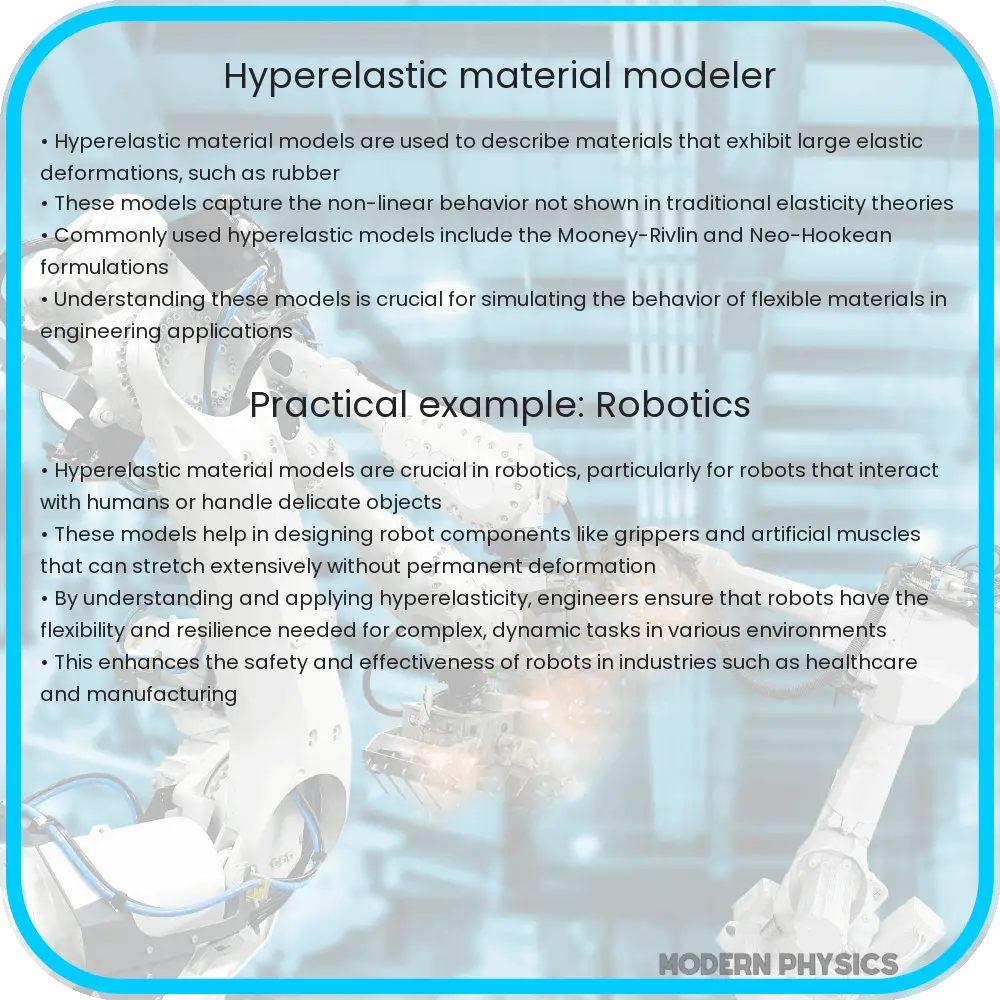
Hyperelastic models are essential in capturing the non-linear elastic response of materials like rubbers, elastomers, and biological tissues. These models are defined by strain energy density functions, which relate the strain energy in a material to the deformation it experiences. The most commonly used models include the Neo-Hookean, Mooney-Rivlin, and Ogden models, each with its unique formulation to address different material behaviors.
- Neo-Hookean Model: Simplified model ideal for moderate deformations, defined by a single material parameter.
- Mooney-Rivlin Model: More general than Neo-Hookean, incorporates two parameters, better for larger deformations.
- Ogden Model: Highly flexible model, capable of handling very large deformations with multiple parameters.
These models are integral in simulating how hyperelastic materials behave under different loading scenarios, such as stretching, compressing, and twisting. Accurate modeling is crucial in predicting how a material might behave in real-world applications, ensuring safety and reliability.
Applications of Hyperelastic Material Modeling
The practical applications of hyperelastic material modeling are diverse and impactful. In the automotive industry, these models are used to design components like tires and engine mounts, where elasticity and durability are paramount. In biomedical engineering, they are vital for simulating the mechanical behavior of human tissues and organs, aiding in the development of prosthetics and other medical devices. Moreover, in consumer products like shoes and sports equipment, hyperelastic modeling ensures comfort and performance.
Advances in computational power and numerical methods have made hyperelastic material modeling more accessible and accurate. Modern software tools can efficiently handle complex geometries and loading conditions, enabling engineers and designers to innovate with confidence. By accurately predicting how materials will perform, designers can optimize their products for both functionality and longevity.
Challenges and Innovations in Hyperelastic Material Modeling
Despite the advances, hyperelastic material modeling still faces challenges, particularly in accurately predicting long-term behavior under varying environmental conditions. Factors like temperature, UV exposure, and chemical interactions can significantly alter the properties of hyperelastic materials, making it challenging to model their behavior over extended periods. Therefore, ongoing research is focused on developing models that can incorporate these environmental factors, providing a more comprehensive understanding of material performance.
Integration with Modern Technologies
The integration of hyperelastic material modeling with other modern technologies is paving the way for groundbreaking applications. For instance, the combination with finite element analysis (FEA) allows for more detailed and precise simulations of complex structures. Additionally, the incorporation of machine learning algorithms is enabling the prediction of material behavior based on vast datasets, further enhancing the accuracy and efficiency of the models.
Future Directions
Looking forward, the field of hyperelastic material modeling is poised for further innovations. One key area is the development of more advanced models that can handle the behavior of composite materials and structures. Additionally, as 3D printing and additive manufacturing technologies evolve, there is a growing need for models that can predict how hyperelastic materials behave in these new manufacturing processes. This will be crucial in sectors like aerospace and biomedical engineering, where customized and complex parts are increasingly in demand.
Conclusion
Hyperelastic material modeling stands as a cornerstone in the field of material science and engineering. Its ability to predict the behavior of materials under extreme conditions is not only fascinating but also immensely practical. As the technology continues to evolve, it opens new frontiers in various industries, from automotive to healthcare. The integration with other technologies like FEA and machine learning is propelling this field into a new era of innovation and discovery. While challenges remain, particularly in long-term behavior prediction and environmental factors, the future of hyperelastic material modeling is bright, promising more accurate, efficient, and advanced solutions for material design and application.