
Explore the enigmatic world of hyper-velocity stars (HVSs), their origins, incredible speeds, and impact on astrophysics, shedding light on galaxy dynamics and dark matter.
Understanding Hyper-Velocity Stars
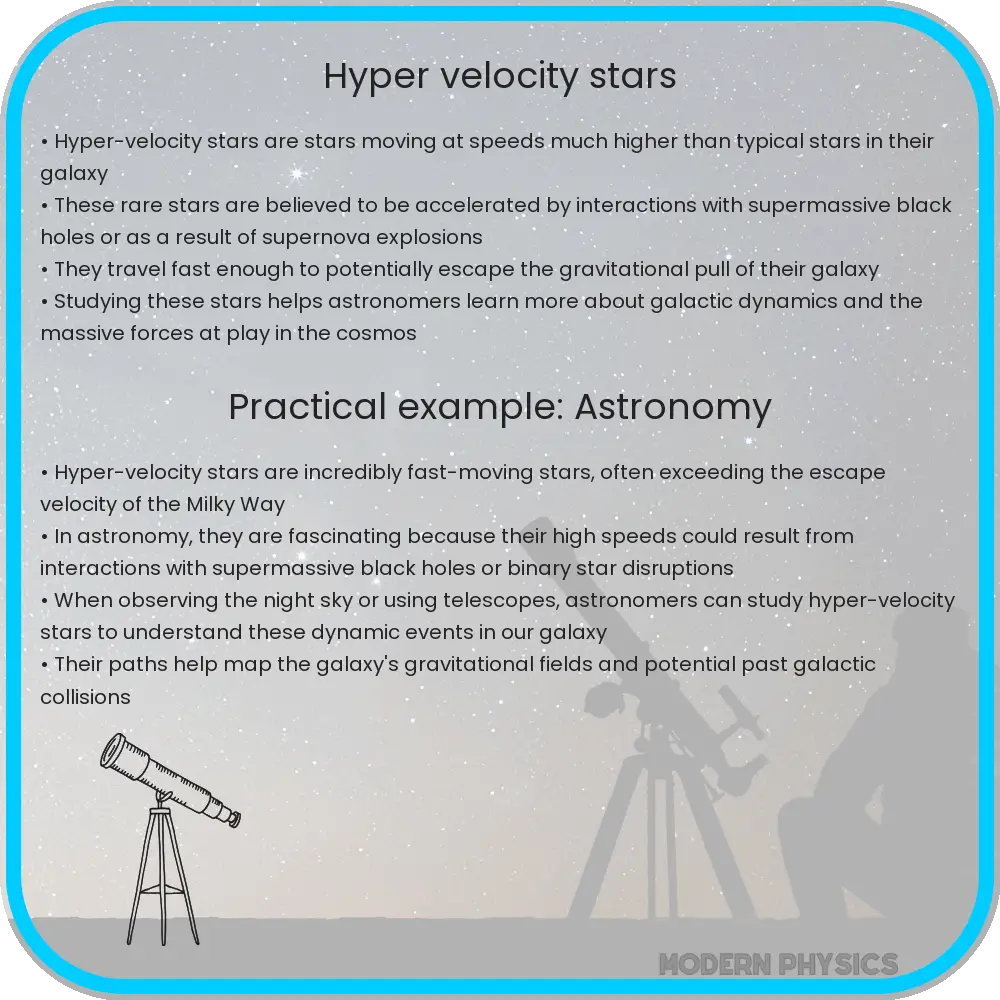
Hyper-velocity stars (HVSs) are astronomical phenomena characterized by their exceptional speed, traveling through space at velocities so great they can escape the gravitational pull of our Milky Way galaxy. This unique class of stars, first identified in the early 21st century, continues to intrigue and puzzle astronomers today.
Origins of Hyper-Velocity Stars
The origins of HVSs are still a topic of active research, but several theories have been proposed to explain their incredible velocities. One leading hypothesis suggests that these stars are the products of binary star systems interacting with the massive black hole at the center of the Milky Way. According to this theory, when a binary star system gets too close to the galaxy’s central black hole, one star is captured while the other is ejected at high speeds, becoming a hyper-velocity star.
Speed and Measurement
Hyper-velocity stars travel at speeds ranging from 300 to over 700 kilometers per second, significantly faster than the average star velocity in the Milky Way. Such high velocities are measured using spectroscopic observations, which allow astronomers to determine the star’s motion towards or away from Earth by observing the Doppler shift in the star’s light spectrum.
Impact in Astrophysics
The study of HVSs has significant implications for astrophysics. They serve as probes of the gravitational fields they traverse, offering insights into the distribution of dark matter in our galaxy. Additionally, the mechanisms behind their ejection contribute to our understanding of the dynamics surrounding supermassive black holes and the galactic center. Furthermore, HVSs challenge existing models of star formation and evolution, prompting new theories and simulations to explain their properties and trajectories.
Challenges in HVS Research
Despite their significance, studying HVSs poses considerable challenges. Their rarity and the vast distances involved make detection and observation difficult. Moreover, differentiating HVSs from stars with high velocities due to other astrophysical processes requires precise measurements and careful analysis.
Future Directions in HVS Research
The future of hyper-velocity star research is promising, with advancements in telescope technology and data analysis methods expected to increase the number of detected HVSs significantly. Upcoming missions and observatories, such as the James Webb Space Telescope and the European Space Agency’s Gaia mission, are anticipated to provide more detailed observations and a better understanding of these stars’ trajectories and origins.
In addition to technological advancements, theoretical work continues to evolve. Simulations and models are becoming increasingly sophisticated, allowing scientists to predict the conditions under which HVSs can be ejected and to simulate their journeys through the galaxy. These models are crucial for identifying the likely origins of observed HVSs and for understanding the complex dynamics at play in their creation.
Collaborative Efforts and Interdisciplinary Impact
The study of HVSs is not confined to the realm of traditional astronomy; it encompasses elements of physics, cosmology, and even galactic archaeology. Collaborative efforts across these disciplines are essential for piecing together the history and mechanics of our galaxy. Moreover, the phenomena of HVSs serve as a unique bridge between the study of stellar dynamics, galactic structure, and black hole physics, offering a rare window into the interplay between these fields.
Conclusion
Hyper-velocity stars represent one of the most fascinating subjects in modern astrophysics, offering insights into the nature of our galaxy and the forces that shape it. Their extreme velocities and unusual trajectories challenge existing theories and models, providing a unique testing ground for new ideas. As observational techniques improve and theoretical models advance, the study of HVSs promises to shed light on some of the most pressing mysteries in the cosmos, from the distribution of dark matter to the behavior of supermassive black holes. In this way, HVSs not only expand our knowledge of the universe but also underscore the interconnectedness of various astrophysical phenomena and the continual need for interdisciplinary research in unlocking the secrets of the cosmos.