
Explore the fascinating world of Horizontal Branch Oscillations in stars, understanding their causes, impacts, and the advanced techniques used to study them.
Introduction to Horizontal Branch Oscillations
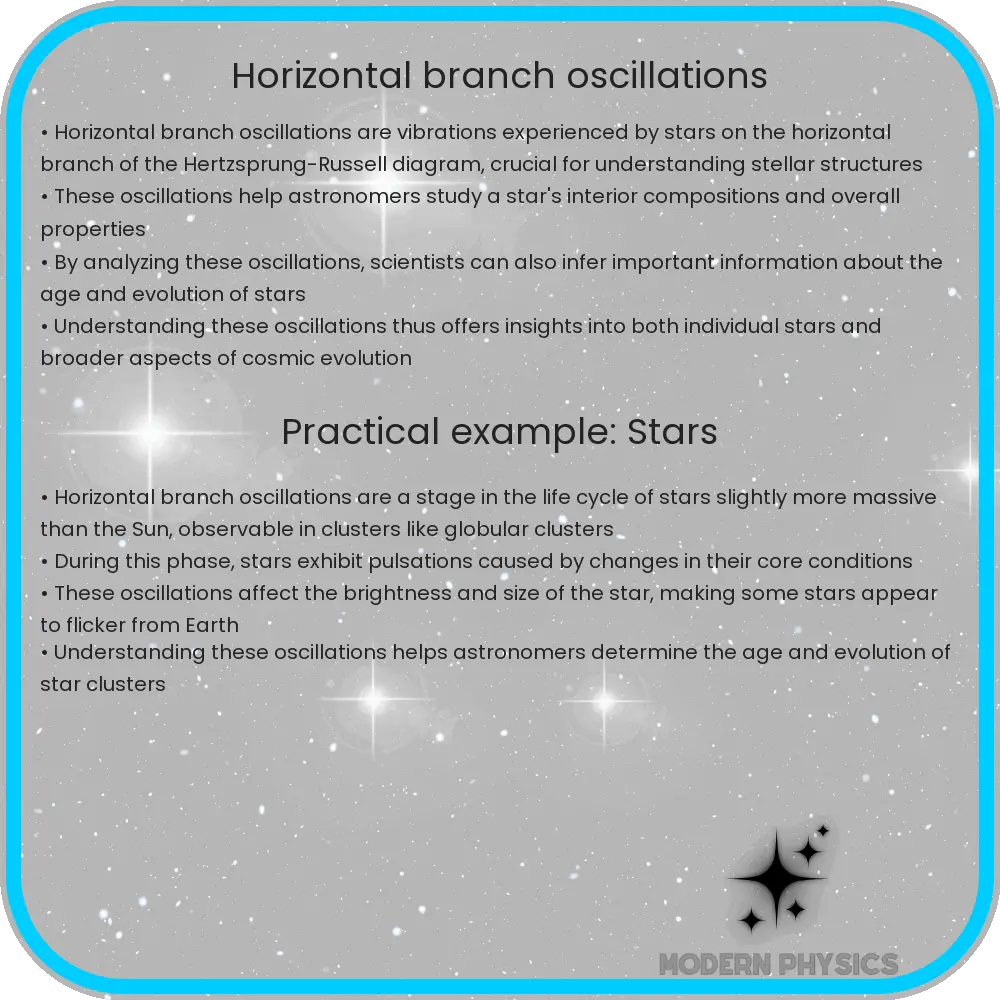
Horizontal Branch Oscillations (HBOs) are a significant astrophysical phenomenon observed in the horizontal branch (HB) stars of globular clusters. These oscillations are of particular interest because they provide deep insights into the internal structure and evolutionary stages of these stars. The horizontal branch is a phase in the life of a star where it undergoes core helium burning after the red giant phase, characterized by a relatively stable period in the star’s life cycle.
Causes of Horizontal Branch Oscillations
The primary cause behind HBOs is believed to be related to the helium fusion process in the core of horizontal branch stars. During this stage, the star’s core is compact and extremely hot, facilitating the fusion of helium into carbon and oxygen. This process can lead to variable and unstable conditions, causing the star to oscillate. Factors such as stellar mass, composition, and age can influence the amplitude and frequency of these oscillations.
- Stellar Mass: The mass of the star plays a crucial role in the development and characteristics of HBOs. Stars with different masses will have different core temperatures, affecting the helium burning process and consequently the nature of the oscillations.
- Chemical Composition: The initial chemical makeup of a star, particularly the helium and heavier elements’ abundance, significantly impacts its horizontal branch evolution and oscillatory behavior.
- Age: The age of the star affects its position on the horizontal branch and, thus, its oscillation properties. Older stars may exhibit different oscillation patterns compared to younger ones.
Impact of Horizontal Branch Oscillations
HBOs have substantial impacts on our understanding of stellar dynamics and evolution. By studying these oscillations, astronomers can gain insights into the interior processes of stars and the fundamental principles governing their evolution. Moreover, these oscillations affect the star’s luminosity and temperature, contributing to our understanding of globular clusters’ characteristics and the distance scale of the universe.
Observational Techniques and Challenges
Observing Horizontal Branch Oscillations presents unique challenges. These include the need for high precision photometry and spectroscopy to detect minute changes in brightness and surface temperature. Space-based telescopes, such as the Hubble Space Telescope and the Gaia satellite, have been instrumental in this regard, providing the necessary precision and broad wavelength coverage. Ground-based observations, while more accessible, often contend with atmospheric interference, making the detection of subtle oscillations more difficult.
Research and Theoretical Models
Theoretical models play a crucial role in understanding HBOs. Astrophysicists use these models to simulate conditions in the interiors of horizontal branch stars, predicting oscillation frequencies and amplitudes based on various physical parameters. These theoretical predictions are then compared with observational data, leading to refinements in our understanding of stellar physics. However, discrepancies between models and observations can highlight gaps in our knowledge, driving further research and development in stellar astrophysics.
- Hydrodynamic Simulations: These simulations allow scientists to model the complex movements of gases and plasma inside stars, helping to predict how these movements contribute to observed oscillations.
- Stellar Evolution Codes: These codes help astronomers predict a star’s life cycle stages, including the horizontal branch phase, providing context for the observed oscillations.
Conclusion
Horizontal Branch Oscillations offer a window into the complex inner workings of stars during a critical phase of their evolution. By studying these oscillations, astronomers can improve their understanding of stellar structure, evolution, and the chemical composition of the universe. Despite the challenges inherent in observing and modeling these phenomena, ongoing advancements in telescope technology and computational models continue to enhance our understanding. As research progresses, we can expect to uncover even more about the mysterious lives of stars and the cosmic tapestry to which they belong.