
Explore the precision, constraints, and dynamics of holonomic systems in robotics and engineering, and their future in AI and technology.
Understanding Holonomic Systems: An Exploration of Precision, Constraints, and Dynamics
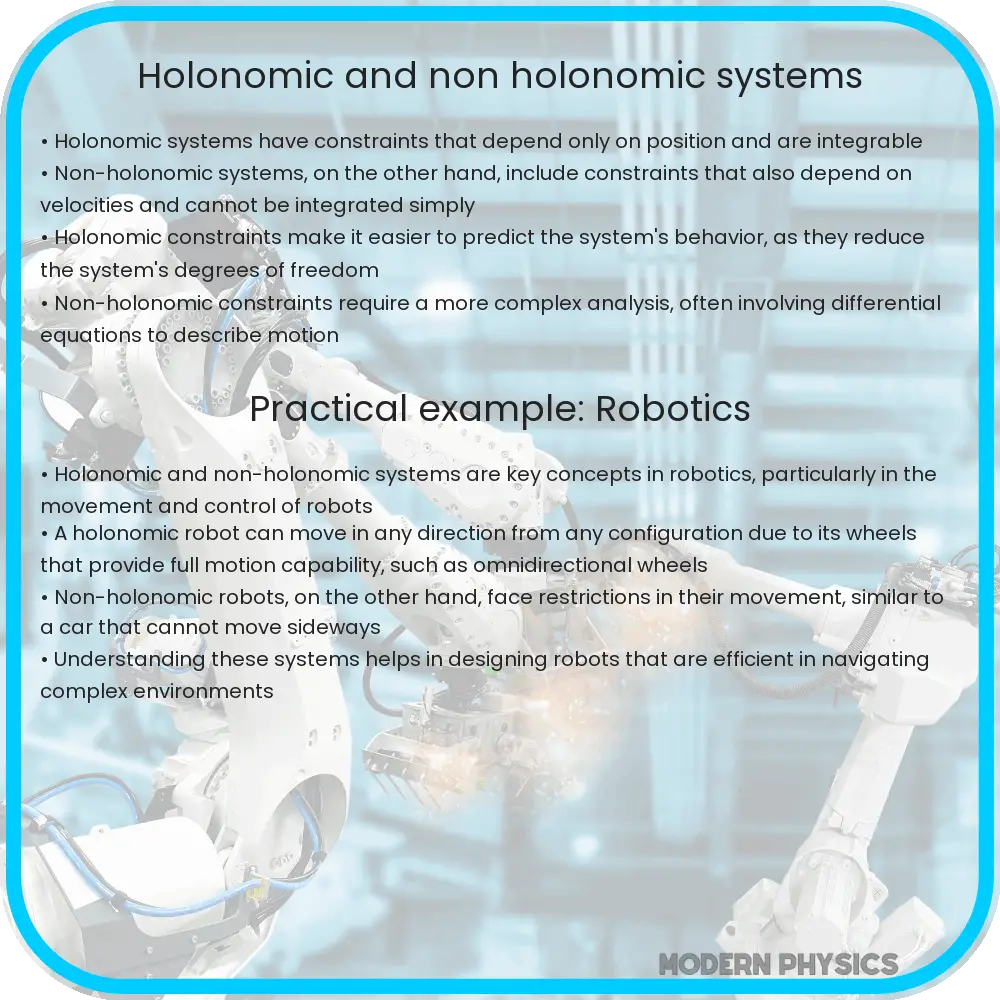
Holonomic systems, a cornerstone concept in robotics and mechanical engineering, represent a specific category of systems where the constraints on motion are integrable into positional constraints. These constraints are expressed as mathematical equations relating to the coordinates of the system, significantly influencing the system’s behavior and control.
Precision in Holonomic Systems
The precision of holonomic systems is pivotal, especially in robotics and automation. Precision refers to the system’s ability to accurately and repeatedly reach a specific position or follow a particular trajectory. This accuracy is often dictated by the quality of the components, the sophistication of the control algorithms, and the precision with which constraints are defined and adhered to.
Constraints in Holonomic Systems
Constraints in holonomic systems are typically described by equations relating to the system’s coordinates. These can be linear or non-linear and may involve time-dependent or independent variables. For example, a robotic arm with joints connected in a certain sequence has its movement constrained by the lengths and angles of its joints. These constraints ensure predictable and controllable motion, which is essential in applications like automated assembly lines or surgical robotics.
Dynamics of Holonomic Systems
The dynamics of holonomic systems involve understanding how forces and torques interact with the constraints to produce motion. This requires a deep understanding of classical mechanics, particularly Newtonian mechanics for most engineering applications. The dynamics are governed by differential equations derived from principles like Newton’s laws of motion and conservation of energy. For instance, the dynamic model of a robotic arm involves equations that describe how the arm moves in response to applied forces, considering its mass, inertia, and constraints.
In conclusion, holonomic systems, with their distinctive constraints, play a critical role in the precision and dynamics of various mechanical and robotic systems. Their study involves an intricate balance of physics, mathematics, and engineering principles to design systems that can perform complex tasks with high accuracy and reliability.
Applications of Holonomic Systems
Holonomic systems find extensive applications in various fields due to their precise control and constraint management. In robotics, these systems are crucial for designing robots that can navigate complex environments, such as planetary rovers or underwater vehicles. In the automotive industry, holonomic constraints are applied in advanced driver-assistance systems (ADAS) for enhanced safety and maneuverability. Similarly, in manufacturing, they enable the design of highly efficient and precise automated machinery, essential for tasks like assembly, painting, or welding.
Challenges in Holonomic Systems
Despite their advantages, holonomic systems present unique challenges. One significant challenge is the complexity in designing and controlling these systems, especially when dealing with non-linear constraints or environments with unpredictable variables. Additionally, ensuring the reliability and durability of such systems under varying operational conditions poses a substantial engineering challenge.
Future Perspectives
The future of holonomic systems is geared towards integrating more advanced technologies like artificial intelligence and machine learning. These technologies promise to enhance the adaptability and decision-making capabilities of holonomic systems, allowing for more autonomous and efficient operations. Furthermore, advancements in materials science and sensor technology will continue to push the boundaries of what these systems can achieve in terms of precision and complexity.
Conclusion
Holonomic systems represent a fascinating intersection of mechanical design, control theory, and practical engineering. Their role in enabling precise, controlled motion makes them indispensable in modern technology, from robotics to automotive engineering. While challenges in design and control persist, ongoing advancements in technology continually expand their capabilities and applications. As we look to the future, the integration of AI and machine learning, along with improvements in material and sensor technologies, will undoubtedly unlock new potentials and applications for holonomic systems, further cementing their role in the technological landscape.