
Discover the benefits of holographic sights for shooting accuracy and versatility, exploring advanced optics technology in our comprehensive guide.
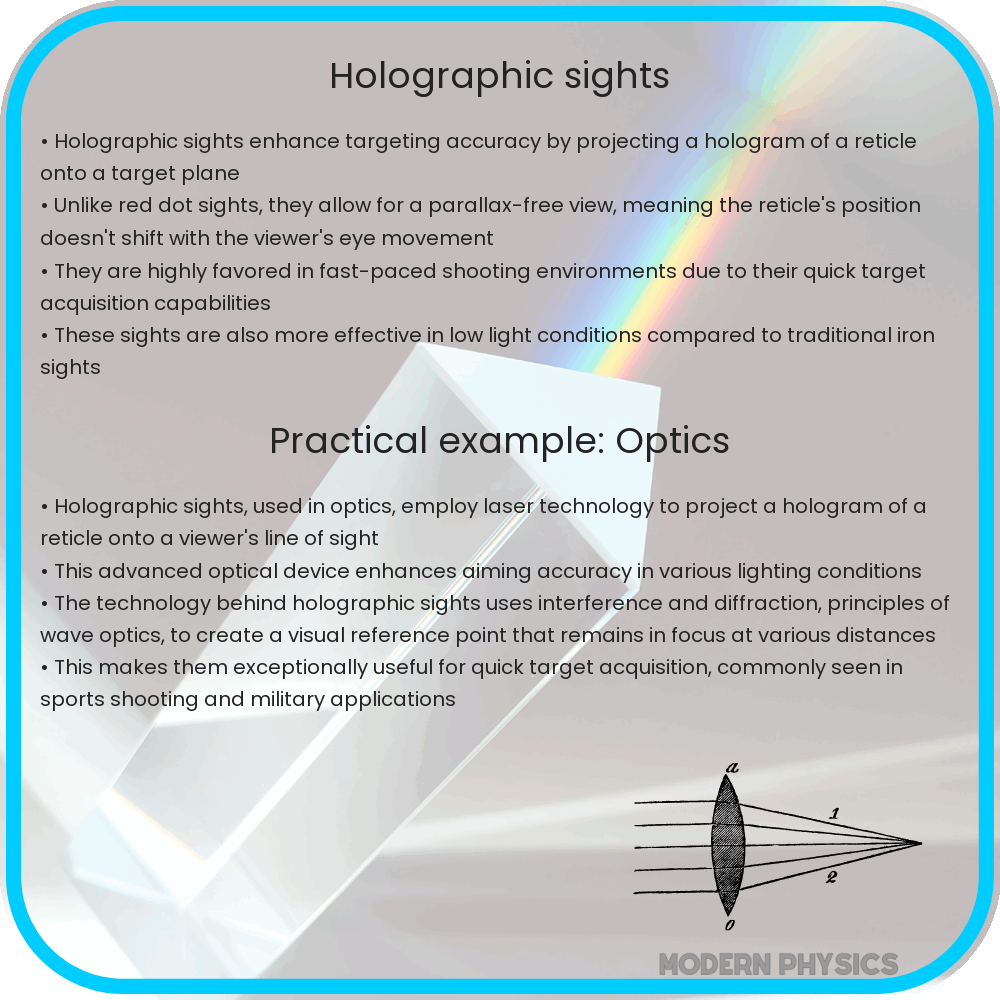
Holographic Sights: Enhancing Shooting Precision through Advanced Optics
Holographic sights represent a significant leap forward in firearm optics technology, offering shooters unparalleled accuracy and versatility. Unlike traditional iron sights and even red dot sights, holographic sights project an illuminated reticle onto a viewing window, creating a virtual sighting point that enhances target acquisition speed and accuracy. This technology leverages complex optics and laser technology to provide a solution that excels in a variety of lighting conditions and environments.
Understanding the Technology Behind Holographic Sights
At the core of holographic sight technology is the use of a laser diode to project a hologram of the reticle. This hologram is recorded in three dimensions onto a holographic film within the sight’s optic. When the shooter looks through the sight, a laser light illuminates and projects this hologram back to the shooter’s eye, allowing for precise aiming. This method ensures that the reticle remains in focus at the same distance as the target, significantly reducing parallax errors and allowing for more accurate shots over different distances.
Accuracy and Versatility
The primary advantage of holographic sights over traditional aiming methods is their ability to allow shooters to keep both eyes open while engaging targets. This not only provides a wider field of view but also improves situational awareness. The reticle, often a simple dot or a more complex pattern, appears to float at the target distance, making it easier to track moving targets and adjust for windage and elevation without losing sight of the objective.
Advancements in Optics Technology
Holographic sights incorporate the latest in optics and laser technology, including advanced coatings and holographic diffraction patterns. These technical enhancements improve the sight’s durability, reliability, and performance in extreme conditions. The use of anti-reflective coatings on the optic lens minimizes glare and maximizes light transmission, ensuring clear visibility even in bright sunlight. Moreover, the robust construction of holographic sights makes them resistant to water, fog, and shock, further testament to their versatility and suitability for a wide range of applications, from military operations to recreational shooting.
Exploring the Impact of Holographic Sights on Shooting Accuracy and Versatility
Holographic sights have revolutionized the way shooters engage targets, offering enhanced accuracy, speed, and adaptability across a wide range of shooting conditions. Unlike traditional iron sights or magnified optics, holographic sights project an illuminated reticle onto a glass panel through the use of hologram technology. This innovative approach to target acquisition has significant implications for both tactical and recreational shooting.
The Science Behind Holographic Sights
At the heart of the holographic sight technology is the use of laser diodes to create a holographic reticle image. This image is then projected onto the shooter’s field of view, appearing as if it’s floating at the target distance. This method allows for parallax-free aiming, meaning that the reticle’s position does not change with the shooter’s eye position, enhancing accuracy significantly.
Advantages of Holographic Sights in Enhancing Shooting Performance
- Improved Accuracy: Holographic sights provide a clear aiming point that is unaffected by the shooter’s eye position, significantly reducing aiming errors and increasing hit probability.
- Faster Target Acquisition: The illuminated reticle design allows shooters to quickly acquire targets, especially in low-light conditions or against visually complex backgrounds.
- Greater Versatility: These sights are effective at both close and medium ranges, making them ideal for a variety of shooting disciplines, from close-quarters combat to hunting.
Optical Technologies and Future Trends
Advancements in optical technologies continue to push the boundaries of what holographic sights can achieve. Innovations in laser and hologram technology are making these sights more durable, reliable, and capable of operating under extreme conditions. Furthermore, the integration of wireless connectivity and smart features, such as ballistic calculators and GPS, is expected to further enhance the versatility and effectiveness of holographic sights in the future.
Conclusion
Holographic sights represent a significant leap forward in shooting optics, offering unmatched accuracy, speed, and versatility. Their unique combination of hologram technology and user-friendly design makes them an indispensable tool for modern shooters. As optical technologies continue to evolve, the future of holographic sights looks promising, with potential enhancements that could redefine standards for shooting accuracy and performance. Whether for tactical applications, competitive shooting, or recreational use, holographic sights offer a clear advantage, demonstrating the profound impact of advanced optics on the shooting sports.