
Explore the intriguing world of high-velocity particle experiments, uncovering the impact of speed, relativity, and groundbreaking discoveries in physics.
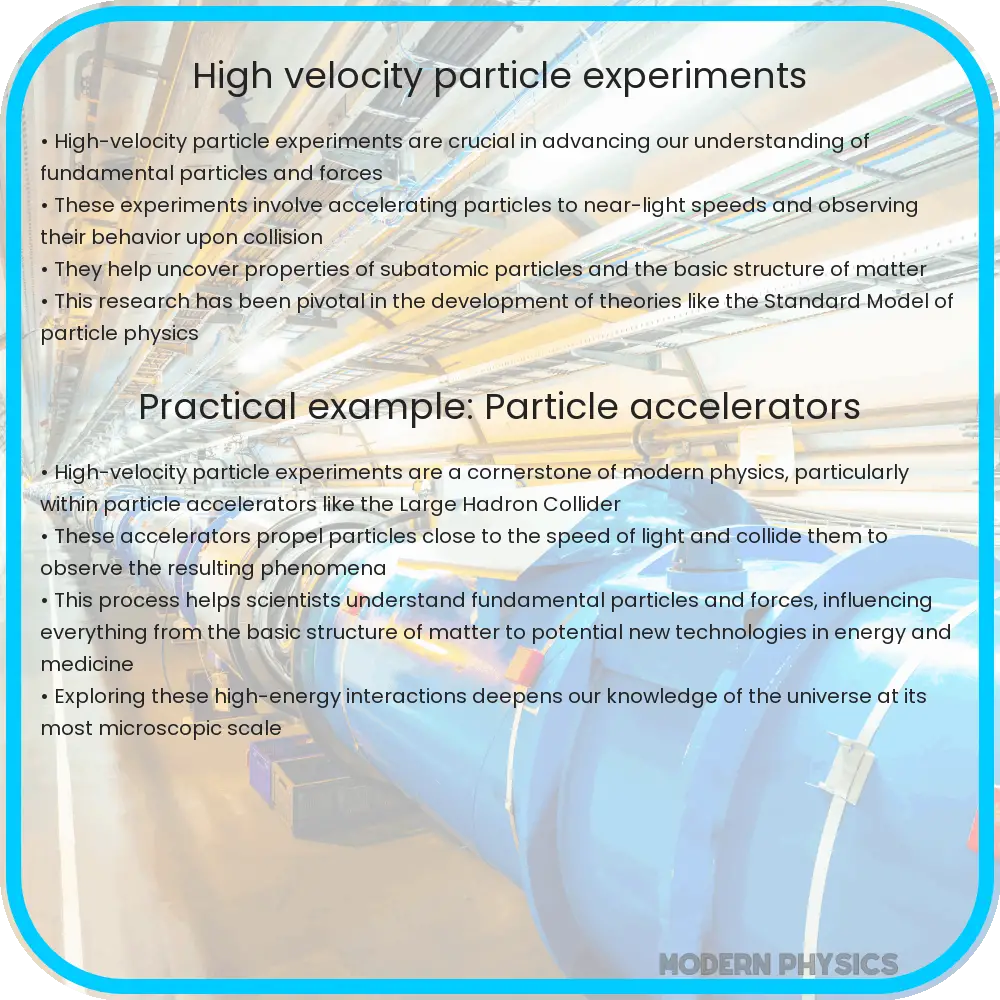
Exploring High-Velocity Particle Experiments: Unveiling the Mysteries of Speed, Impact, and Relativity
High-velocity particle experiments represent a crucial frontier in modern physics, offering insights into the fundamental laws that govern our universe. These experiments involve accelerating particles to incredibly high speeds and observing their behavior and interactions. The findings from these studies have profound implications in the fields of quantum mechanics, relativity, and astrophysics.
The Role of Speed in Particle Experiments
Speed is a critical factor in high-velocity particle experiments. As particles are accelerated to velocities approaching the speed of light, their behavior starts to deviate significantly from classical physics predictions. This high-speed realm is where the principles of Einstein’s Special Theory of Relativity become particularly relevant. According to relativity, as the speed of a particle increases, its mass effectively increases, and time dilates. These changes are imperceptible at everyday speeds but become significant at velocities close to the speed of light.
Impact and Collision Experiments
Collision experiments are a core aspect of high-velocity particle studies. Facilities like the Large Hadron Collider (LHC) accelerate particles in opposite directions before allowing them to collide. These collisions create conditions similar to those just after the Big Bang, giving scientists a glimpse into the early universe’s conditions. The impact results in the formation of new particles, some of which are highly unstable and exist for only fractions of a second. Detecting these particles helps in understanding the fundamental building blocks of matter.
Relativistic Effects on Particles
Relativity plays a pivotal role in high-velocity particle experiments. As particles reach near-light speeds, relativistic effects like time dilation and length contraction come into play. For instance, a particle moving at 99% of the speed of light experiences time at a significantly slower rate compared to a stationary observer. This phenomenon has been confirmed through experiments and is integral to understanding how particles behave under extreme conditions.
In conclusion, high-velocity particle experiments are a window into the extreme conditions of our universe, revealing much about the fundamental properties of matter and the laws of physics. The next part of this article will delve deeper into the specific experiments and discoveries that have been made in this fascinating field of physics.
Is this conversation helpful so far?
Delving Deeper: Significant Experiments and Discoveries
One of the most significant high-velocity particle experiments is the Large Hadron Collider (LHC) at CERN. The LHC has been instrumental in numerous groundbreaking discoveries, including the Higgs boson, a particle that provides key insights into the origin of mass. Another notable experiment is the Relativistic Heavy Ion Collider (RHIC), which collides heavy ions to study a form of matter known as quark-gluon plasma, believed to have existed shortly after the Big Bang.
Technological Advancements in Particle Acceleration
Advancements in technology have played a crucial role in high-velocity particle experiments. Modern particle accelerators, like synchrotrons and cyclotrons, use electromagnetic fields to accelerate particles to near-light speeds. These machines not only enable the study of fundamental particles but also have practical applications in medicine, such as in cancer radiation therapy.
Theoretical Implications and Future Directions
Theoretical physics heavily relies on findings from high-velocity particle experiments. These experiments have led to the development and refinement of the Standard Model of particle physics, which describes the fundamental particles and forces in the universe. Future experiments aim to explore beyond the Standard Model, searching for answers to unsolved mysteries like dark matter and the imbalance between matter and antimatter.
Impact on Astrophysics and Cosmology
High-velocity particle experiments have significant implications for astrophysics and cosmology. By replicating conditions found in extreme astrophysical environments, such as near black holes or during the early stages of the universe, these experiments provide insights into cosmic phenomena and the overall evolution of the cosmos.
Conclusion
In summary, high-velocity particle experiments are a cornerstone of modern physics, providing invaluable insights into the fundamental aspects of our universe. Through advanced technologies and theoretical models, these experiments not only deepen our understanding of the microscopic world but also offer perspectives on the vast cosmos. As technology and theoretical frameworks continue to evolve, the future of high-velocity particle physics promises even more groundbreaking discoveries and a deeper understanding of the intricacies of our universe.