
Helium dimer spectroscopy examines He2 molecules, exploring their weak van der Waals interactions and quantum mechanical effects at low temperatures.
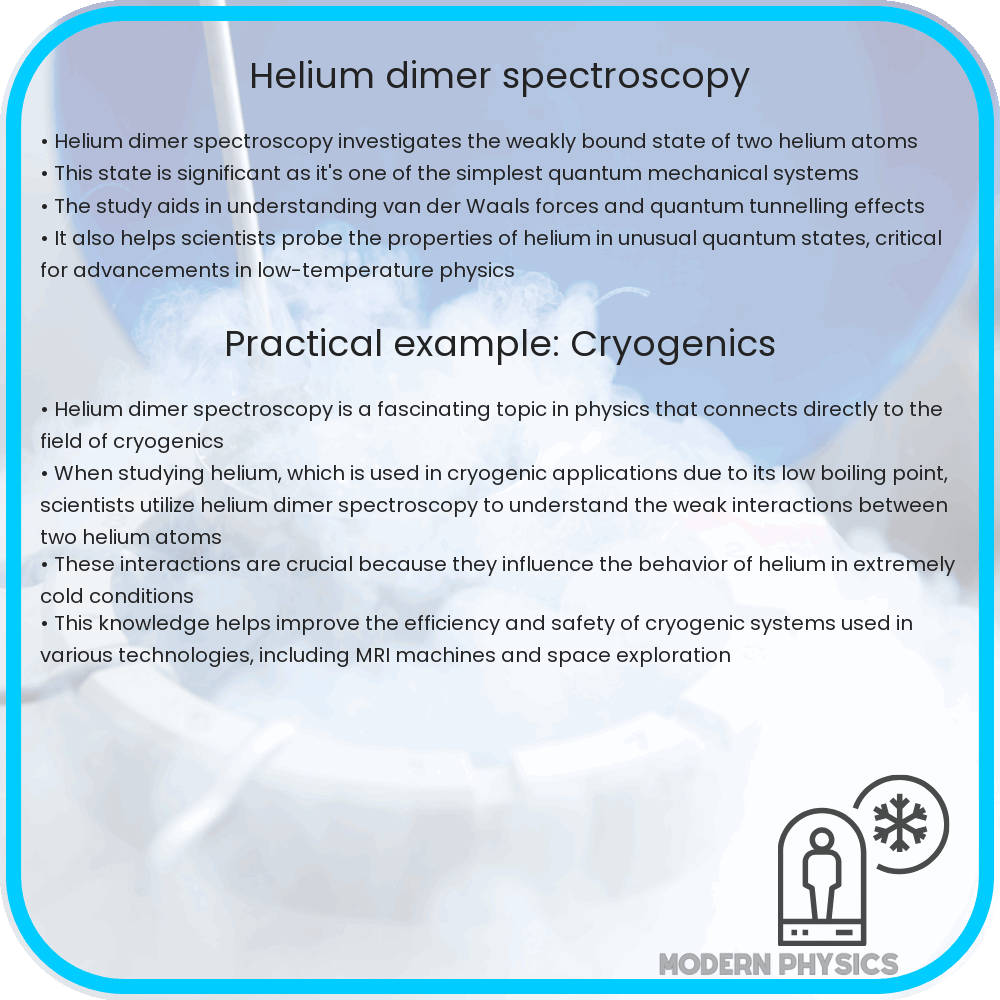
Overview of Helium Dimer Spectroscopy
Helium dimer spectroscopy is a fascinating and intricate field of study within the realm of physical chemistry and quantum physics. This method helps scientists explore the exceptionally weakly-bound state of helium dimers (He2), which are pairs of helium atoms bound together by van der Waals forces. Despite their weak binding, understanding these dimers provides insight into non-covalent bonding, quantum mechanical effects at low temperatures, and intermolecular interactions in the simplest form.
The helium dimer is the largest diatomic molecule known, in terms of bond length, and one of the most elusive due to its weak bonding and the challenge of detection. Notably, the bond length in a helium dimer can exceed 50 angstroms, which is much larger than typical diatomic bond lengths.
Techniques in Helium Dimer Spectroscopy
The critical component in studying helium dimers lies in the techniques used to detect and analyze their spectroscopic characteristics. The most commonly used method is the diffraction technique involving molecular beams. In this approach, helium atoms cooled to extremely low temperatures form dimers within a supersonic expansion beam. Researchers then probe these dimers with laser or electron beams, capturing information on their rotational and vibrational spectra.
Another significant technique is mass spectrometry, which assists in confirming the occurrence and stability of helium dimers. This method also measures the weak binding energy that characterizes the He2 molecule.
Quantum Mechanical Implications of Helium Dimer Studies
Studying helium dimers offers a window into quantum mechanics’ subtleties in a few-body system. Since helium atoms are neutral and possess very close energy levels between their ground and first excited states, the interaction within the dimer is governed largely by quantum fluctuations. This makes He2 an excellent test case for quantum theories related to weak and van der Waals interactions.
Moreover, the large average distance between the helium atoms within the dimer compared to typical molecular sizes allows researchers to observe phenomena such as tunneling and zero-point energy, fundamental concepts in quantum physics. These observations help quantify the role these effects play in molecular interactions at very low temperatures.
- Understanding of van der Waals forces in quantum regimes
- Insights into molecular tunneling processes
- Measurements of zero-point energies in weakly bound systems
Applications and Importance of Helium Dimer Spectroscopy
The study of helium dimers not only enriches basic scientific knowledge but also has practical implications. For instance, insights gained from helium dimer spectroscopy contribute to fields such as superfluidity, the study of quantum gases, and potentially in the development of sensors capable of detecting minuscule forces and disruptions in a controlled environment.
Moreover, helium dimer spectroscopy serves as a cornerstone in low-temperature physics, providing essential data that supports broader research into cryogenics and other technologies that operate at near-zero temperatures.
Challenges in Helium Dimer Research
Despite the advancements in helium dimer spectroscopy, researchers face significant challenges. The primary difficulty lies in the extremely weak interaction that holds the helium atoms together, making experimental detection and analysis highly challenging. Moreover, controlling experimental conditions to maintain the ultracold temperatures necessary for the formation of helium dimers requires precise and sophisticated equipment.
Additionally, due to the non-polar nature of helium, standard spectroscopic techniques that rely on electric dipole transitions cannot be used directly. This necessitates the use of more intricate indirect methods to study their properties, further complicating the research process.
Future Prospects in Helium Dimer Research
Looking ahead, the field of helium dimer spectroscopy promises further exciting developments. Advances in technology and methodologies may allow for more detailed and accurate measurements. Researchers are also exploring the possibility of using helium dimers in quantum computing and other advanced technological applications, owing to their unique quantum mechanical properties.
Moreover, as theoretical models of van der Waals forces and quantum interactions improve, the predictions made using helium dimers as a model system will become more accurate. This could lead to enhanced understanding of complex quantum systems, potentially impacting various scientific and technological fields.
Conclusion
Helium dimer spectroscopy, though challenging, offers profound insights into the quantum mechanical world of weakly bonded systems. The subtleties of He2 interaction not only unfold complexities in quantum physics but also bridge fundamental research with potential industrial applications. As technology progresses, helium dimer research stands to contribute significantly to the fields of low-temperature physics, quantum technology, and beyond, making every research effort a valuable pursuit in the vast landscape of physical science.