
Learn about the principles of heat transfer and its practical applications with a hands-on educational kit for all ages.
Understanding Heat Transfer Through a Practical Kit
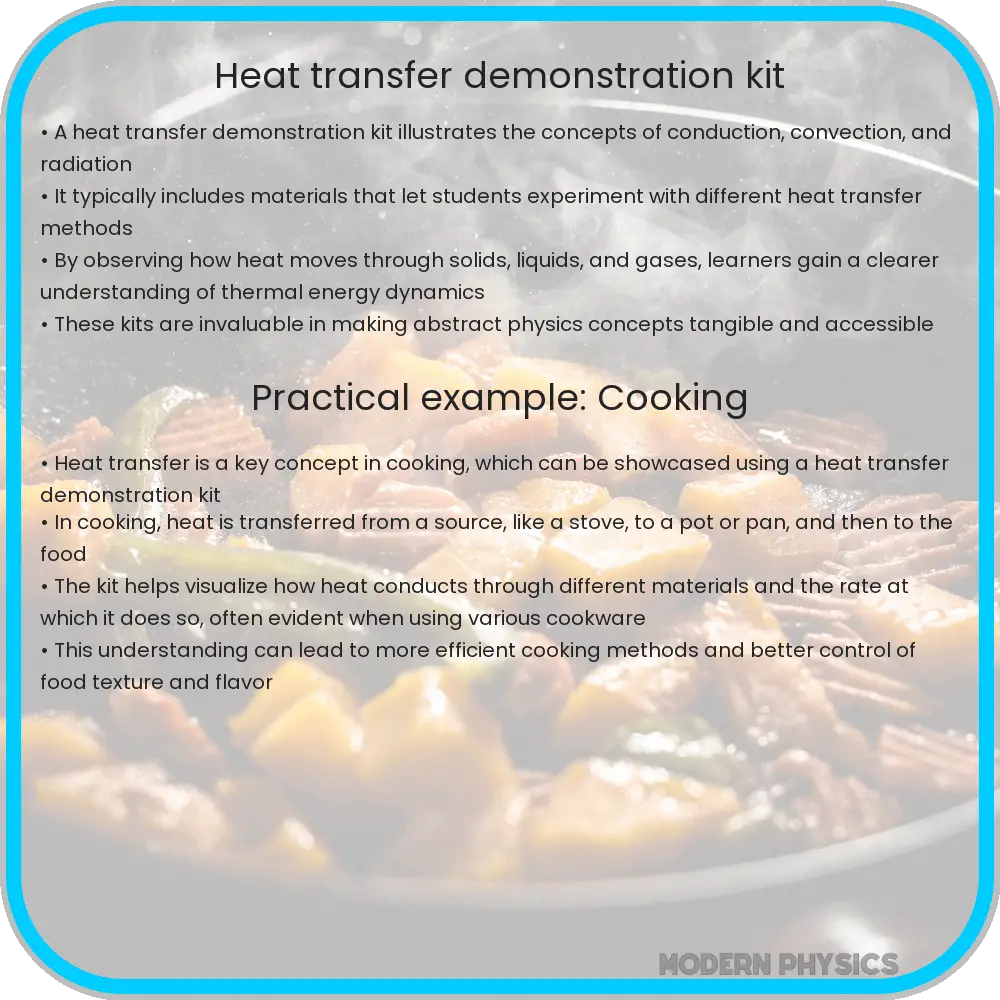
Heat transfer is a fundamental concept in physics that describes how heat moves from one object or substance to another. It plays a critical role in everything from our daily weather to the design of engines and refrigerators. To make this concept more tangible and engaging, a heat transfer kit serves as an excellent educational tool. Such kits often combine theoretical concepts with hands-on experiments, enabling learners of all ages to see the principles of heat transfer in action.
The Essentials of Heat Transfer
The basic idea behind heat transfer lies in the movement of thermal energy due to temperature differences. It’s important to understand that heat always moves from an area of higher temperature to one of lower temperature. There are three primary modes of heat transfer:
- Conduction: This is the transfer of heat through direct contact. Molecules at a higher temperature vibrate more intensely and pass their kinetic energy to neighboring cooler molecules. An example of conduction is a metal spoon getting hot from a boiling pot of soup.
- Convection: Here, heat is transferred by the movement of fluids (which could be liquids or gases). Warm fluid rises and cooler fluid descends in a cycle due to changes in density and thermal energy, like the heating of air over a radiator.
- Radiation: Heat transferred through electromagnetic waves without involving particles directly. The Sun’s warmth reaching the Earth is a classic example of heat transfer by radiation.
Components of a Heat Transfer Kit
A typical heat transfer kit comprises various components designed to demonstrate the principles of conduction, convection, and radiation. These may include:
- Heat Sources: Simple heating elements or lamps to provide controlled amounts of heat.
- Conductive Materials: Metals rods, tiles of different materials, and other elements that clearly show how materials vary in their ability to conduct heat.
- Convection Chambers: Transparent chambers that allow observation of convection currents formed by the heating and cooling of fluids.
- Radiation Demonstrators: Devices such as infrared thermometers or materials with different surface finishes to explore how surfaces emit and absorb radiant energy.
By engaging with each of these components, learners can observe heat transfer in real-time, making abstract concepts much more concrete and understandable.
Typical Experiments Using a Heat Transfer Kit
To provide a clear grasp of how heat transfer works, several experiments can be conducted using the kit:
- Comparing Conductivity: Identify how quickly heat is conducted through different materials by measuring the temperature at various points along rods made of metal, glass, and plastic.
- Visualizing Convection: Use dye to visualize the convection currents in water when heated from below.
- Observing Radiation: Measure how different surfaces absorb or reflect infrared radiation, comparing materials with different colors and textures.
These experiments not only illustrate heat transfer modes but also encourage learners to hypothesize, test, and modify their understanding based on real data, promoting a deeper and more engaging learning experience.
Applying Heat Transfer Concepts in Real-World Scenarios
Understanding the principles of heat transfer can be incredibly useful in real-world applications, ranging from industrial processes to everyday household tasks. Examples include:
- Engineering Applications: Engineers use knowledge of heat transfer to design efficient cooling systems for electronics, automobiles, and large machinery.
- Environmental Control: Heat transfer principles are essential in the design of HVAC (heating, ventilation, and air conditioning) systems to maintain comfortable and healthy indoor environments.
- Culinary Techniques: Cooks manipulate heat transfer when grilling steaks (radiation), boiling water (convection), or preparing a cast iron skillet (conduction).
By relating the experiments conducted with the heat transfer kit to these real-world scenarios, learners can see the practical relevance of their studies and be inspired to explore potential careers where these principles are applied.
Conclusion
The study of heat transfer becomes significantly more engaging and comprehensible when explored through hands-on experiments using a heat transfer kit. By observing the effects of conduction, convection, and radiation firsthand, learners of all ages gain a deeper understanding of these complex physical phenomena. Furthermore, linking these concepts to everyday applications and industrial scenarios shows the practical importance of heat transfer in a variety of fields.
Whether it’s by enhancing their curiosity, fostering analytical skills, or even outlining potential career paths, diving into the principles of heat transfer through practical experimentation is undoubtedly a beneficial and enjoyable learning process. Encouraging continued exploration of physics and its applications helps nurture scientifically literate individuals who are equipped to tackle the challenges of our rapidly evolving technological world.