
Explore the Heat Pipe Demonstrator: an essential tool for understanding and innovating in thermal management, ideal for students and professionals.
Understanding Heat Pipe Technology: A Practical Demonstrator
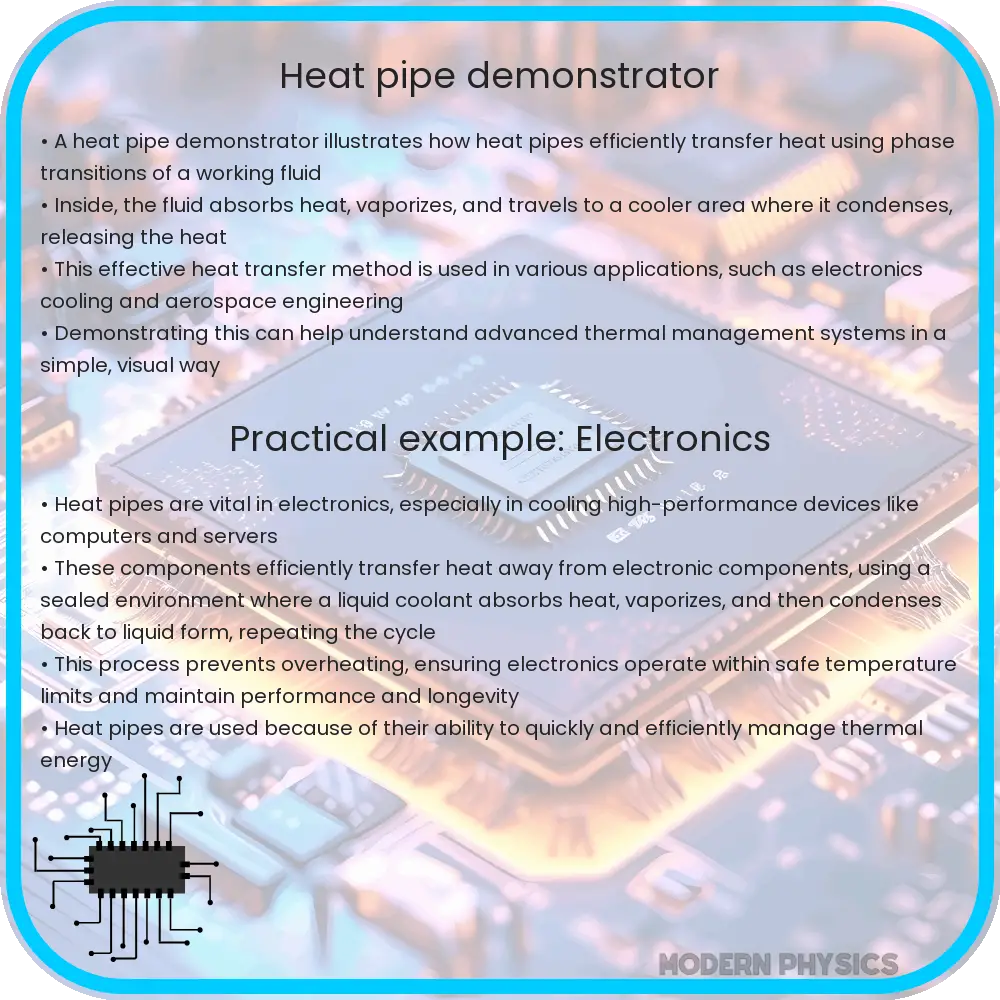
Heat pipes are an integral part of modern thermal management solutions, particularly in electronics cooling and industrial applications. In essence, a heat pipe is a heat-transfer device that combines the principles of both thermal conductivity and phase transition to efficiently manage heat transfer. This article introduces an innovative Heat Pipe Demonstrator, designed to provide an efficient, educational, and practical understanding of heat pipe technology.
Key Components and Functioning
The basic structure of a heat pipe includes a sealed container, a working fluid, and a wick or capillary structure. The container, typically made of materials with high thermal conductivity like copper or aluminum, encloses the working fluid. This fluid, chosen based on the temperature range of operation, undergoes phase transitions (liquid to vapor and vice versa) within the pipe.
Heat Transfer Mechanism
At the heat source (the pipe’s base), the working fluid absorbs heat and vaporizes. This vapor then travels along the pipe to a cooler region, where it condenses, releasing the latent heat. The condensed liquid is returned to the hot end by capillary action through the wick structure, thus completing the cycle. This continuous process results in highly efficient heat transfer.
Advantages of Heat Pipes
- High Thermal Conductivity: Heat pipes can transfer heat over long distances with minimal temperature drop.
- Versatility: They can be designed in various shapes and sizes, making them suitable for diverse applications.
- Passive Operation: Heat pipes function without external power, making them energy-efficient and reliable.
The Heat Pipe Demonstrator: A Practical Tool for Education
The Heat Pipe Demonstrator is an educational tool that visually illustrates the concepts of heat pipe operation. It’s designed to be simple yet effective, showcasing the fundamental principles of phase change and heat transfer. This demonstrator is particularly useful in educational settings, providing students with hands-on experience in thermal physics and engineering.
Applications in Real-World Scenarios
Understanding heat pipes is crucial for professionals in various fields, including mechanical engineering, HVAC systems, and electronics cooling. The Heat Pipe Demonstrator serves as a bridge between theoretical knowledge and practical application, offering insights into efficient thermal management solutions.
Interactive Learning with the Heat Pipe Demonstrator
The Heat Pipe Demonstrator not only illustrates the basic operation of heat pipes but also allows users to interact with the system. This hands-on approach enhances the learning experience, making it easier to understand complex concepts like thermal resistance, phase transition, and heat capacity. By adjusting variables such as heat source intensity or the orientation of the pipe, learners can observe the effects on heat transfer efficiency directly.
Enhancing Practical Skills
This demonstrator is an invaluable resource for students and professionals alike. It helps in developing practical skills crucial for designing and optimizing thermal management systems. Understanding the dynamics of heat pipes through this demonstrator aids in better decision-making in real-world applications, from electronic devices to large-scale industrial systems.
Incorporation into Curriculum
Educational institutions can integrate the Heat Pipe Demonstrator into their curriculum to provide a comprehensive understanding of thermal dynamics. This practical tool complements theoretical studies, bridging the gap between textbook knowledge and real-world applications. It’s especially beneficial for courses in mechanical engineering, physics, and thermodynamics.
Research and Development Implications
Beyond education, the demonstrator can also be a valuable tool in research and development. By providing a clear, tangible representation of heat pipe mechanics, it can inspire innovative designs and improvements in thermal management technologies.
Conclusion
The Heat Pipe Demonstrator is more than just an educational tool; it’s a gateway to understanding and innovating in the field of thermal management. Its practicality, combined with its educational value, makes it an indispensable resource for students, educators, and professionals. By demystifying the complex principles of heat transfer and phase transition, the demonstrator paves the way for efficient, creative solutions in thermal management across various industries. Embracing this technology ensures a deeper understanding and application of one of the most crucial elements in modern engineering and design.