
Explore the principles, measurement, and applications of the heat of immersion in various fields like material science, environmental science, and more.
Understanding the Heat of Immersion
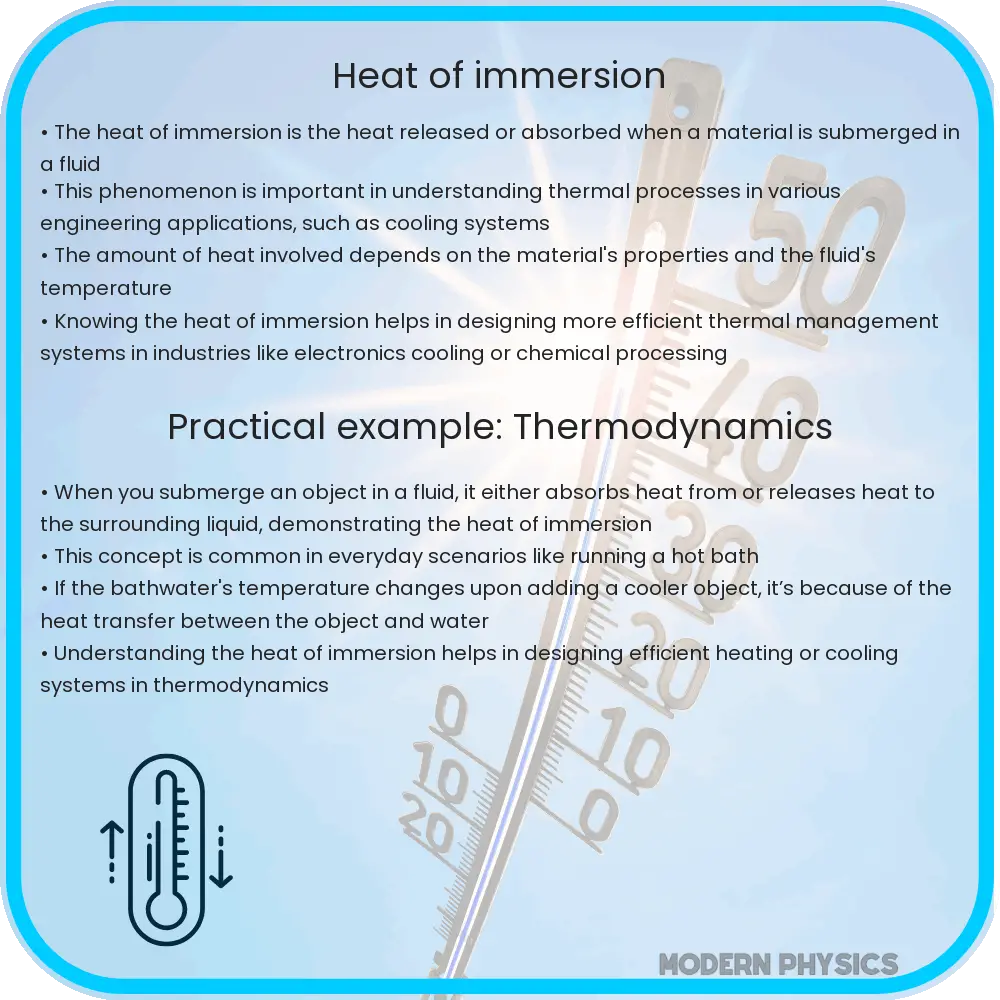
Heat of immersion is a critical concept in thermodynamics and surface chemistry, particularly in the context of understanding how heat energy is absorbed or released when a solid is immersed in a liquid. This phenomenon plays a significant role in various industrial and scientific applications.
Principles of Heat of Immersion
The heat of immersion is fundamentally connected to the interactions between the surface of a solid and the liquid in which it is immersed. When a solid enters a liquid, the liquid molecules interact with the solid’s surface, causing a release or absorption of heat. This heat exchange is influenced by factors such as the nature of the solid and liquid, the surface area of the solid, and the temperature of the system.
Measurement of Heat of Immersion
To measure the heat of immersion, calorimetric techniques are often employed. A calorimeter is a device that measures the amount of heat absorbed or released during a chemical or physical process. In the context of the heat of immersion, the solid is introduced into the liquid within the calorimeter, and the change in temperature is recorded. This change in temperature, along with the known specific heat capacities of the materials involved, allows for the calculation of the heat of immersion. The typical unit of measurement is joules per gram (J/g).
Uses of Heat of Immersion
The concept of heat of immersion has practical applications in a variety of fields:
- Material Science: Understanding how materials interact with liquids can be crucial in the design and manufacture of products ranging from medical implants to coatings.
- Environmental Science: Studying the heat of immersion can help in assessing the environmental impact of substances when they come into contact with water bodies.
- Chemical Engineering: This principle is vital in processes like catalysis, where the interaction between solid catalysts and liquid reactants is fundamental.
Additionally, the heat of immersion is significant in the field of geology, where it aids in understanding mineral-water interactions, and in pharmaceuticals, for drug formulation and stability testing.
Conclusion
In summary, the heat of immersion is a key parameter in understanding the thermodynamics of solid-liquid interactions. Its measurement and application span a wide range of scientific and industrial fields, offering insights into material properties and influencing various technological processes.
Detailed Analysis in Heat of Immersion
In-depth examination of the heat of immersion reveals intricate details about surface phenomena. The amount of heat absorbed or released during immersion is not only indicative of the physical properties of the solid but also provides insights into the molecular interactions at the interface. For instance, a higher heat release might suggest stronger interactions between the solid and liquid molecules.
Calculations and Chemical Implications
The calculation of the heat of immersion typically involves thermodynamic equations. The formula ΔH = mCpΔT, where ΔH is the heat change, m is the mass of the substance, Cp is the specific heat capacity, and ΔT is the change in temperature, is commonly used. This calculation helps in understanding various chemical reactions, especially those involving adsorption and surface chemistry.
Technological Advances and Future Prospects
Recent advancements in technology have enhanced the precision of heat of immersion measurements. Sophisticated calorimeters capable of detecting minute temperature changes have broadened the scope of research in this area. Looking forward, the increasing importance of nanotechnology and the development of new materials will further elevate the significance of understanding the heat of immersion in research and industry.
Practical Examples and Applications
The practical applications of the heat of immersion are diverse:
- Water Purification: By understanding the interaction between adsorbents and contaminants, more efficient water purification methods can be developed.
- Pharmaceuticals: It aids in predicting how drugs will dissolve in bodily fluids, impacting drug delivery and effectiveness.
- Energy Storage: In battery technology, this principle helps in evaluating the efficiency of electrolyte solutions.
Conclusion
The heat of immersion stands as a pivotal concept in understanding the thermodynamic interactions between solids and liquids. Its application extends across various scientific and industrial fields, from environmental science to material engineering. As technology evolves, the precision in measuring and utilizing this phenomenon will only increase, offering new avenues for innovation and discovery. This fundamental concept not only enhances our scientific understanding but also drives practical advancements, making it an invaluable tool in the modern scientific and technological landscape.