
Explore the innovative world of non-equilibrium heat engines, their efficiency potential, dynamics, and the challenges and future of this advanced technology.
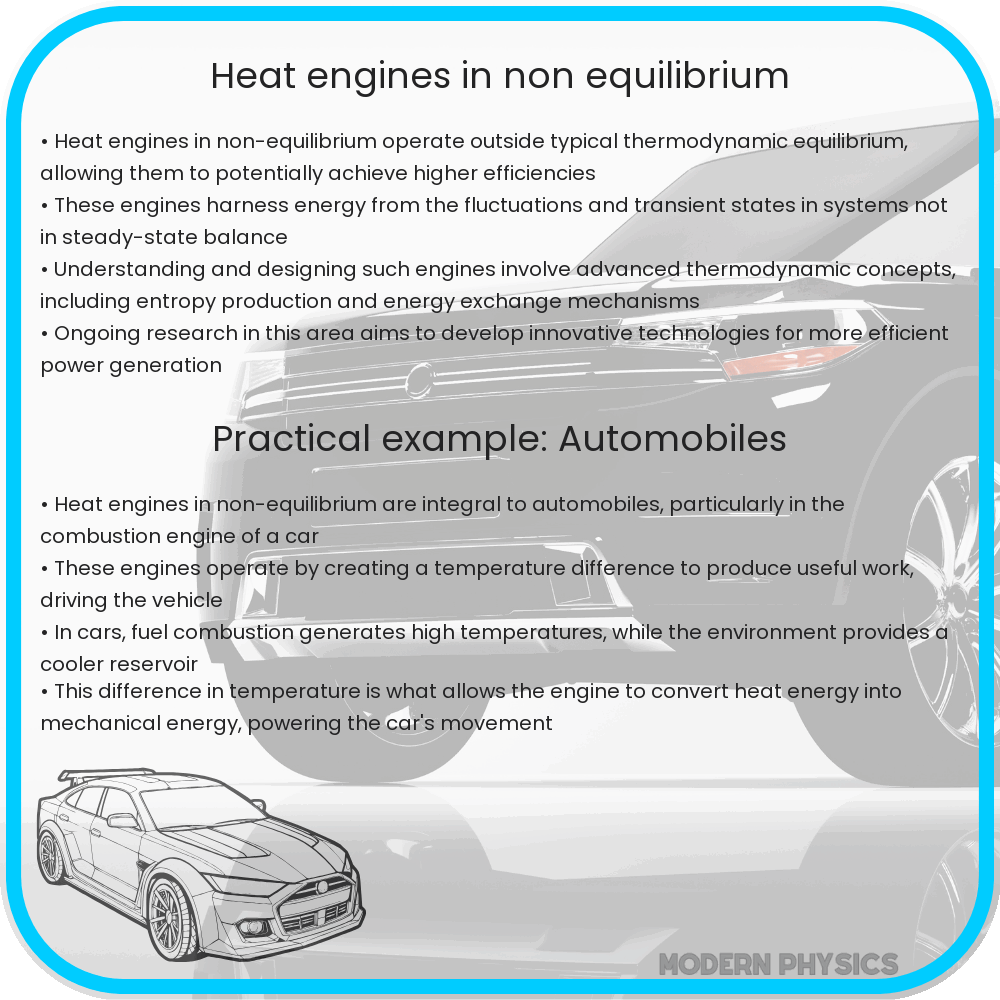
Exploring the Potential of Heat Engines in Non-Equilibrium States
Heat engines, fundamental to modern industry, have traditionally operated under the principles of equilibrium thermodynamics. However, recent advancements in the field have shifted focus towards non-equilibrium heat engines, promising unprecedented efficiency and innovation. This article delves into the dynamics and potential of these cutting-edge systems.
The Efficiency of Non-Equilibrium Heat Engines
Traditional heat engines, like steam turbines and internal combustion engines, rely on the cyclic transfer of heat between high and low temperature reservoirs. The efficiency of such engines is limited by the Carnot efficiency, given by \( 1 – \frac{T_{\text{cold}}}{T_{\text{hot}}} \), where \( T_{\text{cold}} \) and \( T_{\text{hot}} \) are the temperatures of the cold and hot reservoirs, respectively.
In contrast, non-equilibrium heat engines operate far from thermodynamic equilibrium, which means their working substance is not in a uniform state of temperature or pressure throughout the cycle. This deviation opens up possibilities for surpassing traditional efficiency limits. Research has shown that by manipulating variables such as temperature gradients and dynamic working conditions, these engines can, in theory, exceed the Carnot limit.
Innovations in Non-Equilibrium Heat Engines
The innovation in non-equilibrium heat engines is primarily driven by their ability to exploit transient thermodynamic states. For instance, engines utilizing time-dependent temperature fields or rapid adiabatic changes can harness more energy than those operating in a static state. Additionally, leveraging quantum effects and nanoscale phenomena, which are more pronounced in non-equilibrium states, has led to the development of engines with significantly reduced sizes and increased efficiency.
Dynamics of Non-Equilibrium Systems
Understanding the dynamics of non-equilibrium systems is crucial for the advancement of these engines. These dynamics are complex due to the involvement of transient states and non-linear interactions. Researchers utilize advanced computational models and simulations to predict the behavior of these systems under various conditions. This involves studying the flow of heat and work at microscopic levels, often requiring a quantum mechanical approach to fully comprehend the processes involved.
The implications of these studies are vast, ranging from improved industrial machines to revolutionary power sources for spacecraft. As research progresses, we are likely to see a paradigm shift in how we conceive and utilize heat engines, moving away from traditional equilibrium models towards more dynamic and efficient non-equilibrium systems.
Challenges and Future Directions in Non-Equilibrium Heat Engines
Despite the promising advantages, non-equilibrium heat engines face several challenges. The primary issue lies in the complexity of managing and maintaining non-equilibrium states, which often require precise control over environmental conditions. This complexity increases with the scale of the engine, making large-scale applications a significant engineering challenge. Additionally, the theoretical models predicting performance gains need to be rigorously tested and validated in practical scenarios.
Future research in this area is expected to focus on overcoming these challenges. Innovations in materials science, particularly in the development of substances that can withstand extreme and rapidly changing conditions, are crucial. Additionally, advancements in nanotechnology and quantum computing could provide the tools necessary to design and control these intricate systems more effectively.
Environmental and Economic Impact
The shift to non-equilibrium heat engines also holds substantial environmental and economic implications. By surpassing the efficiency limits of traditional engines, these advanced systems can significantly reduce energy waste, leading to lower carbon emissions and improved sustainability. Economically, the increased efficiency could result in reduced operational costs, making industries more competitive and environmentally friendly.
Conclusion
The exploration of non-equilibrium heat engines marks a significant leap in thermodynamic and mechanical engineering. By breaking free from the constraints of equilibrium thermodynamics, these engines offer a path towards unprecedented efficiencies. While the challenges in practical implementation are non-trivial, the potential benefits in terms of efficiency, sustainability, and economic impact are immense. As research continues to unravel the complexities of these systems, we stand on the cusp of a new era in heat engine technology. An era defined not by the limitations of our past understanding but by the boundless possibilities of dynamic, non-equilibrium states.