
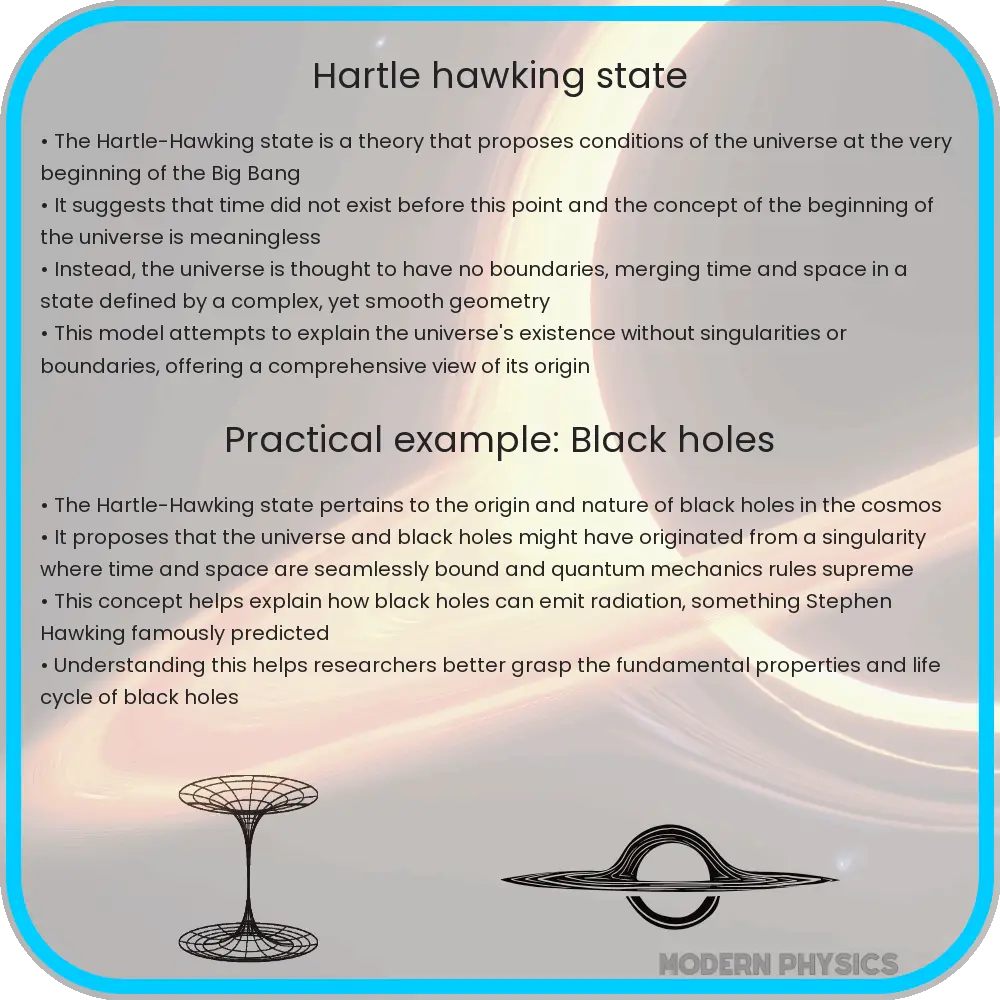
The Hartle-Hawking state is a theory proposing that the universe began from a ‘no-boundary’ condition, merging quantum mechanics and cosmology.
Hartle-Hawking State: Origins of the Universe, Timelessness & Physics
The Hartle-Hawking state is a proposal about the beginning of the universe that merges the realms of cosmology and quantum mechanics. It is named after the physicists James Hartle and Stephen Hawking, who formulated this theory in the early 1980s. This concept provides a profound way of understanding how the universe may have emerged from a state of nothingness, proposing that the universe does not have a traditional beginning.
Origins of the Universe
Traditional cosmology often describes the origin of the universe in terms of the Big Bang theory, where the universe began from a singularity— a point of infinite density and temperature. However, this leads to several paradoxes and unanswered questions, especially when quantum mechanics is applied at such extreme conditions.
The Hartle-Hawking state suggests an alternative to this singularity. Using principles of quantum mechanics, it proposes that the universe started from a ‘no-boundary’ condition. In this model, time and space are initially fused, creating a four-dimensional sphere. As this ‘sphere’ expands, time begins to unfold, giving rise to the dimensions we experience today.
Timelessness
One of the most intriguing aspects of the Hartle-Hawking state is the concept of timelessness at the universe’s origin. Traditional views of the Big Bang imply a clear starting point in time, but the no-boundary proposal suggests something quite different. The idea is that near the beginning, time behaves more like a spatial dimension. This means there’s no distinct time ‘before’ the universe began.
The ‘no-boundary’ condition can be visualized with the analogy of the Earth’s surface. If you move northward, you reach the North Pole, but there’s no clear point where the north begins — it smoothly transitions into a point. Similarly, the universe’s beginning can be thought of as a smooth transition rather than a singular starting point, thereby avoiding the problem of the singularity.
Physics Behind the No-Boundary Proposal
The Hartle-Hawking state can be described mathematically using the path integral formulation of quantum gravity. In simple terms, this involves summing over all possible configurations of the universe’s initial state to determine the most probable history.
The wave function of the universe \( \psi \) can be expressed as:
\[
\psi[h_{ij}] = \int \mathcal{D}g \mathcal{D}\phi \exp{\left(-\frac{S[g, \phi]}{\hbar}\right)}
\]
In this equation:
- \( h_{ij} \): Represents the three-dimensional spatial geometry.
- \( \mathcal{D}g \): Integral over all possible geometries.
- \( \mathcal{D}\phi \): Integral over all possible configurations of the fields.
- \( S[g, \phi] \): The action, which encodes the dynamics of the geometry and fields.
By integrating over these configurations, the Hartle-Hawking state provides a way to calculate the probability amplitude for different initial geometries of the universe, suggesting that the universe is more likely to have started in a smooth, ‘no-boundary’ state.
Implications for Modern Cosmology
The Hartle-Hawking state presents a profound shift in our understanding of the universe’s beginnings. It bridges the gap between general relativity and quantum mechanics, suggesting a universe that is finite but without boundaries. This approach not only offers solutions to the singularity issue but also provides a framework for understanding the quantum aspects of the cosmos.
One of the major implications is that the early universe could be described using a finite, curved space without a distinct temporal start. This perspective aligns with modern quantum gravity theories and may help in formulating a complete theory of quantum cosmology.
Challenges and Criticisms
While the Hartle-Hawking state offers an elegant solution to several cosmological questions, it is not without its challenges and criticisms. One of the primary issues is the difficulty in testing and validating the theory through observations or experiments, due to the extremely high energies and conditions involved at the beginning of the universe.
Moreover, some physicists argue about the interpretation of the path integral and the measure used in the calculations. These criticisms highlight the need for further refinement and understanding of the mathematical formulation of quantum gravity.
Continuing Research and Exploration
The Hartle-Hawking state remains a cornerstone in the quest to understand the origins of our universe. Ongoing research in fields like string theory and loop quantum gravity continues to explore and expand upon these ideas. The progress in observational cosmology, particularly with advancements in telescope technology and cosmic microwave background analysis, also holds promise for providing insights that could support or refute these groundbreaking theories.
Conclusion
The Hartle-Hawking state offers a visionary perspective on the birth of our universe, proposing a universe without a traditional beginning and merging the concepts of quantum mechanics and cosmology. By eliminating the singularity at the Big Bang, it allows for a smooth, ‘no-boundary’ universe that transitions into the spacetime we experience today.
Though still a topic of active research and debate, the Hartle-Hawking state inspires a deeper exploration into the fundamental aspects of the cosmos. As our understanding and technology advance, we may come closer to unraveling the true nature of the universe’s origins, driven by the innovative ideas proposed by physicists like Hartle and Hawking.