
Explore hand pump efficiency in depth, covering dynamics, force, flow rate, design tips, and maintenance for optimal water access.
Understanding Hand Pump Efficiency: Dynamics, Force, and Flow Rate
The efficiency of a hand pump, a manually operated mechanism for drawing water, is a critical factor in determining its effectiveness in various applications. This article delves into the dynamics, force, and flow rate aspects of hand pump efficiency, providing a comprehensive understanding of its working principles.
The Dynamics of Hand Pump Operation
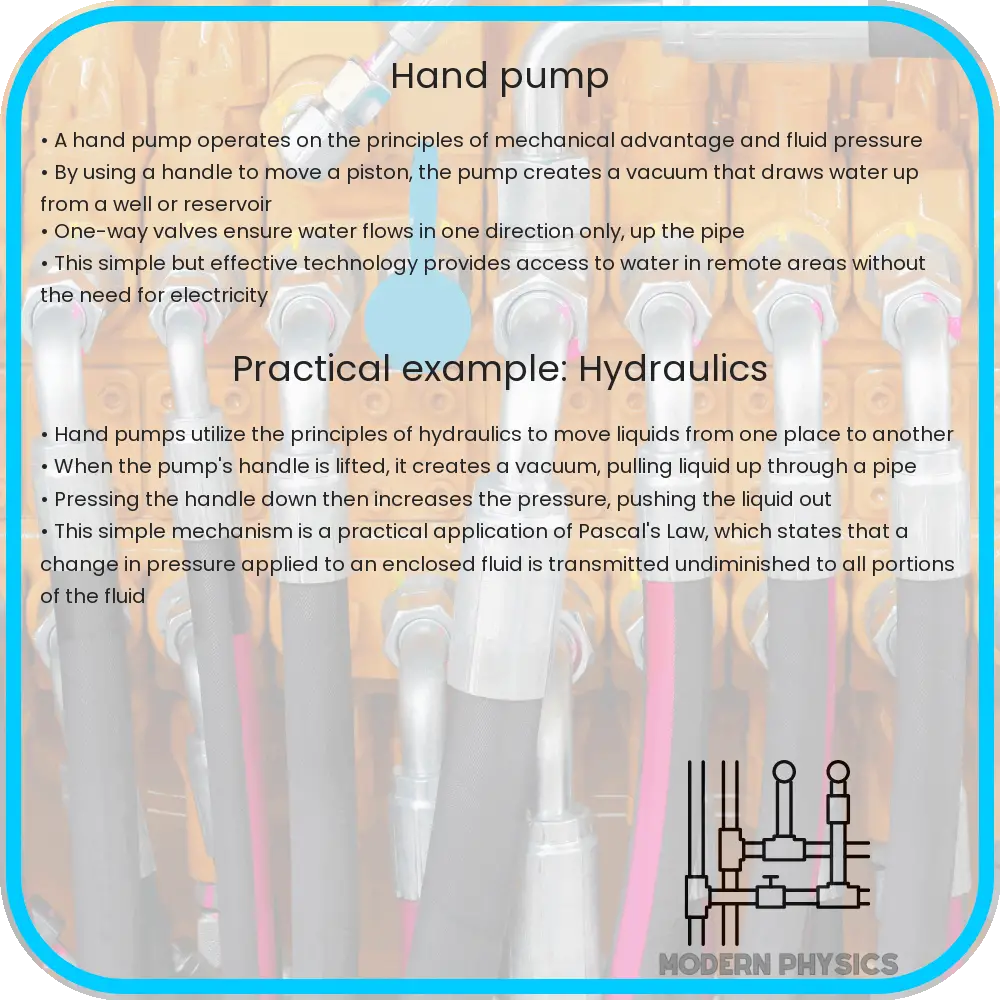
Hand pumps operate on the principle of mechanical advantage, where force applied to the handle is magnified through a system of levers and pistons. The key dynamics involve:
- Piston Movement: The up and down motion of the piston creates a vacuum, drawing water up through a pipe.
- Valve Operation: Check valves ensure a one-way flow of water, preventing backflow and maintaining consistent pressure.
- Leverage: The length and design of the pump handle influence the amount of force required to operate the pump.
Force and Mechanical Advantage
The force exerted on a hand pump handle is directly related to the mechanical advantage provided by its design. The formula for mechanical advantage (MA) is given as:
MA = Load Force (LF) / Effort Force (EF)
Where Load Force is the weight of the water being lifted and Effort Force is the force applied by the user. A higher mechanical advantage means less effort is required to pump water.
Flow Rate and Efficiency
Flow rate, typically measured in liters per minute (L/min), is a crucial measure of a hand pump’s efficiency. It’s influenced by:
- Piston Diameter: A larger piston can displace more water, increasing flow rate.
- Stroke Length: The distance the piston travels in one pumping action also affects the volume of water moved.
- Pumping Speed: The rate at which the handle is pumped impacts the flow rate.
Ultimately, the efficiency of a hand pump is a balance between the force required and the volume of water delivered per pump action. Understanding these dynamics allows for the design and selection of hand pumps best suited for specific needs, whether for irrigation, household use, or emergency situations.
Optimizing Hand Pump Efficiency
Enhancing the efficiency of hand pumps involves fine-tuning various elements, from design modifications to user operation techniques. Here are key factors to consider:
Material Selection and Design
The choice of materials and the design of the pump components significantly impact efficiency. For instance, using lightweight, durable materials for the piston and handle can reduce wear and tear, thereby maintaining efficiency over time. Ergonomic handle design can also reduce the effort required, making the pump more user-friendly.
Maintenance and Sustainability
Regular maintenance is essential to sustain hand pump efficiency. This includes checking for leaks, ensuring valves function properly, and lubricating moving parts. A well-maintained pump not only operates more efficiently but also has a longer lifespan, offering better sustainability.
Innovative Technologies
Incorporating innovative technologies can further enhance hand pump efficiency. For instance, incorporating a pressure gauge helps monitor the pumping pressure, allowing users to operate the pump within its optimal range. Advanced materials like composites can be used to reduce overall weight and increase durability.
Customization for Specific Needs
Customizing hand pumps for specific applications can greatly improve their efficiency. For example, pumps used in arid regions may require deeper boreholes and more robust construction to handle the increased load, while those used in community settings might benefit from a higher flow rate capacity.
Conclusion
Hand pumps are a vital resource in many parts of the world, offering a reliable and sustainable method for accessing water. Understanding the dynamics of hand pump operation, including the roles of force, flow rate, and mechanical design, is crucial in optimizing their efficiency. By considering factors such as material selection, design, maintenance, and innovation, the functionality and longevity of these essential devices can be significantly improved. Ultimately, the aim is to provide a balance between ease of use and maximum water output, ensuring that hand pumps continue to be an effective solution for water access in a variety of settings.